 Movie
Movie Controller

[English] 日本語
 Yorodumi
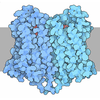
- PDB-9i3r: Human TRPM4 ion channel in MAASTY copolymer lipid nanodisc in a c... -
+ Open data

- Basic information
| Entry | Database: PDB / ID: 9i3r | ||||||||||||||||||||||||||||||
|---|---|---|---|---|---|---|---|---|---|---|---|---|---|---|---|---|---|---|---|---|---|---|---|---|---|---|---|---|---|---|---|
| Title | Human TRPM4 ion channel in MAASTY copolymer lipid nanodisc in a calcium-bound state | ||||||||||||||||||||||||||||||
 Components Components | Transient receptor potential cation channel subfamily M member 4 | ||||||||||||||||||||||||||||||
 Keywords Keywords | MEMBRANE PROTEIN / Ion Channel / Copolymer / Native Nanodisc / Calcium-bound / TRP Channel | ||||||||||||||||||||||||||||||
| Function / homology |  Function and homology information Function and homology informationpositive regulation of atrial cardiac muscle cell action potential / positive regulation of regulation of vascular associated smooth muscle cell membrane depolarization / sodium channel complex / regulation of T cell cytokine production / negative regulation of bone mineralization / membrane depolarization during AV node cell action potential / membrane depolarization during bundle of His cell action potential / membrane depolarization during Purkinje myocyte cell action potential / regulation of ventricular cardiac muscle cell action potential / metal ion transport ...positive regulation of atrial cardiac muscle cell action potential / positive regulation of regulation of vascular associated smooth muscle cell membrane depolarization / sodium channel complex / regulation of T cell cytokine production / negative regulation of bone mineralization / membrane depolarization during AV node cell action potential / membrane depolarization during bundle of His cell action potential / membrane depolarization during Purkinje myocyte cell action potential / regulation of ventricular cardiac muscle cell action potential / metal ion transport / calcium-activated cation channel activity / sodium ion import across plasma membrane / dendritic cell chemotaxis / sodium channel activity / TRP channels / cellular response to ATP / regulation of heart rate by cardiac conduction / positive regulation of fat cell differentiation / monoatomic cation transmembrane transport / protein sumoylation / positive regulation of vasoconstriction / negative regulation of osteoblast differentiation / positive regulation of heart rate / positive regulation of adipose tissue development / positive regulation of insulin secretion involved in cellular response to glucose stimulus / calcium-mediated signaling / transmembrane transport / calcium channel activity / calcium ion transmembrane transport / positive regulation of canonical Wnt signaling pathway / Sensory perception of sweet, bitter, and umami (glutamate) taste / positive regulation of cytosolic calcium ion concentration / protein homotetramerization / neuronal cell body / positive regulation of cell population proliferation / calcium ion binding / Golgi apparatus / endoplasmic reticulum / ATP binding / membrane / identical protein binding / plasma membrane Similarity search - Function | ||||||||||||||||||||||||||||||
| Biological species |  Homo sapiens (human) Homo sapiens (human) | ||||||||||||||||||||||||||||||
| Method | ELECTRON MICROSCOPY / single particle reconstruction / cryo EM / Resolution: 3.46 Å | ||||||||||||||||||||||||||||||
 Authors Authors | Pugh, C.F. / Feilen, L.P. / Zivkovic, D. / Praestegaard, K.F. / Sideris, C. / Borthwick, N.J. / De Lichtenberg, C. / Bolla, J.R. / Autzen, A.A.A. / Autzen, H.E. | ||||||||||||||||||||||||||||||
| Funding support |  Denmark, 1items Denmark, 1items
| ||||||||||||||||||||||||||||||
 Citation Citation | Journal: Nat Commun / Year: 2025 Title: MAASTY: a (dis)ordered copolymer for structural determination of human membrane proteins in native nanodiscs. Authors: Ciara F Pugh / Lukas P Feilen / Dušan Živković / Kaia F Præstegaard / Charalampos Sideris / Neil J Borthwick / Casper de Lichtenberg / Jani R Bolla / Anton A A Autzen / Henriette E Autzen /  Abstract: Amphiphilic copolymers capable of extracting membrane proteins directly from cellular membranes into "native nanodiscs" offer a simplified approach for preparing membrane proteins in lipid nanodiscs ...Amphiphilic copolymers capable of extracting membrane proteins directly from cellular membranes into "native nanodiscs" offer a simplified approach for preparing membrane proteins in lipid nanodiscs compared to approaches that rely on detergent. Copolymer amphiphilicity, length, and composition influence their performance, in addition to the protein itself and the purification conditions used. Here, we report a copolymer composed of methacrylic acid and styrene, which we term MAASTY, leveraging the inherent monomer reactivity ratios to create an anionic copolymer with a statistical distribution of monomers. We show that MAASTY can be used for high-resolution structural determination of a human membrane protein by single particle cryo-electron microscopy, preserving endogenous lipids including cholesterol and exhibiting an enrichment of phosphatidylinositol. Moreover, MAASTY copolymers effectively solubilize a broad range of lipid species and a wide range of different, eukaryotic membrane proteins from mammalian cells. We find that MAASTY copolymers are promising as effective solubilizers of membrane proteins and offer a chemical platform for structural and functional characterization of membrane proteins in native nanodiscs. | ||||||||||||||||||||||||||||||
| History |
|
- Structure visualization
| Structure viewer | Molecule: MolmilJmol/JSmol |
|---|
- Downloads & links
-Download
| PDBx/mmCIF format | 9i3r.cif.gz | 470.4 KB | Display | PDBx/mmCIF format |
|---|---|---|---|---|
| PDB format | pdb9i3r.ent.gz | 354.8 KB | Display | PDB format |
| PDBx/mmJSON format | 9i3r.json.gz | Tree view | PDBx/mmJSON format | |
| Others |  Other downloads Other downloads |
-Validation report
| Arichive directory | https://data.pdbj.org/pub/pdb/validation_reports/i3/9i3rftp://data.pdbj.org/pub/pdb/validation_reports/i3/9i3r | HTTPS FTP |
|---|
-Related structure data
| Related structure data |  52611MC  9smkC M: map data used to model this data C: citing same article ( |
|---|---|
| Similar structure data |

-Links
 PDBj
PDBj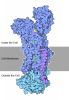
- Assembly
| Deposited unit | 
|
|---|---|
| 1 |
|
-Components
| #1: Protein | Mass: 134770.734 Da / Num. of mol.: 4 Source method: isolated from a genetically manipulated source Details: StrepTagII and eGFP fusion proteins in the N-terminus Source: (gene. exp.) Homo sapiens (human) / Gene: TRPM4, LTRPC4 / Cell line (production host): HEK293F cells / Production host: Homo sapiens (human) / References: UniProt: Q8TD43#2: Chemical | ChemComp-CLR / 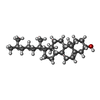 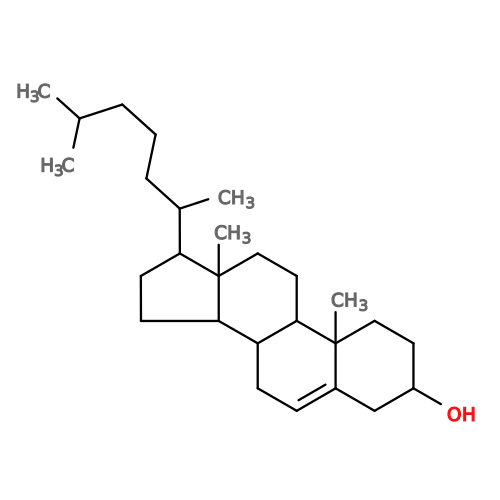 Mass: 386.654 Da / Num. of mol.: 12 / Source method: obtained synthetically / Formula: C27H46O Mass: 386.654 Da / Num. of mol.: 12 / Source method: obtained synthetically / Formula: C27H46O#3: Chemical | ChemComp-CA /   Mass: 40.078 Da / Num. of mol.: 4 / Source method: obtained synthetically / Formula: Ca Mass: 40.078 Da / Num. of mol.: 4 / Source method: obtained synthetically / Formula: CaHas ligand of interest | N | Has protein modification | Y | |
|---|
-Experimental details
-Experiment
| Experiment | Method: ELECTRON MICROSCOPY |
|---|---|
| EM experiment | Aggregation state: PARTICLE / 3D reconstruction method: single particle reconstruction |
- Sample preparation
| Component | Name: Human TRPM4 transient receptor potential cation channel subfamily M member 4 from Homo sapiens Type: COMPLEX / Entity ID: #1 / Source: RECOMBINANT |
|---|---|
| Molecular weight | Value: 0.5372 MDa / Experimental value: NO |
| Source (natural) | Organism: Homo sapiens (human) |
| Source (recombinant) | Organism: Homo sapiens (human) / Cell: HEK293F cells |
| Buffer solution | pH: 7.4 |
| Specimen | Conc.: 1.4 mg/ml / Embedding applied: NO / Shadowing applied: NO / Staining applied: NO / Vitrification applied: YES |
| Specimen support | Grid material: GOLD / Grid mesh size: 300 divisions/in. / Grid type: Quantifoil R1.2/1.3 |
| Vitrification | Instrument: FEI VITROBOT MARK IV / Cryogen name: ETHANE / Humidity: 100 % / Chamber temperature: 277.15 K |
- Electron microscopy imaging
| Experimental equipment |  Model: Titan Krios / Image courtesy: FEI Company |
|---|---|
| Microscopy | Model: TFS KRIOS |
| Electron gun | Electron source:  FIELD EMISSION GUN / Accelerating voltage: 300 kV / Illumination mode: OTHER FIELD EMISSION GUN / Accelerating voltage: 300 kV / Illumination mode: OTHER |
| Electron lens | Mode: OTHER / Nominal magnification: 165000 X / Nominal defocus max: 2500 nm / Nominal defocus min: 800 nm / Cs: 2.7 mm |
| Image recording | Electron dose: 52 e/Å2 / Film or detector model: FEI FALCON IV (4k x 4k) / Num. of grids imaged: 1 / Num. of real images: 6308 |
| EM imaging optics | Energyfilter name: TFS Selectris X |
- Processing
| EM software |
| ||||||||||||||||||||||||||||
|---|---|---|---|---|---|---|---|---|---|---|---|---|---|---|---|---|---|---|---|---|---|---|---|---|---|---|---|---|---|
| CTF correction | Type: NONE | ||||||||||||||||||||||||||||
| 3D reconstruction | Resolution: 3.46 Å / Resolution method: FSC 0.143 CUT-OFF / Num. of particles: 87697 / Symmetry type: POINT | ||||||||||||||||||||||||||||
| Atomic model building | B value: 92 | ||||||||||||||||||||||||||||
| Refinement | Highest resolution: 3.46 Å Stereochemistry target values: REAL-SPACE (WEIGHTED MAP SUM AT ATOM CENTERS) | ||||||||||||||||||||||||||||
| Refine LS restraints |
|
