 Movie
Movie Controller


+ Open data

- Basic information
| Entry | Database: PDB / ID: 9ggm | |||||||||
|---|---|---|---|---|---|---|---|---|---|---|
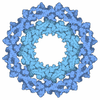
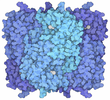
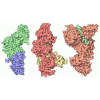
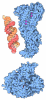
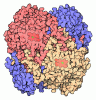
| Title | Cryo-EM structure of KBTBD4 P313PRR mutant-HDAC2 2:2 complex | |||||||||
 Components Components |
| |||||||||
 Keywords Keywords | LIGASE / E3 ligase / deacetylase / transcription / cancer mutation / protein complex | |||||||||
| Function / homology |  Function and homology information Function and homology informationpositive regulation of male mating behavior / protein de-2-hydroxyisobutyrylase activity / protein lysine delactylase activity / negative regulation of dendritic spine development / p75NTR negatively regulates cell cycle via SC1 / fungiform papilla formation / epidermal cell differentiation / histone decrotonylase activity / NuRD complex / positive regulation of interleukin-1 production ...positive regulation of male mating behavior / protein de-2-hydroxyisobutyrylase activity / protein lysine delactylase activity / negative regulation of dendritic spine development / p75NTR negatively regulates cell cycle via SC1 / fungiform papilla formation / epidermal cell differentiation / histone decrotonylase activity / NuRD complex / positive regulation of interleukin-1 production / : / regulation of cell fate specification / EGR2 and SOX10-mediated initiation of Schwann cell myelination / negative regulation of stem cell population maintenance / regulation of stem cell differentiation / histone deacetylase activity, hydrolytic mechanism / histone deacetylase / ESC/E(Z) complex / cardiac muscle hypertrophy / cellular response to dopamine / positive regulation of intracellular estrogen receptor signaling pathway / behavioral response to ethanol / odontogenesis of dentin-containing tooth / STAT3 nuclear events downstream of ALK signaling / embryonic digit morphogenesis / histone deacetylase activity / protein lysine deacetylase activity / Hydrolases; Acting on carbon-nitrogen bonds, other than peptide bonds; In linear amides / response to caffeine / eyelid development in camera-type eye / Notch-HLH transcription pathway / positive regulation of oligodendrocyte differentiation / Sin3-type complex / dendrite development / positive regulation of stem cell population maintenance / histone deacetylase complex / response to amyloid-beta / positive regulation of proteolysis / progesterone receptor signaling pathway / RNA Polymerase I Transcription Initiation / hair follicle placode formation / response to hyperoxia / cellular response to transforming growth factor beta stimulus / Regulation of MECP2 expression and activity / FOXO-mediated transcription of oxidative stress, metabolic and neuronal genes / positive regulation of epithelial to mesenchymal transition / NF-kappaB binding / Transcriptional regulation of brown and beige adipocyte differentiation by EBF2 / cellular response to retinoic acid / Regulation of TP53 Activity through Acetylation / MECP2 regulates neuronal receptors and channels / heat shock protein binding / response to amphetamine / negative regulation of cell migration / SUMOylation of chromatin organization proteins / Regulation of PTEN gene transcription / transcription coregulator binding / ERCC6 (CSB) and EHMT2 (G9a) positively regulate rRNA expression / Regulation of endogenous retroelements by KRAB-ZFP proteins / response to nicotine / response to cocaine / negative regulation of neuron projection development / circadian regulation of gene expression / HDACs deacetylate histones / negative regulation of transforming growth factor beta receptor signaling pathway / Regulation of endogenous retroelements by Piwi-interacting RNAs (piRNAs) / promoter-specific chromatin binding / Negative Regulation of CDH1 Gene Transcription / NoRC negatively regulates rRNA expression / NOTCH1 Intracellular Domain Regulates Transcription / cellular response to hydrogen peroxide / Constitutive Signaling by NOTCH1 PEST Domain Mutants / Constitutive Signaling by NOTCH1 HD+PEST Domain Mutants / histone deacetylase binding / positive regulation of tumor necrosis factor production / cellular response to heat / Factors involved in megakaryocyte development and platelet production / response to lipopolysaccharide / heterochromatin formation / histone binding / Potential therapeutics for SARS / RNA polymerase II-specific DNA-binding transcription factor binding / proteasome-mediated ubiquitin-dependent protein catabolic process / chromosome, telomeric region / response to xenobiotic stimulus / chromatin remodeling / negative regulation of DNA-templated transcription / positive regulation of cell population proliferation / chromatin binding / negative regulation of apoptotic process / positive regulation of DNA-templated transcription / chromatin / negative regulation of transcription by RNA polymerase II / enzyme binding / positive regulation of transcription by RNA polymerase II / protein-containing complex / RNA binding / nucleoplasm / nucleus / cytoplasm Similarity search - Function | |||||||||
| Biological species |  Homo sapiens (human) Homo sapiens (human) | |||||||||
| Method | ELECTRON MICROSCOPY / single particle reconstruction / cryo EM / Resolution: 2.71 Å | |||||||||
 Authors Authors | Chen, Z. / Chi, G. / Pike, A.C.W. / Montes, B. / Bullock, A.N. | |||||||||
| Funding support |  United Kingdom, United Kingdom,  Switzerland, 2items Switzerland, 2items
| |||||||||
 Citation Citation | Journal: Nat Commun / Year: 2025 Title: Structural mimicry of UM171 and neomorphic cancer mutants co-opts E3 ligase KBTBD4 for HDAC1/2 recruitment. Authors: Zhuoyao Chen / Gamma Chi / Timea Balo / Xiangrong Chen / Beatriz Ralsi Montes / Steven C Clifford / Vincenzo D'Angiolella / Timea Szabo / Arpad Kiss / Tibor Novak / András Herner / András ...Authors: Zhuoyao Chen / Gamma Chi / Timea Balo / Xiangrong Chen / Beatriz Ralsi Montes / Steven C Clifford / Vincenzo D'Angiolella / Timea Szabo / Arpad Kiss / Tibor Novak / András Herner / András Kotschy / Alex N Bullock /  Abstract: Neomorphic mutations and drugs can elicit unanticipated effects that require mechanistic understanding to inform clinical practice. Recurrent indel mutations in the Kelch domain of the KBTBD4 E3 ...Neomorphic mutations and drugs can elicit unanticipated effects that require mechanistic understanding to inform clinical practice. Recurrent indel mutations in the Kelch domain of the KBTBD4 E3 ligase rewire epigenetic programs for stemness in medulloblastoma by recruiting LSD1-CoREST-HDAC1/2 complexes as neo-substrates for ubiquitination and degradation. UM171, an investigational drug for haematopoietic stem cell transplantation, was found to degrade LSD1-CoREST-HDAC1/2 complexes in a wild-type KBTBD4-dependent manner, suggesting a potential common mode of action. Here, we identify that these neomorphic interactions are mediated by the HDAC deacetylase domain. Cryo-EM studies of both wild-type and mutant KBTBD4 capture 2:1 and 2:2 KBTBD4-HDAC2 complexes, as well as a 2:1:1 KBTBD4-HDAC2-CoREST1 complex, at resolutions spanning 2.7 to 3.3 Å. The mutant and drug-induced complexes adopt similar structural assemblies requiring both Kelch domains in the KBTBD4 dimer for each HDAC2 interaction. UM171 is identified as a bona fide molecular glue binding across the ternary interface. Most strikingly, the indel mutation reshapes the same surface of KBTBD4 providing an example of a natural mimic of a molecular glue. Together, the structures provide mechanistic understanding of neomorphic KBTBD4, while structure-activity relationship (SAR) analysis of UM171 reveals analog S234984 as a more potent molecular glue for future studies. | |||||||||
| History |
|
- Structure visualization
| Structure viewer | Molecule: MolmilJmol/JSmol |
|---|
- Downloads & links
-Download
| PDBx/mmCIF format | 9ggm.cif.gz | 319.3 KB | Display | PDBx/mmCIF format |
|---|---|---|---|---|
| PDB format | pdb9ggm.ent.gz | 239.2 KB | Display | PDB format |
| PDBx/mmJSON format | 9ggm.json.gz | Tree view | PDBx/mmJSON format | |
| Others |  Other downloads Other downloads |
-Validation report
| Arichive directory | https://data.pdbj.org/pub/pdb/validation_reports/gg/9ggmftp://data.pdbj.org/pub/pdb/validation_reports/gg/9ggm | HTTPS FTP |
|---|
-Related structure data
| Related structure data |  51337MC 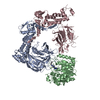 9gglC 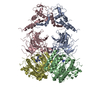 9ggnC 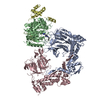 9i2cC M: map data used to model this data C: citing same article ( |
|---|---|
| Similar structure data |

-Links
 PDBj
PDBj

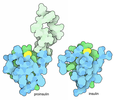
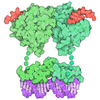
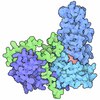
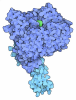

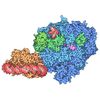
- Assembly
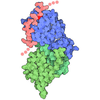
| Deposited unit | 
|
|---|---|
| 1 |
|
-Components
| #1: Protein | Mass: 58463.059 Da / Num. of mol.: 2 / Mutation: Indel mutation R313PRR Source method: isolated from a genetically manipulated source Details: Contains medulloblastoma cancer indel mutation R313PRR Source: (gene. exp.) Homo sapiens (human) / Gene: KBTBD4, BKLHD4 / Cell line (production host): Expi293F / Production host: Homo sapiens (human) / References: UniProt: Q9NVX7#2: Protein | Mass: 55443.156 Da / Num. of mol.: 2 Source method: isolated from a genetically manipulated source Source: (gene. exp.) Homo sapiens (human) / Gene: HDAC2 / Cell (production host): Expi293F / Production host: Homo sapiens (human)References: UniProt: Q92769, histone deacetylase, Hydrolases; Acting on carbon-nitrogen bonds, other than peptide bonds; In linear amides #3: Chemical |   Mass: 65.409 Da / Num. of mol.: 2 / Source method: obtained synthetically / Formula: Zn Mass: 65.409 Da / Num. of mol.: 2 / Source method: obtained synthetically / Formula: ZnHas ligand of interest | N | Has protein modification | N | |
|---|
-Experimental details
-Experiment
| Experiment | Method: ELECTRON MICROSCOPY |
|---|---|
| EM experiment | Aggregation state: PARTICLE / 3D reconstruction method: single particle reconstruction |
- Sample preparation
| Component | Name: KBTBD4 R313PRR cancer mutant in complex with HDAC2 at 2:2 stoichiometry Type: COMPLEX / Entity ID: #1-#2 / Source: RECOMBINANT | ||||||||||||||||||||||||||||||
|---|---|---|---|---|---|---|---|---|---|---|---|---|---|---|---|---|---|---|---|---|---|---|---|---|---|---|---|---|---|---|---|
| Molecular weight | Experimental value: NO | ||||||||||||||||||||||||||||||
| Source (natural) | Organism: Homo sapiens (human) | ||||||||||||||||||||||||||||||
| Source (recombinant) | Organism: Homo sapiens (human) | ||||||||||||||||||||||||||||||
| Buffer solution | pH: 7.5 | ||||||||||||||||||||||||||||||
| Buffer component |
| ||||||||||||||||||||||||||||||
| Specimen | Conc.: 0.4 mg/ml / Embedding applied: NO / Shadowing applied: NO / Staining applied: NO / Vitrification applied: YES | ||||||||||||||||||||||||||||||
| Specimen support | Grid material: GOLD / Grid mesh size: 300 divisions/in. / Grid type: UltrAuFoil R1.2/1.3 | ||||||||||||||||||||||||||||||
| Vitrification | Instrument: FEI VITROBOT MARK IV / Cryogen name: ETHANE / Humidity: 100 % / Chamber temperature: 277.15 K |
- Electron microscopy imaging
| Experimental equipment |  Model: Titan Krios / Image courtesy: FEI Company |
|---|---|
| Microscopy | Model: FEI TITAN KRIOS |
| Electron gun | Electron source:  FIELD EMISSION GUN / Accelerating voltage: 300 kV / Illumination mode: FLOOD BEAM FIELD EMISSION GUN / Accelerating voltage: 300 kV / Illumination mode: FLOOD BEAM |
| Electron lens | Mode: BRIGHT FIELD / Nominal magnification: 105000 X / Nominal defocus max: 2800 nm / Nominal defocus min: 1000 nm |
| Specimen holder | Cryogen: NITROGEN |
| Image recording | Electron dose: 38.6 e/Å2 / Film or detector model: GATAN K3 BIOQUANTUM (6k x 4k) / Num. of grids imaged: 1 / Num. of real images: 13131 |
| Image scans | Width: 5760 / Height: 4092 |
- Processing
| EM software | Name: PHENIX / Version: 1.20.1_4487: / Category: model refinement | ||||||||||||||||||||||||
|---|---|---|---|---|---|---|---|---|---|---|---|---|---|---|---|---|---|---|---|---|---|---|---|---|---|
| CTF correction | Type: PHASE FLIPPING AND AMPLITUDE CORRECTION | ||||||||||||||||||||||||
| Symmetry | Point symmetry: C2 (2 fold cyclic) | ||||||||||||||||||||||||
| 3D reconstruction | Resolution: 2.71 Å / Resolution method: FSC 0.143 CUT-OFF / Num. of particles: 295217 / Symmetry type: POINT | ||||||||||||||||||||||||
| Atomic model building | B value: 107.7 / Protocol: FLEXIBLE FIT / Space: REAL | ||||||||||||||||||||||||
| Atomic model building |
| ||||||||||||||||||||||||
| Refine LS restraints |
|

