 Movie
Movie Controller

[English] 日本語
 Yorodumi
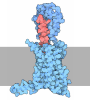
- PDB-9fte: Cryo-EM structure of the adhesion GPCR ADGRV1 in complex with a n... -
+ Open data

- Basic information
| Entry | Database: PDB / ID: 9fte | |||||||||||||||||||||
|---|---|---|---|---|---|---|---|---|---|---|---|---|---|---|---|---|---|---|---|---|---|---|
| Title | Cryo-EM structure of the adhesion GPCR ADGRV1 in complex with a nanobody | |||||||||||||||||||||
 Components Components |
| |||||||||||||||||||||
 Keywords Keywords | MEMBRANE PROTEIN / Adhesion GPCR / Signaling / 7TM / Nanobody | |||||||||||||||||||||
| Function / homology |  Function and homology information Function and homology informationmaintenance of animal organ identity / stereocilium membrane / sensory perception of light stimulus / photoreceptor cell maintenance / sensory perception of sound / photoreceptor inner segment / G protein-coupled receptor activity / signaling receptor complex / cell surface receptor signaling pathway / hydrolase activity ...maintenance of animal organ identity / stereocilium membrane / sensory perception of light stimulus / photoreceptor cell maintenance / sensory perception of sound / photoreceptor inner segment / G protein-coupled receptor activity / signaling receptor complex / cell surface receptor signaling pathway / hydrolase activity / calcium ion binding / cell surface / cytoplasm Similarity search - Function | |||||||||||||||||||||
| Biological species |   Mus musculus (house mouse) Mus musculus (house mouse) Vicugna pacos (alpaca) Vicugna pacos (alpaca) | |||||||||||||||||||||
| Method | ELECTRON MICROSCOPY / single particle reconstruction / cryo EM / Resolution: 3.82 Å | |||||||||||||||||||||
 Authors Authors | Achat, Y. / Prevost, M. / Mechaly, A. / Genera, M. / Colcombet, J.B. / Bezault, A. / Winter, J.M. / Ayme, G. / Venien-Bryan, C. / Wolff, N. | |||||||||||||||||||||
| Funding support |  France, 2items France, 2items
| |||||||||||||||||||||
 Citation Citation | Journal: To Be Published Title: Cryo-EM structure of the adhesion GPCR ADGRV1 in complex with a nanobody Authors: Achat, Y. / Prevost, M. / Mechaly, A. / Genera, M. / Colcombet, J.B. / Bezault, A. / Winter, J.M. / Ayme, G. / Venien-Bryan, C. / Wolff, N. #1: Journal: Acta Crystallogr D Struct Biol / Year: 2018 Title: Real-space refinement in PHENIX for cryo-EM and crystallography. Authors: Pavel V Afonine / Billy K Poon / Randy J Read / Oleg V Sobolev / Thomas C Terwilliger / Alexandre Urzhumtsev / Paul D Adams /   Abstract: This article describes the implementation of real-space refinement in the phenix.real_space_refine program from the PHENIX suite. The use of a simplified refinement target function enables very fast ...This article describes the implementation of real-space refinement in the phenix.real_space_refine program from the PHENIX suite. The use of a simplified refinement target function enables very fast calculation, which in turn makes it possible to identify optimal data-restraint weights as part of routine refinements with little runtime cost. Refinement of atomic models against low-resolution data benefits from the inclusion of as much additional information as is available. In addition to standard restraints on covalent geometry, phenix.real_space_refine makes use of extra information such as secondary-structure and rotamer-specific restraints, as well as restraints or constraints on internal molecular symmetry. The re-refinement of 385 cryo-EM-derived models available in the Protein Data Bank at resolutions of 6 Å or better shows significant improvement of the models and of the fit of these models to the target maps. | |||||||||||||||||||||
| History |
|
- Structure visualization
| Structure viewer | Molecule: MolmilJmol/JSmol |
|---|
- Downloads & links
-Download
| PDBx/mmCIF format | 9fte.cif.gz | 80.6 KB | Display | PDBx/mmCIF format |
|---|---|---|---|---|
| PDB format | pdb9fte.ent.gz | 55 KB | Display | PDB format |
| PDBx/mmJSON format | 9fte.json.gz | Tree view | PDBx/mmJSON format | |
| Others |  Other downloads Other downloads |
-Validation report
| Arichive directory | https://data.pdbj.org/pub/pdb/validation_reports/ft/9fteftp://data.pdbj.org/pub/pdb/validation_reports/ft/9fte | HTTPS FTP |
|---|
-Related structure data
| Related structure data |  50743MC M: map data used to model this data C: citing same article ( |
|---|---|
| Similar structure data |
-Links
 PDBj
PDBj
- Assembly
| Deposited unit | 
|
|---|---|
| 1 |
|
-Components
| #1: Protein | Mass: 47335.199 Da / Num. of mol.: 1 Source method: isolated from a genetically manipulated source Details: 1- / Source: (gene. exp.) Mus musculus (house mouse) / Gene: Adgrv1, Gpr98 / Production host:   Spodoptera frugiperda (fall armyworm) / References: UniProt: B8JJE0 Spodoptera frugiperda (fall armyworm) / References: UniProt: B8JJE0 |
|---|---|
| #2: Antibody | Mass: 15764.383 Da / Num. of mol.: 1 Source method: isolated from a genetically manipulated source Details: 128-137 : c-Myc tag 142-147 : 6x His tag / Source: (gene. exp.) Vicugna pacos (alpaca) / Production host:   Escherichia coli (E. coli) Escherichia coli (E. coli) |
| Has protein modification | Y |
-Experimental details
-Experiment
| Experiment | Method: ELECTRON MICROSCOPY |
|---|---|
| EM experiment | Aggregation state: PARTICLE / 3D reconstruction method: single particle reconstruction |
- Sample preparation
| Component |
| ||||||||||||||||||||||||
|---|---|---|---|---|---|---|---|---|---|---|---|---|---|---|---|---|---|---|---|---|---|---|---|---|---|
| Source (natural) |
| ||||||||||||||||||||||||
| Source (recombinant) |
| ||||||||||||||||||||||||
| Buffer solution | pH: 7.5 | ||||||||||||||||||||||||
| Specimen | Embedding applied: NO / Shadowing applied: NO / Staining applied: NO / Vitrification applied: YES | ||||||||||||||||||||||||
| Vitrification | Cryogen name: ETHANE |
- Electron microscopy imaging
| Experimental equipment |  Model: Titan Krios / Image courtesy: FEI Company |
|---|---|
| Microscopy | Model: FEI TITAN KRIOS |
| Electron gun | Electron source:  FIELD EMISSION GUN / Accelerating voltage: 300 kV / Illumination mode: FLOOD BEAM FIELD EMISSION GUN / Accelerating voltage: 300 kV / Illumination mode: FLOOD BEAM |
| Electron lens | Mode: BRIGHT FIELD / Nominal defocus max: 2600 nm / Nominal defocus min: 800 nm |
| Image recording | Electron dose: 40 e/Å2 / Detector mode: COUNTING / Film or detector model: TFS FALCON 4i (4k x 4k) |
- Processing
| CTF correction | Type: PHASE FLIPPING AND AMPLITUDE CORRECTION | ||||||||||||||||||||||||
|---|---|---|---|---|---|---|---|---|---|---|---|---|---|---|---|---|---|---|---|---|---|---|---|---|---|
| 3D reconstruction | Resolution: 3.82 Å / Resolution method: FSC 0.143 CUT-OFF / Num. of particles: 97447 / Symmetry type: POINT | ||||||||||||||||||||||||
| Refine LS restraints |
|
