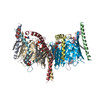
ムービー
ムービー コントローラー


+ データを開く

- 基本情報
基本情報
| 登録情報 | データベース: PDB / ID: 9eii | ||||||||||||||||||||||||
|---|---|---|---|---|---|---|---|---|---|---|---|---|---|---|---|---|---|---|---|---|---|---|---|---|---|
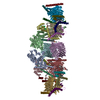
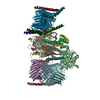
| タイトル | Import stalled PINK1 TOM complex, symmetry expanded | ||||||||||||||||||||||||
 要素 要素 |
| ||||||||||||||||||||||||
 キーワード キーワード | TRANSLOCASE / PINK1 / TOM complex / VDAC | ||||||||||||||||||||||||
| 機能・相同性 |  機能・相同性情報 機能・相同性情報positive regulation of free ubiquitin chain polymerization / positive regulation of synaptic transmission, dopaminergic / positive regulation of cristae formation / tRNA import into mitochondrion / TOM complex / mitochondrial outer membrane permeabilization / mitochondrial transmembrane transport / voltage-gated monoatomic anion channel activity / : / Mitochondrial calcium ion transport ...positive regulation of free ubiquitin chain polymerization / positive regulation of synaptic transmission, dopaminergic / positive regulation of cristae formation / tRNA import into mitochondrion / TOM complex / mitochondrial outer membrane permeabilization / mitochondrial transmembrane transport / voltage-gated monoatomic anion channel activity / : / Mitochondrial calcium ion transport / mitochondrion to lysosome vesicle-mediated transport / maintenance of protein location in mitochondrion / mitochondrion targeting sequence binding / : / mitochondrial outer membrane translocase complex / cellular response to hydrogen sulfide / protein kinase B binding / regulation of autophagy of mitochondrion / phospholipid scramblase activity / protein insertion into mitochondrial outer membrane / regulation of synaptic vesicle transport / ceramide binding / dopamine secretion / mitochondria-associated endoplasmic reticulum membrane contact site / positive regulation of mitochondrial electron transport, NADH to ubiquinone / regulation of oxidative phosphorylation / negative regulation of hypoxia-induced intrinsic apoptotic signaling pathway / negative regulation of hydrogen peroxide-induced neuron intrinsic apoptotic signaling pathway / C3HC4-type RING finger domain binding / protein-transporting ATPase activity / migrasome / regulation of hydrogen peroxide metabolic process / regulation of cellular response to oxidative stress / negative regulation of autophagosome assembly / voltage-gated monoatomic ion channel activity / positive regulation of dopamine secretion / autophagy of mitochondrion / phosphatidylcholine binding / positive regulation of type 2 mitophagy / oxysterol binding / binding of sperm to zona pellucida / Mitochondrial protein import / TORC2 signaling / cellular response to toxic substance / negative regulation of oxidative stress-induced neuron intrinsic apoptotic signaling pathway / regulation of mitochondrion organization / monoatomic anion transport / negative regulation of JNK cascade / : / : / phospholipid translocation / regulation of reactive oxygen species metabolic process / peptidase activator activity / positive regulation of mitochondrial fission / cholesterol binding / astrocyte projection / negative regulation of intrinsic apoptotic signaling pathway in response to hydrogen peroxide / negative regulation of macroautophagy / porin activity / FOXO-mediated transcription of cell death genes / pore complex / negative regulation of mitophagy / Lewy body / protein import into mitochondrial matrix / negative regulation of intrinsic apoptotic signaling pathway / positive regulation of release of cytochrome c from mitochondria / hemopoiesis / negative regulation of reactive oxygen species metabolic process / positive regulation of ATP biosynthetic process / mitochondrial nucleoid / positive regulation of macroautophagy / regulation of protein ubiquitination / transmembrane protein transporter activity / regulation of protein-containing complex assembly / negative regulation of mitochondrial fission / mitophagy / regulation of proteasomal protein catabolic process / monoatomic ion transport / acrosomal vesicle / response to ischemia / positive regulation of protein ubiquitination / PINK1-PRKN Mediated Mitophagy / regulation of mitochondrial membrane potential / cell periphery / respiratory electron transport chain / positive regulation of translation / macroautophagy / mitochondrion organization / regulation of protein stability / intracellular protein transport / mitochondrial intermembrane space / mitochondrial membrane / kinase binding / kinase activity / : / protein transport / growth cone / cell body / cellular response to oxidative stress / protease binding 類似検索 - 分子機能 | ||||||||||||||||||||||||
| 生物種 |  Homo sapiens (ヒト) Homo sapiens (ヒト) | ||||||||||||||||||||||||
| 手法 | 電子顕微鏡法 / 単粒子再構成法 / クライオ電子顕微鏡法 / 解像度: 2.75 Å | ||||||||||||||||||||||||
 データ登録者 データ登録者 | Kirk, N.S. / Glukhova, A. / Callegari, S. / Komander, D. | ||||||||||||||||||||||||
| 資金援助 |  オーストラリア, 2件 オーストラリア, 2件
| ||||||||||||||||||||||||
 引用 引用 | ジャーナル: Science / 年: 2025 タイトル: Structure of human PINK1 at a mitochondrial TOM-VDAC array. 著者: Sylvie Callegari / Nicholas S Kirk / Zhong Yan Gan / Toby Dite / Simon A Cobbold / Andrew Leis / Laura F Dagley / Alisa Glukhova / David Komander / 要旨: Mutations in the ubiquitin kinase PINK1 cause early-onset Parkinson's disease, but how PINK1 is stabilized at depolarized mitochondrial translocase complexes has remained poorly understood. We ...Mutations in the ubiquitin kinase PINK1 cause early-onset Parkinson's disease, but how PINK1 is stabilized at depolarized mitochondrial translocase complexes has remained poorly understood. We determined a 3.1-angstrom resolution cryo-electron microscopy structure of dimeric human PINK1 stabilized at an endogenous array of mitochondrial translocase of the outer membrane (TOM) and voltage-dependent anion channel (VDAC) complexes. Symmetric arrangement of two TOM core complexes around a central VDAC2 dimer is facilitated by TOM5 and TOM20, both of which also bind PINK1 kinase C-lobes. PINK1 enters mitochondria through the proximal TOM40 barrel of the TOM core complex, guided by TOM7 and TOM22. Our structure explains how human PINK1 is stabilized at the TOM complex and regulated by oxidation, uncovers a previously unknown TOM-VDAC assembly, and reveals how a physiological substrate traverses TOM40 during translocation. | ||||||||||||||||||||||||
| 履歴 |
|
- 構造の表示
構造の表示
| 構造ビューア | 分子: MolmilJmol/JSmol |
|---|
- ダウンロードとリンク
-ダウンロード
| PDBx/mmCIF形式 | 9eii.cif.gz | 374.4 KB | 表示 | PDBx/mmCIF形式 |
|---|---|---|---|---|
| PDB形式 | pdb9eii.ent.gz | 297.3 KB | 表示 | PDB形式 |
| PDBx/mmJSON形式 | 9eii.json.gz | ツリー表示 | PDBx/mmJSON形式 | |
| その他 |  その他のダウンロード その他のダウンロード |
-検証レポート
| アーカイブディレクトリ | https://data.pdbj.org/pub/pdb/validation_reports/ei/9eiiftp://data.pdbj.org/pub/pdb/validation_reports/ei/9eii | HTTPS FTP |
|---|
-関連構造データ
-リンク
 PDBj
PDBj
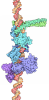

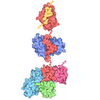
- 集合体
集合体
| 登録構造単位 | 
|
|---|---|
| 1 |
|
-要素
-タンパク質 , 2種, 2分子 BF
| #1: タンパク質 | 分子量: 65561.562 Da / 分子数: 1 / 由来タイプ: 組換発現 / 由来: (組換発現) Homo sapiens (ヒト) / 遺伝子: PINK1 / 細胞株 (発現宿主): Expi293 / 発現宿主: Homo sapiens (ヒト)参照: UniProt: Q9BXM7, non-specific serine/threonine protein kinase |
|---|---|
| #3: タンパク質 | 分子量: 31600.445 Da / 分子数: 1 / 由来タイプ: 天然 / 由来: (天然) Homo sapiens (ヒト) / 細胞株: Expi293 / 参照: UniProt: P45880 |
-Mitochondrial import receptor subunit ... , 6種, 11分子 DIJLZNXPVRT
| #2: タンパク質 | 分子量: 16319.862 Da / 分子数: 1 / 由来タイプ: 天然 / 由来: (天然) Homo sapiens (ヒト) / 細胞株: Expi293 / 参照: UniProt: Q15388 | ||||||||
|---|---|---|---|---|---|---|---|---|---|
| #4: タンパク質 | 分子量: 37926.926 Da / 分子数: 2 / 由来タイプ: 天然 / 由来: (天然) Homo sapiens (ヒト) / 細胞株: Expi293 / 参照: UniProt: O96008#5: タンパク質 | 分子量: 6045.318 Da / 分子数: 2 / 由来タイプ: 天然 / 由来: (天然) Homo sapiens (ヒト) / 細胞株: Expi293 / 参照: UniProt: Q8N4H5#6: タンパク質 | 分子量: 6256.473 Da / 分子数: 2 / 由来タイプ: 天然 / 由来: (天然) Homo sapiens (ヒト) / 細胞株: Expi293 / 参照: UniProt: Q9P0U1#7: タンパク質 | 分子量: 8007.988 Da / 分子数: 2 / 由来タイプ: 天然 / 由来: (天然) Homo sapiens (ヒト) / 細胞株: Expi293 / 参照: UniProt: Q96B49#8: タンパク質 | 分子量: 15532.528 Da / 分子数: 2 / 由来タイプ: 天然 / 由来: (天然) Homo sapiens (ヒト) / 細胞株: Expi293 / 参照: UniProt: Q9NS69 |
-非ポリマー , 1種, 9分子 
| #9: 化合物 | ChemComp-PC1 / 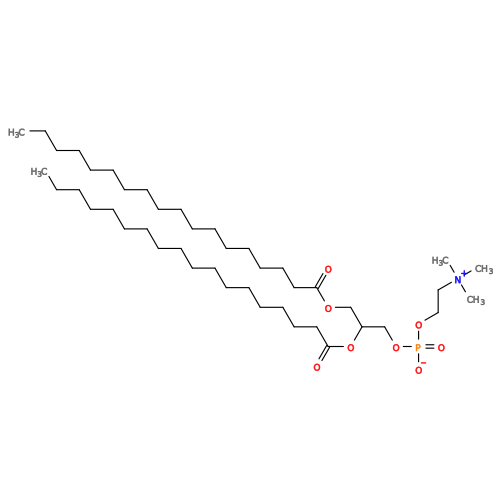 分子量: 790.145 Da / 分子数: 9 / 由来タイプ: 合成 / 式: C44H88NO8P / コメント: リン脂質*YM 分子量: 790.145 Da / 分子数: 9 / 由来タイプ: 合成 / 式: C44H88NO8P / コメント: リン脂質*YM |
|---|
-詳細
| 研究の焦点であるリガンドがあるか | N |
|---|---|
| Has protein modification | Y |
-実験情報
-実験
| 実験 | 手法: 電子顕微鏡法 |
|---|---|
| EM実験 | 試料の集合状態: PARTICLE / 3次元再構成法: 単粒子再構成法 |
- 試料調製
試料調製
| 構成要素 | 名称: Complex of VDAC, TOM core and PINK1 / タイプ: COMPLEX / Entity ID: #1-#8 / 由来: RECOMBINANT |
|---|---|
| 分子量 | 値: 0.75 MDa / 実験値: NO |
| 由来(天然) | 生物種: Homo sapiens (ヒト) |
| 由来(組換発現) | 生物種: Homo sapiens (ヒト) / 株: EXPI293 |
| 緩衝液 | pH: 7.4 |
| 試料 | 濃度: 4.3 mg/ml / 包埋: NO / シャドウイング: NO / 染色: NO / 凍結: YES |
| 急速凍結 | 装置: FEI VITROBOT MARK IV / 凍結剤: ETHANE / 湿度: 90 % / 凍結前の試料温度: 277 K / 詳細: Blot force 10 for 2 s. |
- 電子顕微鏡撮影
| 実験機器 |  モデル: Titan Krios / 画像提供: FEI Company |
|---|---|
| 顕微鏡 | モデル: TFS KRIOS |
| 電子銃 | 電子線源:  FIELD EMISSION GUN / 加速電圧: 300 kV / 照射モード: FLOOD BEAM FIELD EMISSION GUN / 加速電圧: 300 kV / 照射モード: FLOOD BEAM |
| 電子レンズ | モード: BRIGHT FIELD / 倍率(公称値): 105000 X / 最大 デフォーカス(公称値): 2000 nm / 最小 デフォーカス(公称値): 500 nm / Cs: 2.7 mm / C2レンズ絞り径: 50 µm |
| 試料ホルダ | 凍結剤: NITROGEN 試料ホルダーモデル: FEI TITAN KRIOS AUTOGRID HOLDER |
| 撮影 | 平均露光時間: 3.34 sec. / 電子線照射量: 52.4 e/Å2 フィルム・検出器のモデル: GATAN K3 BIOQUANTUM (6k x 4k) 撮影したグリッド数: 2 / 実像数: 16992 |
- 解析
解析
| EMソフトウェア |
| ||||||||||||||||||||||||||||||||||||||||||||||||
|---|---|---|---|---|---|---|---|---|---|---|---|---|---|---|---|---|---|---|---|---|---|---|---|---|---|---|---|---|---|---|---|---|---|---|---|---|---|---|---|---|---|---|---|---|---|---|---|---|---|
| CTF補正 | 詳細: Patch CTF / タイプ: PHASE FLIPPING AND AMPLITUDE CORRECTION | ||||||||||||||||||||||||||||||||||||||||||||||||
| 粒子像の選択 | 選択した粒子像数: 5700000 / 詳細: Picked using low resolution templates | ||||||||||||||||||||||||||||||||||||||||||||||||
| 3次元再構成 | 解像度: 2.75 Å / 解像度の算出法: FSC 0.143 CUT-OFF / 粒子像の数: 791000 / 対称性のタイプ: POINT | ||||||||||||||||||||||||||||||||||||||||||||||||
| 原子モデル構築 |
| ||||||||||||||||||||||||||||||||||||||||||||||||
| 原子モデル構築 |
| ||||||||||||||||||||||||||||||||||||||||||||||||
| 精密化 | 最高解像度: 2.75 Å 立体化学のターゲット値: REAL-SPACE (WEIGHTED MAP SUM AT ATOM CENTERS) | ||||||||||||||||||||||||||||||||||||||||||||||||
| 拘束条件 |
|