 ムービー
ムービー コントローラー


+ データを開く

- 基本情報
基本情報
| 登録情報 | データベース: PDB / ID: 8x19 | ||||||
|---|---|---|---|---|---|---|---|
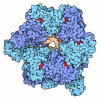
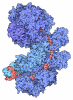
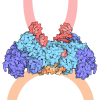
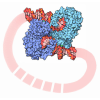
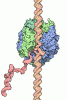
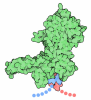
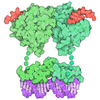
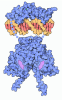
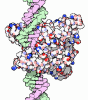
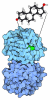
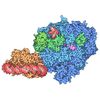
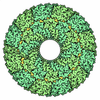
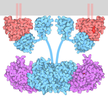
| タイトル | Structure of nucleosome-bound SRCAP-C in the ADP-BeFx-bound state | ||||||
 要素 要素 |
| ||||||
 キーワード キーワード | DNA BINDING PROTEIN/DNA / Remodeler / SRCAP / H2A.Z / DNA BINDING PROTEIN-DNA complex | ||||||
| 機能・相同性 |  機能・相同性情報 機能・相同性情報positive regulation of lymphoid progenitor cell differentiation / catalytic activity, acting on a protein / histone H3K18ac reader activity / promoter-enhancer loop anchoring activity / telomerase RNA localization to Cajal body / intestinal stem cell homeostasis / hematopoietic stem cell homeostasis / regulation of DNA strand elongation / positive regulation of telomere maintenance in response to DNA damage / histone chaperone activity ...positive regulation of lymphoid progenitor cell differentiation / catalytic activity, acting on a protein / histone H3K18ac reader activity / promoter-enhancer loop anchoring activity / telomerase RNA localization to Cajal body / intestinal stem cell homeostasis / hematopoietic stem cell homeostasis / regulation of DNA strand elongation / positive regulation of telomere maintenance in response to DNA damage / histone chaperone activity / positive regulation of norepinephrine uptake / establishment of protein localization to chromatin / R2TP complex / heart process / dynein axonemal particle / bBAF complex / Formation of the embryonic stem cell BAF (esBAF) complex / cellular response to cytochalasin B / neural retina development / negative regulation of G0 to G1 transition / npBAF complex / brahma complex / nBAF complex / Formation of the canonical BAF (cBAF) complex / regulation of transepithelial transport / RPAP3/R2TP/prefoldin-like complex / Formation of neuronal progenitor and neuronal BAF (npBAF and nBAF) / Swr1 complex / morphogenesis of a polarized epithelium / Formation of the polybromo-BAF (pBAF) complex / structural constituent of postsynaptic actin cytoskeleton / Formation of annular gap junctions / Formation of the dystrophin-glycoprotein complex (DGC) / Activation of the TFAP2 (AP-2) family of transcription factors / Gap junction degradation / Formation of the non-canonical BAF (ncBAF) complex / GBAF complex / regulation of G0 to G1 transition / protein localization to adherens junction / Cell-extracellular matrix interactions / dense body / Folding of actin by CCT/TriC / Tat protein binding / muscle cell differentiation / postsynaptic actin cytoskeleton / Ino80 complex / RSC-type complex / blastocyst formation / Regulation of CDH1 Function / regulation of double-strand break repair / regulation of nucleotide-excision repair / Prefoldin mediated transfer of substrate to CCT/TriC / Adherens junctions interactions / RHOF GTPase cycle / adherens junction assembly / box C/D snoRNP assembly / apical protein localization / Sensory processing of sound by outer hair cells of the cochlea / ATP-dependent chromatin remodeler activity / negative regulation of transcription by RNA polymerase I / nucleolus organization / Interaction between L1 and Ankyrins / positive regulation of DNA damage response, signal transduction by p53 class mediator / SWI/SNF complex / regulation of mitotic metaphase/anaphase transition / tight junction / Sensory processing of sound by inner hair cells of the cochlea / positive regulation of T cell differentiation / apical junction complex / positive regulation of double-strand break repair / spinal cord development / regulation of chromosome organization / maintenance of blood-brain barrier / regulation of norepinephrine uptake / transporter regulator activity / positive regulation of stem cell population maintenance / positive regulation of transcription by RNA polymerase I / NuA4 histone acetyltransferase complex / RUNX1 interacts with co-factors whose precise effect on RUNX1 targets is not known / histone H3K27ac reader activity / establishment or maintenance of cell polarity / regulation of T cell proliferation / Regulation of MITF-M-dependent genes involved in pigmentation / Recycling pathway of L1 / cortical cytoskeleton / regulation of DNA replication / MLL1 complex / TFIID-class transcription factor complex binding / nitric-oxide synthase binding / regulation of embryonic development / regulation of G1/S transition of mitotic cell cycle / brush border / somatic stem cell population maintenance / EPH-ephrin mediated repulsion of cells / Telomere Extension By Telomerase / protein folding chaperone complex / negative regulation of cell differentiation / RHO GTPases Activate WASPs and WAVEs / regulation of synaptic vesicle endocytosis / positive regulation of myoblast differentiation 類似検索 - 分子機能 | ||||||
| 生物種 |  Homo sapiens (ヒト) Homo sapiens (ヒト) | ||||||
| 手法 | 電子顕微鏡法 / 単粒子再構成法 / クライオ電子顕微鏡法 / 解像度: 3.2 Å | ||||||
 データ登録者 データ登録者 | Yu, J. / Wang, Q. / Yu, Z. / Li, W. / Wang, L. / Xu, Y. | ||||||
| 資金援助 |  中国, 1件 中国, 1件
| ||||||
 引用 引用 | ジャーナル: Cell Discov / 年: 2024 タイトル: Structural insights into histone exchange by human SRCAP complex. 著者: Jiali Yu / Fengrui Sui / Feng Gu / Wanjun Li / Zishuo Yu / Qianmin Wang / Shuang He / Li Wang / Yanhui Xu / 要旨: Histone variant H2A.Z is found at promoters and regulates transcription. The ATP-dependent chromatin remodeler SRCAP complex (SRCAP-C) promotes the replacement of canonical histone H2A-H2B dimer with ...Histone variant H2A.Z is found at promoters and regulates transcription. The ATP-dependent chromatin remodeler SRCAP complex (SRCAP-C) promotes the replacement of canonical histone H2A-H2B dimer with H2A.Z-H2B dimer. Here, we determined structures of human SRCAP-C bound to H2A-containing nucleosome at near-atomic resolution. The SRCAP subunit integrates a 6-subunit actin-related protein (ARP) module and an ATPase-containing motor module. The ATPase-associated ARP module encircles half of the nucleosome along the DNA and may restrain net DNA translocation, a unique feature of SRCAP-C. The motor module adopts distinct nucleosome binding modes in the apo (nucleotide-free), ADP-bound, and ADP-BeF-bound states, suggesting that ATPase-driven movement destabilizes H2A-H2B by unwrapping the entry DNA and pulls H2A-H2B out of nucleosome through the ZNHIT1 subunit. Structure-guided chromatin immunoprecipitation sequencing analysis confirmed the requirement of H2A-contacting ZNHIT1 in maintaining H2A.Z occupancy on the genome. Our study provides structural insights into the mechanism of H2A-H2A.Z exchange mediated by SRCAP-C. | ||||||
| 履歴 |
|
- 構造の表示
構造の表示
| 構造ビューア | 分子: MolmilJmol/JSmol |
|---|
- ダウンロードとリンク
-ダウンロード
| PDBx/mmCIF形式 | 8x19.cif.gz | 1.3 MB | 表示 | PDBx/mmCIF形式 |
|---|---|---|---|---|
| PDB形式 | pdb8x19.ent.gz | 表示 | PDB形式 | |
| PDBx/mmJSON形式 | 8x19.json.gz | ツリー表示 | PDBx/mmJSON形式 | |
| その他 |  その他のダウンロード その他のダウンロード |
-検証レポート
| アーカイブディレクトリ | https://data.pdbj.org/pub/pdb/validation_reports/x1/8x19ftp://data.pdbj.org/pub/pdb/validation_reports/x1/8x19 | HTTPS FTP |
|---|
-関連構造データ


-リンク
 PDBj
PDBj



- 集合体
集合体
| 登録構造単位 | 
|
|---|---|
| 1 |
|
-要素
-タンパク質 , 14種, 23分子 AEBFCGDHIJKLMOQNPRSUTVW
| #1: タンパク質 | 分子量: 14135.523 Da / 分子数: 2 / 由来タイプ: 組換発現 / 由来: (組換発現) Homo sapiens (ヒト) / 遺伝子: H2AC6, H2AFL, HIST1H2AC / 発現宿主:   Escherichia coli (大腸菌) / 参照: UniProt: Q93077 Escherichia coli (大腸菌) / 参照: UniProt: Q93077#2: タンパク質 | 分子量: 13937.213 Da / 分子数: 2 / 由来タイプ: 組換発現 / 由来: (組換発現) Homo sapiens (ヒト)遺伝子: H2BC4, H2BFL, HIST1H2BC, H2BC6, H2BFH, HIST1H2BE, H2BC7, H2BFG, HIST1H2BF, H2BC8, H2BFA, HIST1H2BG, H2BC10, H2BFK, HIST1H2BI 発現宿主: Escherichia coli (大腸菌) / 参照: UniProt: P62807#3: タンパク質 | 分子量: 15437.167 Da / 分子数: 2 / 由来タイプ: 組換発現 / 由来: (組換発現) Homo sapiens (ヒト)遺伝子: H3C1, H3FA, HIST1H3A, H3C2, H3FL, HIST1H3B, H3C3, H3FC HIST1H3C, H3C4, H3FB, HIST1H3D, H3C6, H3FD, HIST1H3E, H3C7, H3FI, HIST1H3F, H3C8, H3FH, HIST1H3G, H3C10, H3FK, HIST1H3H, H3C11, H3FF, ...遺伝子: H3C1, H3FA, HIST1H3A, H3C2, H3FL, HIST1H3B, H3C3, H3FC HIST1H3C, H3C4, H3FB, HIST1H3D, H3C6, H3FD, HIST1H3E, H3C7, H3FI, HIST1H3F, H3C8, H3FH, HIST1H3G, H3C10, H3FK, HIST1H3H, H3C11, H3FF, HIST1H3I, H3C12, H3FJ, HIST1H3J 発現宿主: Escherichia coli (大腸菌) / 参照: UniProt: P68431#4: タンパク質 | 分子量: 11394.426 Da / 分子数: 2 / 由来タイプ: 組換発現 / 由来: (組換発現) Homo sapiens (ヒト)遺伝子: H4C1, H4/A, H4FA, HIST1H4A, H4C2, H4/I, H4FI, HIST1H4B, H4C3, H4/G, H4FG, HIST1H4C, H4C4, H4/B, H4FB, HIST1H4D, H4C5, H4/J, H4FJ, HIST1H4E, H4C6, H4/C, H4FC, HIST1H4F, H4C8, H4/H, H4FH, ...遺伝子: H4C1, H4/A, H4FA, HIST1H4A, H4C2, H4/I, H4FI, HIST1H4B, H4C3, H4/G, H4FG, HIST1H4C, H4C4, H4/B, H4FB, HIST1H4D, H4C5, H4/J, H4FJ, HIST1H4E, H4C6, H4/C, H4FC, HIST1H4F, H4C8, H4/H, H4FH, HIST1H4H, H4C9, H4/M, H4FM, HIST1H4I, H4C11, H4/E, H4FE, HIST1H4J, H4C12, H4/D, H4FD, HIST1H4K, H4C13, H4/K, H4FK, HIST1H4L, H4C14, H4/N, H4F2, H4FN, HIST2H4, HIST2H4A, H4C15, H4/O, H4FO, HIST2H4B, H4C16, H4-16, HIST4H4 発現宿主: Escherichia coli (大腸菌) / 参照: UniProt: P62805#5: タンパク質 | | 分子量: 343915.250 Da / 分子数: 1 / 由来タイプ: 組換発現 / 由来: (組換発現) Homo sapiens (ヒト) / 遺伝子: SRCAP, KIAA0309 / 発現宿主: Homo sapiens (ヒト)参照: UniProt: Q6ZRS2, 加水分解酵素; 酸無水物に作用; 酸無水物に作用・細胞または細胞小器官の運動に関与 #6: タンパク質 | | 分子量: 40658.363 Da / 分子数: 1 / 由来タイプ: 組換発現 / 由来: (組換発現) Homo sapiens (ヒト) / 遺伝子: VPS72, TCFL1, YL1 / 発現宿主: Homo sapiens (ヒト) / 参照: UniProt: Q15906#7: タンパク質 | | 分子量: 45857.902 Da / 分子数: 1 / 由来タイプ: 組換発現 / 由来: (組換発現) Homo sapiens (ヒト) / 遺伝子: ACTR6, CDA12 / 発現宿主: Homo sapiens (ヒト) / 参照: UniProt: Q9GZN1#8: タンパク質 | | 分子量: 17567.023 Da / 分子数: 1 / 由来タイプ: 組換発現 / 由来: (組換発現) Homo sapiens (ヒト) / 遺伝子: ZNHIT1, CGBP1, ZNFN4A1 / 発現宿主: Homo sapiens (ヒト) / 参照: UniProt: O43257#9: タンパク質 | 分子量: 50296.914 Da / 分子数: 3 / 由来タイプ: 組換発現 / 由来: (組換発現) Homo sapiens (ヒト) / 遺伝子: RUVBL1, INO80H, NMP238, TIP49, TIP49A / 発現宿主: Homo sapiens (ヒト) / 参照: UniProt: Q9Y265, DNA helicase#10: タンパク質 | 分子量: 51222.465 Da / 分子数: 3 / 由来タイプ: 組換発現 / 由来: (組換発現) Homo sapiens (ヒト) / 遺伝子: RUVBL2, INO80J, TIP48, TIP49B, CGI-46 / 発現宿主: Homo sapiens (ヒト) / 参照: UniProt: Q9Y230, DNA helicase#11: タンパク質 | 分子量: 41782.660 Da / 分子数: 2 / 由来タイプ: 組換発現 / 由来: (組換発現) Homo sapiens (ヒト) / 遺伝子: ACTB / 発現宿主: Homo sapiens (ヒト)参照: UniProt: P60709, 加水分解酵素; 酸無水物に作用; 酸無水物に作用・細胞または細胞小器官の運動に関与 #12: タンパク質 | | 分子量: 47509.812 Da / 分子数: 1 / 由来タイプ: 組換発現 / 由来: (組換発現) Homo sapiens (ヒト) / 遺伝子: ACTL6A, BAF53, BAF53A, INO80K / 発現宿主: Homo sapiens (ヒト) / 参照: UniProt: O96019#13: タンパク質 | | 分子量: 53090.699 Da / 分子数: 1 / 由来タイプ: 組換発現 / 由来: (組換発現) Homo sapiens (ヒト) / 遺伝子: DMAP1, KIAA1425 / 発現宿主: Homo sapiens (ヒト) / 参照: UniProt: Q9NPF5#14: タンパク質 | | 分子量: 26541.537 Da / 分子数: 1 / 由来タイプ: 組換発現 / 由来: (組換発現) Homo sapiens (ヒト) / 遺伝子: YEATS4, GAS41 / 発現宿主: Homo sapiens (ヒト) / 参照: UniProt: O95619 |
|---|
-DNA鎖 , 2種, 2分子 XY
| #15: DNA鎖 | 分子量: 45644.070 Da / 分子数: 1 / 由来タイプ: 合成 / 由来: (合成) Homo sapiens (ヒト) |
|---|---|
| #16: DNA鎖 | 分子量: 45105.727 Da / 分子数: 1 / 由来タイプ: 合成 / 由来: (合成) Homo sapiens (ヒト) |
-非ポリマー , 4種, 11分子 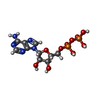

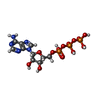
| #17: 化合物 | ChemComp-ADP / 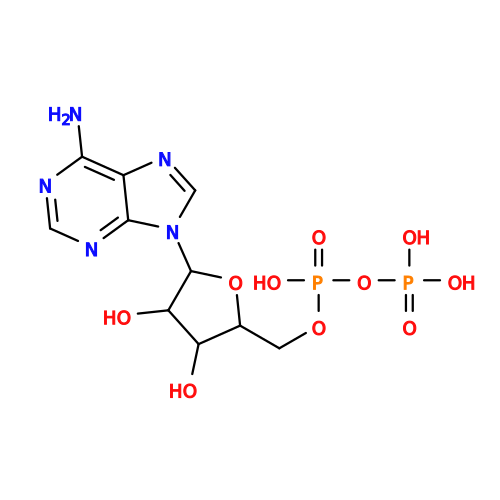 分子量: 427.201 Da / 分子数: 7 / 由来タイプ: 合成 / 式: C10H15N5O10P2 / タイプ: SUBJECT OF INVESTIGATION / コメント: ADP, エネルギー貯蔵分子*YM 分子量: 427.201 Da / 分子数: 7 / 由来タイプ: 合成 / 式: C10H15N5O10P2 / タイプ: SUBJECT OF INVESTIGATION / コメント: ADP, エネルギー貯蔵分子*YM#18: 化合物 | ChemComp-MG / | 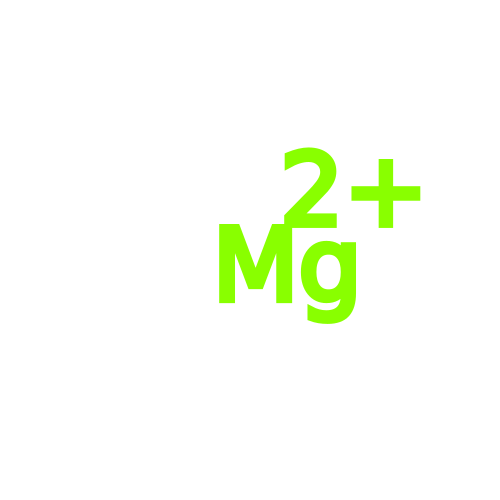 分子量: 24.305 Da / 分子数: 1 / 由来タイプ: 合成 / 式: Mg / タイプ: SUBJECT OF INVESTIGATION 分子量: 24.305 Da / 分子数: 1 / 由来タイプ: 合成 / 式: Mg / タイプ: SUBJECT OF INVESTIGATION#19: 化合物 | ChemComp-BEF / | 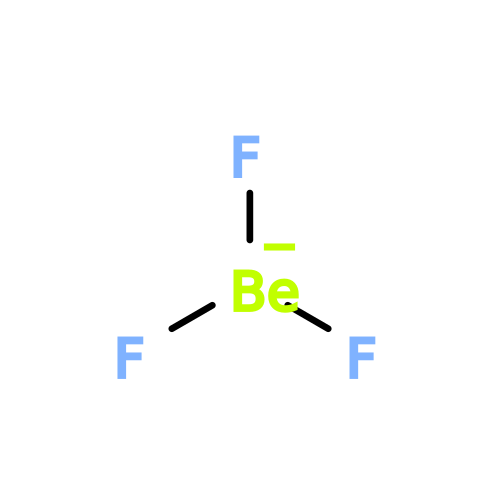 分子量: 66.007 Da / 分子数: 1 / 由来タイプ: 合成 / 式: BeF3 / タイプ: SUBJECT OF INVESTIGATION 分子量: 66.007 Da / 分子数: 1 / 由来タイプ: 合成 / 式: BeF3 / タイプ: SUBJECT OF INVESTIGATION#20: 化合物 | 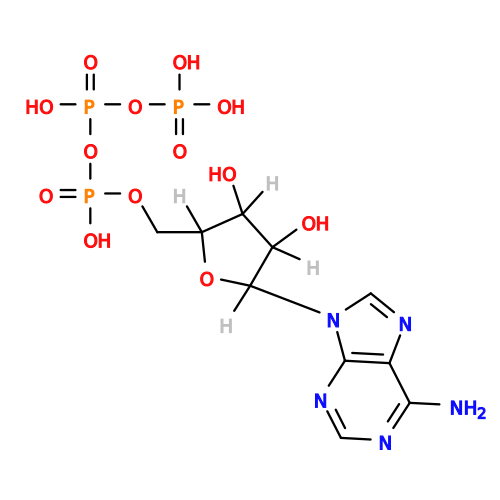 分子量: 507.181 Da / 分子数: 2 / 由来タイプ: 合成 / 式: C10H16N5O13P3 / タイプ: SUBJECT OF INVESTIGATION / コメント: ATP, エネルギー貯蔵分子*YM 分子量: 507.181 Da / 分子数: 2 / 由来タイプ: 合成 / 式: C10H16N5O13P3 / タイプ: SUBJECT OF INVESTIGATION / コメント: ATP, エネルギー貯蔵分子*YM |
|---|
-詳細
| 研究の焦点であるリガンドがあるか | Y |
|---|
-実験情報
-実験
| 実験 | 手法: 電子顕微鏡法 |
|---|---|
| EM実験 | 試料の集合状態: PARTICLE / 3次元再構成法: 単粒子再構成法 |
- 試料調製
試料調製
| 構成要素 | 名称: Structure of nucleosome-bound SRCAP-C in the ADP-BeFx-bound state タイプ: COMPLEX / Entity ID: #4-#6, #8-#12, #14, #1-#3, #7, #13, #15-#16 / 由来: MULTIPLE SOURCES |
|---|---|
| 由来(天然) | 生物種: Homo sapiens (ヒト) |
| 由来(組換発現) | 生物種: Homo sapiens (ヒト) |
| 緩衝液 | pH: 8 |
| 試料 | 包埋: NO / シャドウイング: NO / 染色: NO / 凍結: YES |
| 急速凍結 | 凍結剤: ETHANE |
- 電子顕微鏡撮影
| 実験機器 |  モデル: Titan Krios / 画像提供: FEI Company |
|---|---|
| 顕微鏡 | モデル: FEI TITAN KRIOS |
| 電子銃 | 電子線源:  FIELD EMISSION GUN / 加速電圧: 300 kV / 照射モード: FLOOD BEAM FIELD EMISSION GUN / 加速電圧: 300 kV / 照射モード: FLOOD BEAM |
| 電子レンズ | モード: BRIGHT FIELD / 最大 デフォーカス(公称値): 2500 nm / 最小 デフォーカス(公称値): 1500 nm |
| 撮影 | 電子線照射量: 50 e/Å2 / フィルム・検出器のモデル: GATAN K3 (6k x 4k) |
- 解析
解析
| EMソフトウェア | 名称: PHENIX / バージョン: 1.20.1_4487: / カテゴリ: モデル精密化 |
|---|---|
| CTF補正 | タイプ: PHASE FLIPPING AND AMPLITUDE CORRECTION |
| 3次元再構成 | 解像度: 3.2 Å / 解像度の算出法: FSC 0.143 CUT-OFF / 粒子像の数: 475617 / 対称性のタイプ: POINT |
