 Movie
Movie Controller

[English] 日本語
 Yorodumi
- PDB-8udr: Structure of the P1B7 antibody bound to the Sotorasib-modified KR... -
+ Open data

- Basic information
| Entry | Database: PDB / ID: 8udr | |||||||||||||||||||||||||||||||||||||||||||||||||||||||||||||||||||||||||||||||||||||||||||||
|---|---|---|---|---|---|---|---|---|---|---|---|---|---|---|---|---|---|---|---|---|---|---|---|---|---|---|---|---|---|---|---|---|---|---|---|---|---|---|---|---|---|---|---|---|---|---|---|---|---|---|---|---|---|---|---|---|---|---|---|---|---|---|---|---|---|---|---|---|---|---|---|---|---|---|---|---|---|---|---|---|---|---|---|---|---|---|---|---|---|---|---|---|---|---|
| Title | Structure of the P1B7 antibody bound to the Sotorasib-modified KRas G12C peptide presented by the A*03:01 MHC I complex | |||||||||||||||||||||||||||||||||||||||||||||||||||||||||||||||||||||||||||||||||||||||||||||
 Components Components |
| |||||||||||||||||||||||||||||||||||||||||||||||||||||||||||||||||||||||||||||||||||||||||||||
 Keywords Keywords | IMMUNE SYSTEM / antibody / MHC / haptenated peptide / PEPTIDE BINDING PROTEIN | |||||||||||||||||||||||||||||||||||||||||||||||||||||||||||||||||||||||||||||||||||||||||||||
| Function / homology |  Function and homology information Function and homology informationpositive regulation of memory T cell activation / T cell mediated cytotoxicity directed against tumor cell target / positive regulation of CD8-positive, alpha-beta T cell activation / CD8-positive, alpha-beta T cell activation / positive regulation of CD8-positive, alpha-beta T cell proliferation / T cell mediated cytotoxicity / antigen processing and presentation of endogenous peptide antigen via MHC class I via ER pathway, TAP-dependent / response to mineralocorticoid / GMP binding / TAP complex binding ...positive regulation of memory T cell activation / T cell mediated cytotoxicity directed against tumor cell target / positive regulation of CD8-positive, alpha-beta T cell activation / CD8-positive, alpha-beta T cell activation / positive regulation of CD8-positive, alpha-beta T cell proliferation / T cell mediated cytotoxicity / antigen processing and presentation of endogenous peptide antigen via MHC class I via ER pathway, TAP-dependent / response to mineralocorticoid / GMP binding / TAP complex binding / antigen processing and presentation of exogenous peptide antigen via MHC class I / Golgi medial cisterna / LRR domain binding / response to isolation stress / CD8 receptor binding / response to gravity / myoblast proliferation / protection from natural killer cell mediated cytotoxicity / cardiac muscle cell proliferation / Signaling by RAS GAP mutants / Signaling by RAS GTPase mutants / Activation of RAS in B cells / TAP binding / endoplasmic reticulum exit site / RAS signaling downstream of NF1 loss-of-function variants / RUNX3 regulates p14-ARF / detection of bacterium / SOS-mediated signalling / antigen processing and presentation of endogenous peptide antigen via MHC class Ib / antigen processing and presentation of endogenous peptide antigen via MHC class I via ER pathway, TAP-independent / Activated NTRK3 signals through RAS / Activated NTRK2 signals through RAS / SHC1 events in ERBB4 signaling / Signalling to RAS / beta-2-microglobulin binding / SHC-related events triggered by IGF1R / Activated NTRK2 signals through FRS2 and FRS3 / Estrogen-stimulated signaling through PRKCZ / SHC-mediated cascade:FGFR3 / MET activates RAS signaling / positive regulation of Ras protein signal transduction / SHC-mediated cascade:FGFR2 / SHC-mediated cascade:FGFR4 / Signaling by PDGFRA transmembrane, juxtamembrane and kinase domain mutants / Signaling by PDGFRA extracellular domain mutants / PTK6 Regulates RHO GTPases, RAS GTPase and MAP kinases / T cell receptor binding / Erythropoietin activates RAS / SHC-mediated cascade:FGFR1 / Signaling by FGFR4 in disease / Signaling by CSF3 (G-CSF) / FRS-mediated FGFR3 signaling / Signaling by FLT3 ITD and TKD mutants / FRS-mediated FGFR2 signaling / FRS-mediated FGFR4 signaling / p38MAPK events / Signaling by FGFR3 in disease / FRS-mediated FGFR1 signaling / Tie2 Signaling / protein-membrane adaptor activity / Signaling by FGFR2 in disease / Signaling by FLT3 fusion proteins / GRB2 events in EGFR signaling / SHC1 events in EGFR signaling / FLT3 Signaling / Signaling by FGFR1 in disease / EGFR Transactivation by Gastrin / NCAM signaling for neurite out-growth / CD209 (DC-SIGN) signaling / liver development / GRB2 events in ERBB2 signaling / Downstream signal transduction / response to glucocorticoid / Insulin receptor signalling cascade / SHC1 events in ERBB2 signaling / regulation of natural killer cell mediated immunity / early endosome lumen / Nef mediated downregulation of MHC class I complex cell surface expression / positive regulation of T cell mediated cytotoxicity / DAP12 interactions / Constitutive Signaling by Overexpressed ERBB2 / Ras activation upon Ca2+ influx through NMDA receptor / Signaling by phosphorylated juxtamembrane, extracellular and kinase domain KIT mutants / Endosomal/Vacuolar pathway / VEGFR2 mediated cell proliferation / small monomeric GTPase / Antigen Presentation: Folding, assembly and peptide loading of class I MHC / FCERI mediated MAPK activation / lumenal side of endoplasmic reticulum membrane / regulation of iron ion transport / female pregnancy / negative regulation of iron ion transport / negative regulation of forebrain neuron differentiation / antigen processing and presentation of exogenous peptide antigen via MHC class Ib / peptide antigen assembly with MHC class I protein complex / ER to Golgi transport vesicle membrane / Signaling by ERBB2 TMD/JMD mutants / HFE-transferrin receptor complex / MHC class I peptide loading complex / transferrin transport Similarity search - Function | |||||||||||||||||||||||||||||||||||||||||||||||||||||||||||||||||||||||||||||||||||||||||||||
| Biological species |  Homo sapiens (human) Homo sapiens (human) | |||||||||||||||||||||||||||||||||||||||||||||||||||||||||||||||||||||||||||||||||||||||||||||
| Method | ELECTRON MICROSCOPY / single particle reconstruction / cryo EM / Resolution: 3.1 Å | |||||||||||||||||||||||||||||||||||||||||||||||||||||||||||||||||||||||||||||||||||||||||||||
 Authors Authors | Chan, L.M. / Roweder, P.J. / Craik, C.S. / Verba, K.A. | |||||||||||||||||||||||||||||||||||||||||||||||||||||||||||||||||||||||||||||||||||||||||||||
| Funding support |  United States, 3items United States, 3items
| |||||||||||||||||||||||||||||||||||||||||||||||||||||||||||||||||||||||||||||||||||||||||||||
 Citation Citation | Journal: Cancer Res / Year: 2025 Title: Therapeutic Targeting and Structural Characterization of a Sotorasib-Modified KRAS G12C-MHC I Complex Demonstrate the Antitumor Efficacy of Hapten-Based Strategies. Authors: Apurva Pandey / Peter J Rohweder / Lieza M Chan / Chayanid Ongpipattanakul / Dong Hee Chung / Bryce Paolella / Fiona M Quimby / Ngoc Nguyen / Kliment A Verba / Michael J Evans / Charles S Craik / Abstract: Antibody-based therapies have emerged as a powerful strategy for the management of diverse cancers. Unfortunately, tumor-specific antigens remain challenging to identify and target. Recent work ...Antibody-based therapies have emerged as a powerful strategy for the management of diverse cancers. Unfortunately, tumor-specific antigens remain challenging to identify and target. Recent work established that inhibitor-modified peptide adducts derived from KRAS G12C are competent for antigen presentation via MHC I and can be targeted by antibody-based therapeutics, offering a means to directly target an intracellular oncoprotein at the cell surface with combination therapies. Here, we validated the antigen display of "haptenated" KRAS G12C peptide fragments on tumors in mouse models treated with the FDA-approved KRAS G12C covalent inhibitor sotorasib using PET/CT imaging of an 89Zr-labeled P1B7 IgG antibody, which selectively binds sotorasib-modified KRAS G12C-MHC I complexes. Targeting this peptide-MHC I complex with radioligand therapy using 225Ac- or 177Lu-P1B7 IgG effectively inhibited tumor growth in combination with sotorasib. Elucidation of the 3.1 Å cryo-EM structure of P1B7 bound to a haptenated KRAS G12C peptide-MHC I complex confirmed that the sotorasib-modified KRAS G12C peptide is presented via a canonical binding pose and showed that P1B7 binds the complex in a T-cell receptor-like manner. Together, these findings demonstrate the potential value of targeting unique oncoprotein-derived, haptenated MHC I complexes with radioligand therapeutics and provide a structural framework for developing next generation antibodies. Significance: Radioligand therapy using an antibody targeting KRAS-derived, sotorasib-modified MHC I complexes elicits antitumor effects superior to those of sotorasib alone and provides a potential strategy to repurpose sotorasib as a hapten to overcome resistance. | |||||||||||||||||||||||||||||||||||||||||||||||||||||||||||||||||||||||||||||||||||||||||||||
| History |
|
- Structure visualization
| Structure viewer | Molecule: MolmilJmol/JSmol |
|---|
- Downloads & links
-Download
| PDBx/mmCIF format | 8udr.cif.gz | 272.5 KB | Display | PDBx/mmCIF format |
|---|---|---|---|---|
| PDB format | pdb8udr.ent.gz | 219.5 KB | Display | PDB format |
| PDBx/mmJSON format | 8udr.json.gz | Tree view | PDBx/mmJSON format | |
| Others |  Other downloads Other downloads |
-Validation report
| Arichive directory | https://data.pdbj.org/pub/pdb/validation_reports/ud/8udrftp://data.pdbj.org/pub/pdb/validation_reports/ud/8udr | HTTPS FTP |
|---|
-Related structure data
| Related structure data |  42151MC M: map data used to model this data C: citing same article ( |
|---|---|
| Similar structure data |
-Links
 PDBj
PDBj

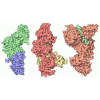
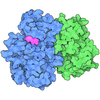
- Assembly
| Deposited unit | 
|
|---|---|
| 1 |
|
-Components
-Protein , 2 types, 2 molecules AB
| #1: Protein | Mass: 31757.953 Da / Num. of mol.: 1 Source method: isolated from a genetically manipulated source Source: (gene. exp.) Homo sapiens (human) / Gene: HLA-A / Production host:   Escherichia coli (E. coli) / References: UniProt: P04439 Escherichia coli (E. coli) / References: UniProt: P04439 |
|---|---|
| #2: Protein | Mass: 11748.160 Da / Num. of mol.: 1 Source method: isolated from a genetically manipulated source Source: (gene. exp.) Homo sapiens (human) / Gene: B2M, CDABP0092, HDCMA22P / Production host: Escherichia coli (E. coli) / References: UniProt: P61769 |
-Antibody , 2 types, 2 molecules DE
| #4: Antibody | Mass: 24103.029 Da / Num. of mol.: 1 Source method: isolated from a genetically manipulated source Source: (gene. exp.) Homo sapiens (human) / Cell line (production host): HEK293T / Production host: Homo sapiens (human) |
|---|---|
| #5: Antibody | Mass: 22580.805 Da / Num. of mol.: 1 Source method: isolated from a genetically manipulated source Source: (gene. exp.) Homo sapiens (human) / Cell line (production host): HEK293T / Production host: Homo sapiens (human) |
-Protein/peptide / Non-polymers , 2 types, 2 molecules C
| #3: Protein/peptide | Mass: 889.094 Da / Num. of mol.: 1 / Source method: obtained synthetically / Source: (synth.) Homo sapiens (human) / References: UniProt: P01116 |
|---|---|
| #6: Chemical | ChemComp-MOV / 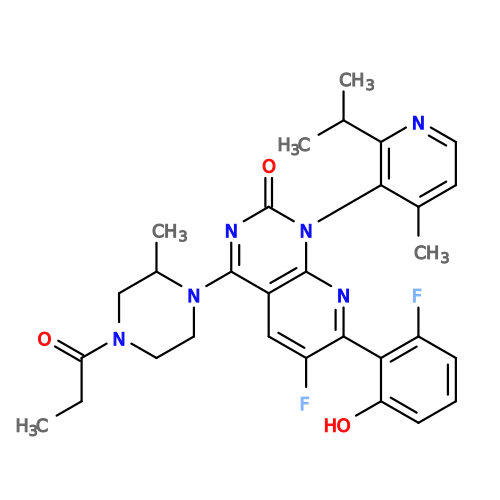 Mass: 562.610 Da / Num. of mol.: 1 / Source method: obtained synthetically / Formula: C30H32F2N6O3 / Feature type: SUBJECT OF INVESTIGATION Mass: 562.610 Da / Num. of mol.: 1 / Source method: obtained synthetically / Formula: C30H32F2N6O3 / Feature type: SUBJECT OF INVESTIGATION |
-Details
| Has ligand of interest | Y |
|---|---|
| Has protein modification | Y |
-Experimental details
-Experiment
| Experiment | Method: ELECTRON MICROSCOPY |
|---|---|
| EM experiment | Aggregation state: PARTICLE / 3D reconstruction method: single particle reconstruction |
- Sample preparation
| Component | Name: P1B7 antibody:V7-Sotorasib A*03:01 MHC I complex / Type: COMPLEX / Entity ID: #1-#2, #4-#5, #3 / Source: RECOMBINANT | |||||||||||||||
|---|---|---|---|---|---|---|---|---|---|---|---|---|---|---|---|---|
| Molecular weight | Value: 0.127044 MDa / Experimental value: NO | |||||||||||||||
| Source (natural) | Organism: Homo sapiens (human) | |||||||||||||||
| Source (recombinant) | Organism: Homo sapiens (human) / Cell: HEK293T | |||||||||||||||
| Buffer solution | pH: 7.5 / Details: 20mM HEPES ph 7.5, 100 mM KCl | |||||||||||||||
| Buffer component |
| |||||||||||||||
| Specimen | Conc.: 0.0762 mg/ml / Embedding applied: NO / Shadowing applied: NO / Staining applied: NO / Vitrification applied: YES | |||||||||||||||
| Specimen support | Grid material: GOLD / Grid mesh size: 300 divisions/in. / Grid type: Quantifoil R1.2/1.3 | |||||||||||||||
| Vitrification | Instrument: FEI VITROBOT MARK IV / Cryogen name: ETHANE / Humidity: 100 % / Chamber temperature: 277.15 K |
- Electron microscopy imaging
| Experimental equipment |  Model: Titan Krios / Image courtesy: FEI Company |
|---|---|
| Microscopy | Model: FEI TITAN KRIOS |
| Electron gun | Electron source:  FIELD EMISSION GUN / Accelerating voltage: 300 kV / Illumination mode: FLOOD BEAM FIELD EMISSION GUN / Accelerating voltage: 300 kV / Illumination mode: FLOOD BEAM |
| Electron lens | Mode: BRIGHT FIELD / Nominal magnification: 105000 X / Nominal defocus max: 20000 nm / Nominal defocus min: 7000 nm / Cs: 2.7 mm / C2 aperture diameter: 70 µm / Alignment procedure: COMA FREE |
| Specimen holder | Cryogen: NITROGEN / Specimen holder model: FEI TITAN KRIOS AUTOGRID HOLDER |
| Image recording | Average exposure time: 2 sec. / Electron dose: 45.8 e/Å2 / Film or detector model: GATAN K3 (6k x 4k) / Num. of grids imaged: 1 / Num. of real images: 3795 |
| EM imaging optics | Energyfilter name: GIF Bioquantum / Energyfilter slit width: 10 eV |
- Processing
| EM software |
| ||||||||||||||||||||||||||||||
|---|---|---|---|---|---|---|---|---|---|---|---|---|---|---|---|---|---|---|---|---|---|---|---|---|---|---|---|---|---|---|---|
| CTF correction | Type: PHASE FLIPPING AND AMPLITUDE CORRECTION | ||||||||||||||||||||||||||||||
| Particle selection | Num. of particles selected: 1375850 | ||||||||||||||||||||||||||||||
| 3D reconstruction | Resolution: 3.1 Å / Resolution method: FSC 0.143 CUT-OFF / Num. of particles: 286405 / Symmetry type: POINT | ||||||||||||||||||||||||||||||
| Refine LS restraints |
|
