 Movie
Movie Controller


+ Open data

- Basic information
| Entry | Database: PDB / ID: 8gcr | ||||||
|---|---|---|---|---|---|---|---|
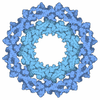
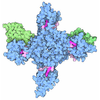
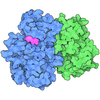
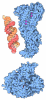
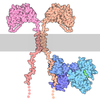
| Title | HPV16 E6-E6AP-p53 complex | ||||||
 Components Components |
| ||||||
 Keywords Keywords | VIRAL PROTEIN / Complex / HPV / ubiquitin ligase / tumor suppressor | ||||||
| Function / homology |  Function and homology information Function and homology information: / symbiont-mediated suppression of host transcription / regulation of ubiquitin-dependent protein catabolic process / symbiont-mediated suppression of host apoptosis / HECT-type E3 ubiquitin transferase / transcription regulator activator activity / negative regulation of helicase activity / signal transduction by p53 class mediator / Loss of function of TP53 in cancer due to loss of tetramerization ability / Regulation of TP53 Expression ...: / symbiont-mediated suppression of host transcription / regulation of ubiquitin-dependent protein catabolic process / symbiont-mediated suppression of host apoptosis / HECT-type E3 ubiquitin transferase / transcription regulator activator activity / negative regulation of helicase activity / signal transduction by p53 class mediator / Loss of function of TP53 in cancer due to loss of tetramerization ability / Regulation of TP53 Expression / regulation of cell cycle G2/M phase transition / negative regulation of G1 to G0 transition / Transcriptional activation of cell cycle inhibitor p21 / negative regulation of pentose-phosphate shunt / Activation of NOXA and translocation to mitochondria / ATP-dependent DNA/DNA annealing activity / oligodendrocyte apoptotic process / positive regulation of thymocyte apoptotic process / oxidative stress-induced premature senescence / bone marrow development / cellular response to actinomycin D / circadian behavior / regulation of Cdc42 protein signal transduction / positive regulation of programmed necrotic cell death / RUNX3 regulates CDKN1A transcription / TP53 Regulates Transcription of Death Receptors and Ligands / Activation of PUMA and translocation to mitochondria / TP53 regulates transcription of additional cell cycle genes whose exact role in the p53 pathway remain uncertain / mRNA transcription / Regulation of TP53 Activity through Association with Co-factors / Urea cycle / ER overload response / hematopoietic stem cell differentiation / Formation of Senescence-Associated Heterochromatin Foci (SAHF) / TP53 Regulates Transcription of Caspase Activators and Caspases / intrinsic apoptotic signaling pathway by p53 class mediator / entrainment of circadian clock by photoperiod / Zygotic genome activation (ZGA) / TP53 Regulates Transcription of Genes Involved in Cytochrome C Release / PI5P Regulates TP53 Acetylation / positive regulation of release of cytochrome c from mitochondria / Association of TriC/CCT with target proteins during biosynthesis / hematopoietic progenitor cell differentiation / negative regulation of telomere maintenance via telomerase / progesterone receptor signaling pathway / SUMOylation of transcription factors / TP53 regulates transcription of several additional cell death genes whose specific roles in p53-dependent apoptosis remain uncertain / response to progesterone / intrinsic apoptotic signaling pathway in response to DNA damage by p53 class mediator / replicative senescence / Transcriptional Regulation by VENTX / TFIID-class transcription factor complex binding / viral process / regulation of proteolysis / intrinsic apoptotic signaling pathway in response to endoplasmic reticulum stress / Pyroptosis / determination of adult lifespan / positive regulation of RNA polymerase II transcription preinitiation complex assembly / general transcription initiation factor binding / negative regulation of fibroblast proliferation / positive regulation of execution phase of apoptosis / carbohydrate transmembrane transporter activity / type II interferon-mediated signaling pathway / TP53 Regulates Transcription of Genes Involved in G1 Cell Cycle Arrest / maltose binding / maltose transport / maltodextrin transmembrane transport / postsynaptic cytosol / cellular response to glucose starvation / ATP-binding cassette (ABC) transporter complex, substrate-binding subunit-containing / core promoter sequence-specific DNA binding / cis-regulatory region sequence-specific DNA binding / protein autoubiquitination / Regulation of TP53 Activity through Acetylation / intrinsic apoptotic signaling pathway / mitotic G1 DNA damage checkpoint signaling / proteasome complex / positive regulation of intrinsic apoptotic signaling pathway / negative regulation of TORC1 signaling / 14-3-3 protein binding / response to gamma radiation / protein K48-linked ubiquitination / MDM2/MDM4 family protein binding / TP53 Regulates Transcription of Genes Involved in G2 Cell Cycle Arrest / protein phosphatase 2A binding / DNA damage response, signal transduction by p53 class mediator / positive regulation of protein ubiquitination / transcription initiation-coupled chromatin remodeling / molecular function activator activity / Regulation of PTEN gene transcription / tumor necrosis factor-mediated signaling pathway / cellular response to ionizing radiation / cellular response to xenobiotic stimulus / TP53 Regulates Metabolic Genes / brain development / PDZ domain binding / TP53 Regulates Transcription of DNA Repair Genes / cellular response to gamma radiation / mRNA 3'-UTR binding / Regulation of NF-kappa B signaling Similarity search - Function | ||||||
| Biological species |   Escherichia coli O157:H7 (bacteria) Escherichia coli O157:H7 (bacteria) Human papillomavirus type 16 Human papillomavirus type 16 Homo sapiens (human) Homo sapiens (human) | ||||||
| Method | ELECTRON MICROSCOPY / single particle reconstruction / cryo EM / Resolution: 3.38 Å | ||||||
 Authors Authors | Bratkowski, M.A. / Wang, J.C.K. / Hao, Q. / Nile, A.H. | ||||||
| Funding support |  United States, 1items United States, 1items
| ||||||
 Citation Citation | Journal: Nat Commun / Year: 2024 Title: Structure of the p53 degradation complex from HPV16. Authors: John C K Wang / Hannah T Baddock / Amirhossein Mafi / Ian T Foe / Matthew Bratkowski / Ting-Yu Lin / Zena D Jensvold / Magdalena Preciado López / David Stokoe / Dan Eaton / Qi Hao / Aaron H Nile / Abstract: Human papillomavirus (HPV) is a significant contributor to the global cancer burden, and its carcinogenic activity is facilitated in part by the HPV early protein 6 (E6), which interacts with the E3- ...Human papillomavirus (HPV) is a significant contributor to the global cancer burden, and its carcinogenic activity is facilitated in part by the HPV early protein 6 (E6), which interacts with the E3-ligase E6AP, also known as UBE3A, to promote degradation of the tumor suppressor, p53. In this study, we present a single-particle cryoEM structure of the full-length E6AP protein in complex with HPV16 E6 (16E6) and p53, determined at a resolution of ~3.3 Å. Our structure reveals extensive protein-protein interactions between 16E6 and E6AP, explaining their picomolar binding affinity. These findings shed light on the molecular basis of the ternary complex, which has been pursued as a potential therapeutic target for HPV-driven cervical, anal, and oropharyngeal cancers over the last two decades. Understanding the structural and mechanistic underpinnings of this complex is crucial for developing effective therapies to combat HPV-induced cancers. Our findings may help to explain why previous attempts to disrupt this complex have failed to generate therapeutic modalities and suggest that current strategies should be reevaluated. | ||||||
| History |
|
- Structure visualization
| Structure viewer | Molecule: MolmilJmol/JSmol |
|---|
- Downloads & links
-Download
| PDBx/mmCIF format | 8gcr.cif.gz | 189.9 KB | Display | PDBx/mmCIF format |
|---|---|---|---|---|
| PDB format | pdb8gcr.ent.gz | 136.2 KB | Display | PDB format |
| PDBx/mmJSON format | 8gcr.json.gz | Tree view | PDBx/mmJSON format | |
| Others |  Other downloads Other downloads |
-Validation report
| Arichive directory | https://data.pdbj.org/pub/pdb/validation_reports/gc/8gcrftp://data.pdbj.org/pub/pdb/validation_reports/gc/8gcr | HTTPS FTP |
|---|
-Related structure data
| Related structure data |  29941MC M: map data used to model this data C: citing same article ( |
|---|---|
| Similar structure data |
-Links
 PDBj
PDBj
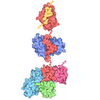
- Assembly
| Deposited unit | 
|
|---|---|
| 1 |
|
-Components
| #1: Protein | Mass: 61190.582 Da / Num. of mol.: 1 / Mutation: C87S,C104S,C118S,C147S Source method: isolated from a genetically manipulated source Details: The cysteine to serine mutations are in the protein E6 portion of the chimeric construct.,The cysteine to serine mutations are in the protein E6 portion of the chimeric construct. Source: (gene. exp.) Escherichia coli O157:H7 (bacteria), (gene. exp.) Human papillomavirus type 16Gene: malE, Z5632, ECs5017, E6 / Production host: Escherichia coli (E. coli) / References: UniProt: P0AEY0, UniProt: P03126 | ||
|---|---|---|---|
| #2: Protein | Mass: 24643.930 Da / Num. of mol.: 1 Source method: isolated from a genetically manipulated source Source: (gene. exp.) Homo sapiens (human) / Gene: TP53, P53 / Production host: Escherichia coli (E. coli) / References: UniProt: P04637 | ||
| #3: Protein | Mass: 104305.281 Da / Num. of mol.: 1 Source method: isolated from a genetically manipulated source Source: (gene. exp.) Homo sapiens (human) / Gene: UBE3A, E6AP, EPVE6AP, HPVE6A / Production host:   Spodoptera frugiperda (fall armyworm) Spodoptera frugiperda (fall armyworm)References: UniProt: Q05086, HECT-type E3 ubiquitin transferase | ||
| #4: Chemical |   Mass: 65.409 Da / Num. of mol.: 3 / Source method: obtained synthetically / Formula: Zn Mass: 65.409 Da / Num. of mol.: 3 / Source method: obtained synthetically / Formula: ZnHas ligand of interest | N | |
-Experimental details
-Experiment
| Experiment | Method: ELECTRON MICROSCOPY |
|---|---|
| EM experiment | Aggregation state: PARTICLE / 3D reconstruction method: single particle reconstruction |
- Sample preparation
| Component |
| ||||||||||||||||||||||||||||||
|---|---|---|---|---|---|---|---|---|---|---|---|---|---|---|---|---|---|---|---|---|---|---|---|---|---|---|---|---|---|---|---|
| Molecular weight | Experimental value: NO | ||||||||||||||||||||||||||||||
| Source (natural) |
| ||||||||||||||||||||||||||||||
| Source (recombinant) |
| ||||||||||||||||||||||||||||||
| Buffer solution | pH: 7 | ||||||||||||||||||||||||||||||
| Buffer component |
| ||||||||||||||||||||||||||||||
| Specimen | Conc.: 2.15 mg/ml / Embedding applied: NO / Shadowing applied: NO / Staining applied: NO / Vitrification applied: YES | ||||||||||||||||||||||||||||||
| Specimen support | Grid type: Quantifoil R1.2/1.3 | ||||||||||||||||||||||||||||||
| Vitrification | Instrument: FEI VITROBOT MARK IV / Cryogen name: ETHANE / Humidity: 100 % / Chamber temperature: 277.15 K |
- Electron microscopy imaging
| Experimental equipment |  Model: Titan Krios / Image courtesy: FEI Company |
|---|---|
| Microscopy | Model: FEI TITAN KRIOS |
| Electron gun | Electron source:  FIELD EMISSION GUN / Accelerating voltage: 300 kV / Illumination mode: FLOOD BEAM FIELD EMISSION GUN / Accelerating voltage: 300 kV / Illumination mode: FLOOD BEAM |
| Electron lens | Mode: BRIGHT FIELD / Nominal defocus max: 2500 nm / Nominal defocus min: 1500 nm |
| Image recording | Electron dose: 80.5 e/Å2 / Film or detector model: GATAN K3 (6k x 4k) |
- Processing
| Software |
| ||||||||||||||||||||||||
|---|---|---|---|---|---|---|---|---|---|---|---|---|---|---|---|---|---|---|---|---|---|---|---|---|---|
| EM software |
| ||||||||||||||||||||||||
| CTF correction | Type: PHASE FLIPPING AND AMPLITUDE CORRECTION | ||||||||||||||||||||||||
| Particle selection | Num. of particles selected: 2349301 | ||||||||||||||||||||||||
| 3D reconstruction | Resolution: 3.38 Å / Resolution method: FSC 0.143 CUT-OFF / Num. of particles: 105794 / Symmetry type: POINT | ||||||||||||||||||||||||
| Atomic model building | Accession code: 4xr8 / Source name: PDB / Type: experimental model | ||||||||||||||||||||||||
| Refinement | Cross valid method: NONE | ||||||||||||||||||||||||
| Refine LS restraints |
|
