 Movie
Movie Controller

[English] 日本語
 Yorodumi
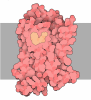
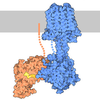
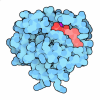
- PDB-31bg: Cryo-EM structure of Dopamine 3 receptor:Go complex bound to bito... -
+ Open data

- Basic information
| Entry | Database: PDB / ID: 31bg | |||||||||||||||||||||
|---|---|---|---|---|---|---|---|---|---|---|---|---|---|---|---|---|---|---|---|---|---|---|
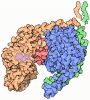
| Title | Cryo-EM structure of Dopamine 3 receptor:Go complex bound to bitopic AB13-46A | |||||||||||||||||||||
 Components Components |
| |||||||||||||||||||||
 Keywords Keywords | MEMBRANE PROTEIN / Bitopic molecules / dopamine receptor / drug selectivity / structure-based drug design / GPCRs / G protein-coupled receptors / ligand-triggered receptor conformation | |||||||||||||||||||||
| Function / homology |  Function and homology information Function and homology informationmusculoskeletal movement, spinal reflex action / acid secretion / dopamine neurotransmitter receptor activity, coupled via Gi/Go / response to histamine / regulation of potassium ion transport / adenylate cyclase-inhibiting dopamine receptor signaling pathway / Dopamine receptors / regulation of dopamine uptake involved in synaptic transmission / phospholipase C-activating dopamine receptor signaling pathway / positive regulation of dopamine receptor signaling pathway ...musculoskeletal movement, spinal reflex action / acid secretion / dopamine neurotransmitter receptor activity, coupled via Gi/Go / response to histamine / regulation of potassium ion transport / adenylate cyclase-inhibiting dopamine receptor signaling pathway / Dopamine receptors / regulation of dopamine uptake involved in synaptic transmission / phospholipase C-activating dopamine receptor signaling pathway / positive regulation of dopamine receptor signaling pathway / negative regulation of oligodendrocyte differentiation / mu-type opioid receptor binding / corticotropin-releasing hormone receptor 1 binding / G-protein activation / Activation of the phototransduction cascade / Glucagon-type ligand receptors / Thromboxane signalling through TP receptor / Sensory perception of sweet, bitter, and umami (glutamate) taste / G beta:gamma signalling through PI3Kgamma / G beta:gamma signalling through CDC42 / Cooperation of PDCL (PhLP1) and TRiC/CCT in G-protein beta folding / Activation of G protein gated Potassium channels / Inhibition of voltage gated Ca2+ channels via Gbeta/gamma subunits / Ca2+ pathway / G alpha (z) signalling events / G protein-coupled dopamine receptor signaling pathway / High laminar flow shear stress activates signaling by PIEZO1 and PECAM1:CDH5:KDR in endothelial cells / Glucagon-like Peptide-1 (GLP1) regulates insulin secretion / G protein-coupled receptor internalization / Vasopressin regulates renal water homeostasis via Aquaporins / Adrenaline,noradrenaline inhibits insulin secretion / ADP signalling through P2Y purinoceptor 12 / negative regulation of synaptic transmission, glutamatergic / G alpha (q) signalling events / G alpha (i) signalling events / Thrombin signalling through proteinase activated receptors (PARs) / arachidonate secretion / photoreceptor outer segment membrane / response to morphine / spectrin binding / dopamine metabolic process / positive regulation of cytokinesis / negative regulation of cytosolic calcium ion concentration / sensory perception of taste / alkylglycerophosphoethanolamine phosphodiesterase activity / retina development in camera-type eye / parallel fiber to Purkinje cell synapse / regulation of dopamine secretion / social behavior / negative regulation of insulin secretion / negative regulation of protein secretion / cardiac muscle cell apoptotic process / photoreceptor outer segment / prepulse inhibition / postsynaptic modulation of chemical synaptic transmission / negative regulation of blood pressure / behavioral response to cocaine / positive regulation of mitotic nuclear division / photoreceptor inner segment / muscle contraction / visual learning / learning / adenylate cyclase-inhibiting serotonin receptor signaling pathway / G protein-coupled serotonin receptor binding / locomotory behavior / negative regulation of phosphatidylinositol 3-kinase/protein kinase B signal transduction / bioluminescence / circadian regulation of gene expression / response to cocaine / generation of precursor metabolites and energy / intracellular calcium ion homeostasis / cell population proliferation / GABA-ergic synapse / G protein-coupled receptor activity / G-protein beta/gamma-subunit complex binding / adenylate cyclase-inhibiting G protein-coupled receptor signaling pathway / adenylate cyclase-modulating G protein-coupled receptor signaling pathway / phospholipase C-activating G protein-coupled receptor signaling pathway / G beta:gamma signalling through PLC beta / Presynaptic function of Kainate receptors / Thromboxane signalling through TP receptor / Activation of G protein gated Potassium channels / Inhibition of voltage gated Ca2+ channels via Gbeta/gamma subunits / G-protein activation / Glucagon signaling in metabolic regulation / G beta:gamma signalling through CDC42 / Prostacyclin signalling through prostacyclin receptor / G beta:gamma signalling through BTK / ADP signalling through P2Y purinoceptor 12 / Glucagon-type ligand receptors / Adrenaline,noradrenaline inhibits insulin secretion / Vasopressin regulates renal water homeostasis via Aquaporins / G alpha (z) signalling events / Glucagon-like Peptide-1 (GLP1) regulates insulin secretion / ADP signalling through P2Y purinoceptor 1 / cellular response to catecholamine stimulus / G beta:gamma signalling through PI3Kgamma / ADORA2B mediated anti-inflammatory cytokines production / adenylate cyclase-activating dopamine receptor signaling pathway / cellular response to prostaglandin E stimulus Similarity search - Function | |||||||||||||||||||||
| Biological species |  Homo sapiens (human) Homo sapiens (human)  Rattus norvegicus (Norway rat) Rattus norvegicus (Norway rat)  Aequorea victoria (jellyfish) Aequorea victoria (jellyfish) | |||||||||||||||||||||
| Method | ELECTRON MICROSCOPY / single particle reconstruction / cryo EM / Resolution: 3.47 Å | |||||||||||||||||||||
 Authors Authors | Arroyo-Urea, S. / Garcia-Nafria, J. | |||||||||||||||||||||
| Funding support |  Spain, 2items Spain, 2items
| |||||||||||||||||||||
 Citation Citation | Journal: JACS Au / Year: 2026 Title: A Ligand-Triggered Receptor Conformation Enables the Design of Selective Agonists for the Dopamine 3 Receptor (DR) Using a Bitopic Strategy. Authors: Sandra Arroyo-Urea / Antonina L Nazarova / Alexander Knieb / Hawau Abdulsalam / Khorshada Jahan / Ting Du / Song Gao / Amy Hauck Newman / Vsevolod Katritch / Javier García-Nafría / Alessandro Bonifazi /  Abstract: While G protein-coupled receptors (GPCRs) represent the largest drug target family, designing subtype-selective molecules is still a challenge, especially to distinguish among closely related ...While G protein-coupled receptors (GPCRs) represent the largest drug target family, designing subtype-selective molecules is still a challenge, especially to distinguish among closely related subtypes. One of the most challenging cases is the distinction between dopamine DR and DR, pivotal receptors in motor functions and cognition, and targets of Parkinson's disease treatments, schizophrenia, or substance use disorders. Attempts to design DR-selective molecules with ligands binding toward the first transmembrane helix (the most sequence-diverse and conformationally flexible segment in GPCRs but rarely participating in ligand binding) allowed us to discover a ligand-induced ordering of TM1 unique to DR, yielding an unexploited selectivity site for drug development. Using rational bitopic drug design and the ligand-triggered conformation of the DR we designed, synthesized, and characterized the most selective DR agonists to date, >100,000-fold more selective than available ligands. More specifically, we report DR partial agonists AB12-82 () and AB13-73A (), with >575,000- and >750,000-fold subtype selectivity, picomolar potency, and 85% and 49% efficacy, respectively. We also present the most selective full agonists reported to date, AB13-08 () and AB13-46A (), presenting low and subnanomolar potencies with >2,800- and 6,300-fold selectivity for DR. Overall, we introduce a first-in-class pharmacological toolbox to dissect the (patho)-physiology of DR, open new avenues for the design of improved neurotherapeutics, and show that using ligand-induced TM1 reorganizations might represent a promising strategy for the design of subtype-selective molecules in other GPCRs. | |||||||||||||||||||||
| History |
|
- Structure visualization
| Structure viewer | Molecule: MolmilJmol/JSmol |
|---|
- Downloads & links
-Download
| PDBx/mmCIF format | 31bg.cif.gz | 178.7 KB | Display | PDBx/mmCIF format |
|---|---|---|---|---|
| PDB format | pdb31bg.ent.gz | Display | PDB format | |
| PDBx/mmJSON format | 31bg.json.gz | Tree view | PDBx/mmJSON format | |
| Others |  Other downloads Other downloads |
-Validation report
| Arichive directory | https://data.pdbj.org/pub/pdb/validation_reports/1b/31bgftp://data.pdbj.org/pub/pdb/validation_reports/1b/31bg | HTTPS FTP |
|---|
-Related structure data
| Related structure data |  58252MC M: map data used to model this data C: citing same article ( |
|---|---|
| Similar structure data |
-Links
 PDBj
PDBj


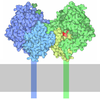

- Assembly
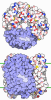
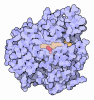
| Deposited unit | 
|
|---|---|
| 1 |
|
-Components
| #1: Protein | Mass: 40097.438 Da / Num. of mol.: 1 / Mutation: S47N, G204A, E246A, M249K, A326S, K54E Source method: isolated from a genetically manipulated source Source: (gene. exp.) Homo sapiens (human) / Gene: GNAO1 / Production host:  Trichoplusia ni (cabbage looper) Trichoplusia ni (cabbage looper)References: UniProt: P09471, Hydrolases; Acting on acid anhydrides; Acting on GTP to facilitate cellular and subcellular movement |
|---|---|
| #2: Protein | Mass: 39373.992 Da / Num. of mol.: 1 Source method: isolated from a genetically manipulated source Details: His-Gbeta-1 / Source: (gene. exp.) Rattus norvegicus (Norway rat) / Gene: GNB1 / Production host: Trichoplusia ni (cabbage looper) / References: UniProt: P54311 |
| #3: Protein | Mass: 7861.143 Da / Num. of mol.: 1 Source method: isolated from a genetically manipulated source Source: (gene. exp.) Homo sapiens (human) / Gene: GNG2 / Production host: Trichoplusia ni (cabbage looper) / References: UniProt: P59768 |
| #4: Protein | Mass: 74660.891 Da / Num. of mol.: 1 Source method: isolated from a genetically manipulated source Details: HASS-FLAG-eGFP-D3R,HASS-FLAG-eGFP-D3R Source: (gene. exp.) Aequorea victoria (jellyfish), (gene. exp.) Homo sapiens (human)Gene: GFP, DRD3 / Production host: Trichoplusia ni (cabbage looper) / References: UniProt: P42212, UniProt: P35462 |
| #5: Chemical | ChemComp-A1J83 / ~{ Mass: 463.572 Da / Num. of mol.: 1 / Source method: obtained synthetically / Formula: C26H33N5O3 / Feature type: SUBJECT OF INVESTIGATION |
| Has ligand of interest | Y |
| Has protein modification | Y |
-Experimental details
-Experiment
| Experiment | Method: ELECTRON MICROSCOPY |
|---|---|
| EM experiment | Aggregation state: PARTICLE / 3D reconstruction method: single particle reconstruction |
- Sample preparation
| Component | Name: Dopamine 3 Receptor:Go complex bound to bitopic AB13-46A Type: COMPLEX / Entity ID: #1-#4 / Source: RECOMBINANT |
|---|---|
| Source (natural) | Organism: Homo sapiens (human) |
| Source (recombinant) | Organism: Trichoplusia ni (cabbage looper) |
| Buffer solution | pH: 7.4 |
| Specimen | Conc.: 2.8 mg/ml / Embedding applied: NO / Shadowing applied: NO / Staining applied: NO / Vitrification applied: YES |
| Specimen support | Grid material: GOLD / Grid type: Quantifoil R1/1 |
| Vitrification | Instrument: FEI VITROBOT MARK IV / Cryogen name: ETHANE / Humidity: 100 % |
- Electron microscopy imaging
| Experimental equipment |  Model: Titan Krios / Image courtesy: FEI Company |
|---|---|
| Microscopy | Model: TFS KRIOS |
| Electron gun | Electron source:  FIELD EMISSION GUN / Accelerating voltage: 300 kV / Illumination mode: FLOOD BEAM FIELD EMISSION GUN / Accelerating voltage: 300 kV / Illumination mode: FLOOD BEAM |
| Electron lens | Mode: BRIGHT FIELD / Nominal defocus max: 3000 nm / Nominal defocus min: 1000 nm |
| Image recording | Electron dose: 52.3 e/Å2 / Film or detector model: GATAN K3 BIOCONTINUUM (6k x 4k) / Num. of real images: 13180 |
- Processing
| EM software |
| ||||||||||||||||||||||||||||||||
|---|---|---|---|---|---|---|---|---|---|---|---|---|---|---|---|---|---|---|---|---|---|---|---|---|---|---|---|---|---|---|---|---|---|
| CTF correction | Type: PHASE FLIPPING AND AMPLITUDE CORRECTION | ||||||||||||||||||||||||||||||||
| 3D reconstruction | Resolution: 3.47 Å / Resolution method: FSC 0.143 CUT-OFF / Num. of particles: 120394 / Symmetry type: POINT |
