 Movie
Movie Controller

[English] 日本語
 Yorodumi
- PDB-22rd: High-resolution cryo-EM structure of human Polo-like kinase 1 in ... -
+ Open data

- Basic information
| Entry | Database: PDB / ID: 22rd | |||||||||||||||||||||||||||
|---|---|---|---|---|---|---|---|---|---|---|---|---|---|---|---|---|---|---|---|---|---|---|---|---|---|---|---|---|
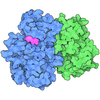
| Title | High-resolution cryo-EM structure of human Polo-like kinase 1 in complex with onvansertib | |||||||||||||||||||||||||||
 Components Components | Serine/threonine-protein kinase PLK1 | |||||||||||||||||||||||||||
 Keywords Keywords | TRANSFERASE / small protein-ligand complex | |||||||||||||||||||||||||||
| Function / homology |  Function and homology information Function and homology informationMitotic Telophase/Cytokinesis / regulation of protein localization to cell cortex / positive regulation of mitotic nuclear envelope disassembly / Mitotic Metaphase/Anaphase Transition / Activation of NIMA Kinases NEK9, NEK6, NEK7 / polo kinase / Phosphorylation of Emi1 / metaphase/anaphase transition of mitotic cell cycle / mitotic nuclear membrane disassembly / anaphase-promoting complex binding ...Mitotic Telophase/Cytokinesis / regulation of protein localization to cell cortex / positive regulation of mitotic nuclear envelope disassembly / Mitotic Metaphase/Anaphase Transition / Activation of NIMA Kinases NEK9, NEK6, NEK7 / polo kinase / Phosphorylation of Emi1 / metaphase/anaphase transition of mitotic cell cycle / mitotic nuclear membrane disassembly / anaphase-promoting complex binding / synaptonemal complex / Phosphorylation of the APC/C / Golgi inheritance / astral microtubule organization / mitotic cleavage furrow formation / outer kinetochore / microtubule bundle formation / mitotic chromosome condensation / regulation of mitotic spindle assembly / double-strand break repair via alternative nonhomologous end joining / Polo-like kinase mediated events / positive regulation of mitotic metaphase/anaphase transition / Golgi Cisternae Pericentriolar Stack Reorganization / centrosome cycle / positive regulation of ubiquitin-dependent protein catabolic process / sister chromatid cohesion / regulation of mitotic metaphase/anaphase transition / centriolar satellite / mitotic spindle assembly checkpoint signaling / mitotic spindle pole / regulation of mitotic cell cycle phase transition / spindle midzone / mitotic G2 DNA damage checkpoint signaling / regulation of anaphase-promoting complex-dependent catabolic process / mitotic sister chromatid segregation / mitotic cytokinesis / negative regulation of double-strand break repair via homologous recombination / Regulation of MITF-M-dependent genes involved in cell cycle and proliferation / Cyclin A/B1/B2 associated events during G2/M transition / protein localization to chromatin / Loss of Nlp from mitotic centrosomes / Loss of proteins required for interphase microtubule organization from the centrosome / Amplification of signal from unattached kinetochores via a MAD2 inhibitory signal / Recruitment of mitotic centrosome proteins and complexes / centriole / Recruitment of NuMA to mitotic centrosomes / Anchoring of the basal body to the plasma membrane / Mitotic Prometaphase / EML4 and NUDC in mitotic spindle formation / AURKA Activation by TPX2 / Resolution of Sister Chromatid Cohesion / mitotic spindle organization / regulation of mitotic cell cycle / regulation of cytokinesis / Condensation of Prophase Chromosomes / G2/M transition of mitotic cell cycle / establishment of protein localization / RHO GTPases Activate Formins / positive regulation of protein localization to nucleus / APC/C:Cdh1 mediated degradation of Cdc20 and other APC/C:Cdh1 targeted proteins in late mitosis/early G1 / kinetochore / spindle / double-strand break repair / microtubule cytoskeleton / The role of GTSE1 in G2/M progression after G2 checkpoint / Separation of Sister Chromatids / positive regulation of proteasomal ubiquitin-dependent protein catabolic process / mitotic cell cycle / Regulation of PLK1 Activity at G2/M Transition / spindle pole / midbody / microtubule binding / regulation of cell cycle / protein kinase activity / protein phosphorylation / protein serine kinase activity / protein serine/threonine kinase activity / centrosome / negative regulation of apoptotic process / protein kinase binding / chromatin / negative regulation of transcription by RNA polymerase II / magnesium ion binding / nucleoplasm / ATP binding / identical protein binding / nucleus / cytosol / cytoplasm Similarity search - Function | |||||||||||||||||||||||||||
| Biological species |  Homo sapiens (human) Homo sapiens (human) | |||||||||||||||||||||||||||
| Method | ELECTRON MICROSCOPY / single particle reconstruction / cryo EM / Resolution: 3.38 Å | |||||||||||||||||||||||||||
 Authors Authors | Park, K. / Yoo, Y. / Jeon, H. / Choi, K. / Kwon, E. / Lim, H. / Kim, D.Y. / No, K.T. | |||||||||||||||||||||||||||
| Funding support | 1items
| |||||||||||||||||||||||||||
 Citation Citation | Journal: Nat Commun / Year: 2026 Title: High-resolution cryo-EM structures of small protein-ligand complexes near the theoretical size limit. Authors: Kunwoong Park / Youngki Yoo / Hyunbum Jeon / Kiju Choi / Hanseong Kim / Eunju Kwon / Hyun-Ho Lim / Dong Young Kim / Kyoung Tai No /  Abstract: Cryo-electron microscopy (cryo-EM) is a widely used technique for determining macromolecular structures at near-atomic resolution. The theoretical lower limit of particle sizes suitable for cryo-EM ...Cryo-electron microscopy (cryo-EM) is a widely used technique for determining macromolecular structures at near-atomic resolution. The theoretical lower limit of particle sizes suitable for cryo-EM structural analysis is estimated to be 38 kDa; typical constraints involve factors such as image contrast and particle alignment accuracy. In this study, we present cryo-EM structures of two protein-ligand complexes near this lower size threshold. First, the structure of the maltose-binding protein complexed with maltose, with a structurally ordered mass of 40.8 kDa, was determined at a resolution of 2.4 Å; both the maltose and water molecules were clearly identified in this structure. The second structure was the kinase domain of human PLK1 complexed with onvansertib, with a structurally ordered mass of 31.6 kDa, below the theoretical 38 kDa limit; this domain was determined at a resolution of 3.4 Å using a gold-supported grid in the presence of β-octyl-glucoside. The density map clearly shows the backbone of PLK1 secondary structure, and the onvansertib. These results demonstrate that cryo-EM can be effectively employed to determine structures of small proteins or domains, and to perform structure-based drug screening for small proteins, without requiring structural fiducials for particle alignment. | |||||||||||||||||||||||||||
| History |
|
- Structure visualization
| Structure viewer | Molecule: MolmilJmol/JSmol |
|---|
- Downloads & links
-Download
| PDBx/mmCIF format | 22rd.cif.gz | 69.7 KB | Display | PDBx/mmCIF format |
|---|---|---|---|---|
| PDB format | pdb22rd.ent.gz | 47.8 KB | Display | PDB format |
| PDBx/mmJSON format | 22rd.json.gz | Tree view | PDBx/mmJSON format | |
| Others |  Other downloads Other downloads |
-Validation report
| Arichive directory | https://data.pdbj.org/pub/pdb/validation_reports/2r/22rdftp://data.pdbj.org/pub/pdb/validation_reports/2r/22rd | HTTPS FTP |
|---|
-Related structure data
| Related structure data |  68616MC  9xkoC M: map data used to model this data C: citing same article ( |
|---|---|
| Similar structure data |

-Links
 PDBj
PDBj
- Assembly
| Deposited unit | 
|
|---|---|
| 1 |
|
-Components
| #1: Protein | Mass: 37480.621 Da / Num. of mol.: 1 / Mutation: T210V Source method: isolated from a genetically manipulated source Source: (gene. exp.) Homo sapiens (human) / Gene: PLK1 / Production host:   Spodoptera frugiperda (fall armyworm) / References: UniProt: P53350 Spodoptera frugiperda (fall armyworm) / References: UniProt: P53350 |
|---|---|
| #2: Chemical | ChemComp-937 /   Mass: 532.518 Da / Num. of mol.: 1 / Source method: obtained synthetically / Formula: C24H27F3N8O3 / Feature type: SUBJECT OF INVESTIGATION Mass: 532.518 Da / Num. of mol.: 1 / Source method: obtained synthetically / Formula: C24H27F3N8O3 / Feature type: SUBJECT OF INVESTIGATION |
| Has ligand of interest | Y |
| Has protein modification | N |
-Experimental details
-Experiment
| Experiment | Method: ELECTRON MICROSCOPY |
|---|---|
| EM experiment | Aggregation state: PARTICLE / 3D reconstruction method: single particle reconstruction |
- Sample preparation
| Component | Name: High-resolution cryo-EM structure of human Polo-like kinase 1 in complex with onvansertib Type: COMPLEX / Entity ID: #1 / Source: RECOMBINANT |
|---|---|
| Molecular weight | Experimental value: NO |
| Source (natural) | Organism: Homo sapiens (human) |
| Source (recombinant) | Organism: Spodoptera frugiperda (fall armyworm) |
| Buffer solution | pH: 7.5 |
| Specimen | Embedding applied: NO / Shadowing applied: NO / Staining applied: NO / Vitrification applied: YES |
| Vitrification | Cryogen name: ETHANE / Humidity: 100 % |
- Electron microscopy imaging
| Experimental equipment |  Model: Titan Krios / Image courtesy: FEI Company |
|---|---|
| Microscopy | Model: TFS KRIOS |
| Electron gun | Electron source:  FIELD EMISSION GUN / Accelerating voltage: 300 kV / Illumination mode: FLOOD BEAM FIELD EMISSION GUN / Accelerating voltage: 300 kV / Illumination mode: FLOOD BEAM |
| Electron lens | Mode: BRIGHT FIELD / Nominal defocus max: 2000 nm / Nominal defocus min: 600 nm / Alignment procedure: ZEMLIN TABLEAU |
| Specimen holder | Cryogen: NITROGEN |
| Image recording | Electron dose: 60 e/Å2 / Film or detector model: FEI FALCON IV (4k x 4k) |
- Processing
| EM software |
| ||||||||||||||||||||||||
|---|---|---|---|---|---|---|---|---|---|---|---|---|---|---|---|---|---|---|---|---|---|---|---|---|---|
| CTF correction | Type: PHASE FLIPPING ONLY | ||||||||||||||||||||||||
| Particle selection | Num. of particles selected: 6021153 | ||||||||||||||||||||||||
| 3D reconstruction | Resolution: 3.38 Å / Resolution method: FSC 0.143 CUT-OFF / Num. of particles: 200803 / Symmetry type: POINT | ||||||||||||||||||||||||
| Atomic model building | Protocol: FLEXIBLE FIT | ||||||||||||||||||||||||
| Atomic model building | PDB-ID: 2yac Accession code: 2yac / Source name: PDB / Type: experimental model | ||||||||||||||||||||||||
| Refinement | Highest resolution: 3.38 Å Stereochemistry target values: REAL-SPACE (WEIGHTED MAP SUM AT ATOM CENTERS) | ||||||||||||||||||||||||
| Refine LS restraints |
|

