 Movie
Movie Controller


+ Open data

- Basic information
| Entry | Database: PDB / ID: 22kk | |||||||||
|---|---|---|---|---|---|---|---|---|---|---|
| Title | Cryo-EM structure of the BTNL3-BTNL8-TCR complex | |||||||||
 Components Components |
| |||||||||
 Keywords Keywords | IMMUNE SYSTEM / Cryo-EM / immune | |||||||||
| Function / homology |  Function and homology information Function and homology informationextrathymic T cell selection / Butyrophilin (BTN) family interactions / regulation of cytokine production / T cell receptor signaling pathway / adaptive immune response / external side of plasma membrane / signaling receptor binding / plasma membrane Similarity search - Function | |||||||||
| Biological species |  Homo sapiens (human) Homo sapiens (human) | |||||||||
| Method | ELECTRON MICROSCOPY / single particle reconstruction / cryo EM / Resolution: 3.1 Å | |||||||||
 Authors Authors | Dong, D. / Zhu, Y. / Huang, Z. | |||||||||
| Funding support |  China, 1items China, 1items
| |||||||||
 Citation Citation | Journal: Immunity / Year: 2026 Title: Butyrophilin-like 3 and 8 tetramers clamp Vγ4Vδ1 T cell receptors for antigen-independent activation. Authors: De Dong / Huiling Li / Yuwei Zhu / Zebin Lu / Junliang Zhu / Xinyu Tian / Zhiwei Huang / Abstract: BTNL3 and BTNL8, butyrophilin-like (BTNL) family receptors, are predominantly expressed on intestinal epithelial cells. The BTNL3-BTNL8 complex selectively activates human Vγ4⁺ T cells, which play ...BTNL3 and BTNL8, butyrophilin-like (BTNL) family receptors, are predominantly expressed on intestinal epithelial cells. The BTNL3-BTNL8 complex selectively activates human Vγ4⁺ T cells, which play critical roles in intestinal immune homeostasis and tissue damage repair. Here, we report the structure of the BTNL3-BTNL8-Vγ4Vδ1 T cell receptor (TCR) complex. The structure reveals that BTNL3-BTNL8 forms an antigen-independent tetramer, in contrast to the phosphoantigen-driven association of BTN2A1-BTN3A1. Two BTNL3-BTNL8 heterodimers clamp a head-to-head TCR homodimer to form a 2:2:2 BTNL3:BTNL8:Vγ4Vδ1 TCR complex, with the Vγ4 HV4 and CDR2 loops jointly engaging BTNL3. Structural alignment indicates that the CD1d binding site on TCR overlaps spatially with one monomer within a TCR dimer, suggesting that TCR dimerization sterically precludes simultaneous engagement of CD1d molecules. Together, our results elucidate the structural mechanism of BTNL3-BTNL8-mediated engagement and activation of Vγ4Vδ1 TCR, offering insights into γδ TCR signaling initiation. | |||||||||
| History |
|
- Structure visualization
| Structure viewer | Molecule: MolmilJmol/JSmol |
|---|
- Downloads & links
-Download
| PDBx/mmCIF format | 22kk.cif.gz | 521.9 KB | Display | PDBx/mmCIF format |
|---|---|---|---|---|
| PDB format | pdb22kk.ent.gz | 424.3 KB | Display | PDB format |
| PDBx/mmJSON format | 22kk.json.gz | Tree view | PDBx/mmJSON format | |
| Others |  Other downloads Other downloads |
-Validation report
| Arichive directory | https://data.pdbj.org/pub/pdb/validation_reports/2k/22kkftp://data.pdbj.org/pub/pdb/validation_reports/2k/22kk | HTTPS FTP |
|---|
-Related structure data
| Related structure data |  68398MC M: map data used to model this data C: citing same article ( |
|---|---|
| Similar structure data |
-Links
 PDBj
PDBj
- Assembly
| Deposited unit | 
|
|---|---|
| 1 |
|
-Components
| #1: Protein | Mass: 52305.293 Da / Num. of mol.: 2 Source method: isolated from a genetically manipulated source Source: (gene. exp.) Homo sapiens (human) / Gene: BTNL3, BTNLR, COLF4100, UNQ744/PRO1472 / Production host: Homo sapiens (human) / References: UniProt: Q6UXE8#2: Protein | Mass: 56819.516 Da / Num. of mol.: 2 Source method: isolated from a genetically manipulated source Source: (gene. exp.) Homo sapiens (human) / Gene: BTNL8, UNQ702/PRO1347 / Production host: Homo sapiens (human) / References: UniProt: Q6UX41#3: Protein | Mass: 32590.609 Da / Num. of mol.: 2 Source method: isolated from a genetically manipulated source Source: (gene. exp.) Homo sapiens (human) / Production host: Homo sapiens (human)#4: Protein | Mass: 36531.496 Da / Num. of mol.: 2 Source method: isolated from a genetically manipulated source Source: (gene. exp.) Homo sapiens (human) / Production host: Homo sapiens (human)Has protein modification | Y | |
|---|
-Experimental details
-Experiment
| Experiment | Method: ELECTRON MICROSCOPY |
|---|---|
| EM experiment | Aggregation state: PARTICLE / 3D reconstruction method: single particle reconstruction |
- Sample preparation
| Component | Name: BTNL3-BTNL8-TCR / Type: COMPLEX / Entity ID: all / Source: RECOMBINANT |
|---|---|
| Source (natural) | Organism: Homo sapiens (human) |
| Source (recombinant) | Organism: Homo sapiens (human) |
| Buffer solution | pH: 7 |
| Specimen | Embedding applied: NO / Shadowing applied: NO / Staining applied: NO / Vitrification applied: YES |
| Vitrification | Cryogen name: NITROGEN |
- Electron microscopy imaging
| Experimental equipment | 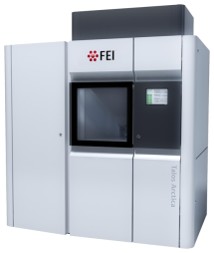 Model: Talos Arctica / Image courtesy: FEI Company |
|---|---|
| Microscopy | Model: FEI TALOS ARCTICA |
| Electron gun | Electron source:  FIELD EMISSION GUN / Accelerating voltage: 300 kV / Illumination mode: FLOOD BEAM FIELD EMISSION GUN / Accelerating voltage: 300 kV / Illumination mode: FLOOD BEAM |
| Electron lens | Mode: BRIGHT FIELD / Nominal defocus max: 2500 nm / Nominal defocus min: 1200 nm |
| Image recording | Electron dose: 50 e/Å2 / Film or detector model: FEI FALCON III (4k x 4k) |
- Processing
| EM software |
| ||||||||||||||||||||||||
|---|---|---|---|---|---|---|---|---|---|---|---|---|---|---|---|---|---|---|---|---|---|---|---|---|---|
| CTF correction | Type: PHASE FLIPPING AND AMPLITUDE CORRECTION | ||||||||||||||||||||||||
| 3D reconstruction | Resolution: 3.1 Å / Resolution method: FSC 0.143 CUT-OFF / Num. of particles: 548003 / Symmetry type: POINT | ||||||||||||||||||||||||
| Refinement | Highest resolution: 3.1 Å Stereochemistry target values: REAL-SPACE (WEIGHTED MAP SUM AT ATOM CENTERS) | ||||||||||||||||||||||||
| Refine LS restraints |
|
