 Movie
Movie Controller

[English] 日本語
 Yorodumi
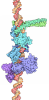
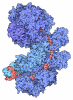
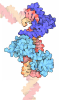
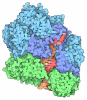
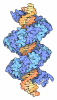
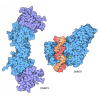
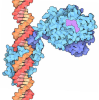
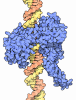
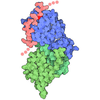
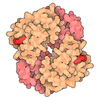
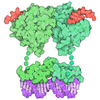
- PDB-21me: Cryo-EM structure of heterotypic CENP-A/H3 nucleosome isolated fr... -
+ Open data

- Basic information
| Entry | Database: PDB / ID: 21me | |||||||||||||||||||||||||||||||||||||||
|---|---|---|---|---|---|---|---|---|---|---|---|---|---|---|---|---|---|---|---|---|---|---|---|---|---|---|---|---|---|---|---|---|---|---|---|---|---|---|---|---|
| Title | Cryo-EM structure of heterotypic CENP-A/H3 nucleosome isolated from human cells | |||||||||||||||||||||||||||||||||||||||
 Components Components |
| |||||||||||||||||||||||||||||||||||||||
 Keywords Keywords | NUCLEAR PROTEIN / chromatin / mitosis / centromere | |||||||||||||||||||||||||||||||||||||||
| Function / homology |  Function and homology information Function and homology informationprotein localization to chromosome, centromeric region / CENP-A containing chromatin assembly / condensed chromosome, centromeric region / kinetochore assembly / mitotic cytokinesis / chromosome, centromeric region / mitotic metaphase chromosome alignment / negative regulation of tumor necrosis factor-mediated signaling pathway / pericentric heterochromatin / negative regulation of megakaryocyte differentiation ...protein localization to chromosome, centromeric region / CENP-A containing chromatin assembly / condensed chromosome, centromeric region / kinetochore assembly / mitotic cytokinesis / chromosome, centromeric region / mitotic metaphase chromosome alignment / negative regulation of tumor necrosis factor-mediated signaling pathway / pericentric heterochromatin / negative regulation of megakaryocyte differentiation / protein localization to CENP-A containing chromatin / Chromatin modifying enzymes / Replacement of protamines by nucleosomes in the male pronucleus / CENP-A containing nucleosome / Amplification of signal from unattached kinetochores via a MAD2 inhibitory signal / Packaging Of Telomere Ends / Mitotic Prometaphase / Recognition and association of DNA glycosylase with site containing an affected purine / Cleavage of the damaged purine / EML4 and NUDC in mitotic spindle formation / telomere organization / Interleukin-7 signaling / ChAHP complex assembly / Deposition of new CENPA-containing nucleosomes at the centromere / Recognition and association of DNA glycosylase with site containing an affected pyrimidine / Cleavage of the damaged pyrimidine / RNA Polymerase I Promoter Opening / Resolution of Sister Chromatid Cohesion / Inhibition of DNA recombination at telomere / Assembly of the ORC complex at the origin of replication / FXIIa activates plasma kallikrein-kinin system / SUMOylation of chromatin organization proteins / Regulation of endogenous retroelements by the Human Silencing Hub (HUSH) complex / Meiotic synapsis / DNA methylation / Condensation of Prophase Chromosomes / Chromatin modifications during the maternal to zygotic transition (MZT) / HCMV Late Events / SIRT1 negatively regulates rRNA expression / ERCC6 (CSB) and EHMT2 (G9a) positively regulate rRNA expression / PRC2 methylates histones and DNA / NuRD complex assembly / Regulation of endogenous retroelements by KRAB-ZFP proteins / Interaction of NuRD complexes with transcription factors / Defective pyroptosis / establishment of mitotic spindle orientation / HDACs deacetylate histones / CHD1 and CHD2 subfamily / Transcriptional regulation by small RNAs / lipopolysaccharide binding / Regulation of endogenous retroelements by Piwi-interacting RNAs (piRNAs) / RNA Polymerase I Promoter Escape / Nonhomologous End-Joining (NHEJ) / epigenetic regulation of gene expression / RHO GTPases Activate Formins / CHD6, CHD7, CHD8, CHD9 subfamily / HDMs demethylate histones / Activated PKN1 stimulates transcription of AR (androgen receptor) regulated genes KLK2 and KLK3 / RUNX1 regulates genes involved in megakaryocyte differentiation and platelet function / Negative Regulation of CDH1 Gene Transcription / NoRC negatively regulates rRNA expression / PKMTs methylate histone lysines / G2/M DNA damage checkpoint / Formation of the beta-catenin:TCF transactivating complex / B-WICH complex positively regulates rRNA expression / DNA Damage/Telomere Stress Induced Senescence / kinetochore / Meiotic recombination / Pre-NOTCH Transcription and Translation / Activation of anterior HOX genes in hindbrain development during early embryogenesis / Transcriptional regulation of granulopoiesis / RMTs methylate histone arginines / HCMV Early Events / Metalloprotease DUBs / nucleosomal DNA binding / innate immune response in mucosa / Separation of Sister Chromatids / structural constituent of chromatin / nucleosome assembly / Regulation of PD-L1(CD274) transcription / UCH proteinases / nucleosome / HATs acetylate histones / E3 ubiquitin ligases ubiquitinate target proteins / killing of cells of another organism / Recruitment and ATM-mediated phosphorylation of repair and signaling proteins at DNA double strand breaks / Factors involved in megakaryocyte development and platelet production / MLL4 and MLL3 complexes regulate expression of PPARG target genes in adipogenesis and hepatic steatosis / RUNX1 regulates transcription of genes involved in differentiation of HSCs / chromatin organization / Processing of DNA double-strand break ends / Dengue Virus-Host Interactions / antimicrobial humoral immune response mediated by antimicrobial peptide / Senescence-Associated Secretory Phenotype (SASP) / heterochromatin formation / defense response to Gram-negative bacterium / Oxidative Stress Induced Senescence / antibacterial humoral response / Estrogen-dependent gene expression / chromosome, telomeric region Similarity search - Function | |||||||||||||||||||||||||||||||||||||||
| Biological species |  Homo sapiens (human) Homo sapiens (human) | |||||||||||||||||||||||||||||||||||||||
| Method | ELECTRON MICROSCOPY / single particle reconstruction / cryo EM / Resolution: 3.58 Å | |||||||||||||||||||||||||||||||||||||||
 Authors Authors | Tanida, E. / Hatazawa, S. / Oishi, T. / Kobayashi, Y. / Ogasawara, M. / Jaskiewicz, M.A. / Takizawa, Y. / Kurumizaka, H. | |||||||||||||||||||||||||||||||||||||||
| Funding support |  Japan, 12items Japan, 12items
| |||||||||||||||||||||||||||||||||||||||
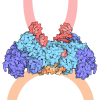
 Citation Citation | Journal: Commun Biol / Year: 2026 Title: Cryo-EM structures of CENP-A nucleosomes isolated from human cells. Authors: Eisho Tanida / Suguru Hatazawa / Takumi Oishi / Yuki Kobayashi / Mitsuo Ogasawara / Marta A Jaskiewicz / Akihito Harada / Takeru Fujii / Yasuyuki Ohkawa / Yoshimasa Takizawa / Hitoshi Kurumizaka / Abstract: Centromeres ensure accurate chromosome segregation, and their identity is specified epigenetically by the histone H3 variant CENP-A. Although the structures of reconstituted CENP-A nucleosomes have ...Centromeres ensure accurate chromosome segregation, and their identity is specified epigenetically by the histone H3 variant CENP-A. Although the structures of reconstituted CENP-A nucleosomes have provided important insights, how this epigenetic mark is structurally organized within native chromatin remains incompletely understood. Here, we combine cryogenic electron microscopy with chromatin immunoprecipitation (ChIP-CryoEM) to determine the structures of human CENP-A nucleosomes isolated directly from cells without crosslinking or stabilizing agents. We resolved two distinct cellular CENP-A nucleosome structures: a homotypic CENP-A nucleosome and a heterotypic CENP-A/H3 nucleosome, which have been proposed to represent centromeric and ectopic nucleosomes, respectively. Both cellular CENP-A nucleosomes assemble as histone octamers and wrap DNA in a left-handed superhelix, supporting an octameric model proposed for native CENP-A chromatin. In addition, the hallmark CENP-A-specific structural features previously characterized in vitro, including the shortened CENP-A N-terminal α-helix and the distinctive RG loop, are preserved in cellular CENP-A nucleosomes. These findings define the structural organization of CENP-A nucleosomes in cellular chromatin. | |||||||||||||||||||||||||||||||||||||||
| History |
|
- Structure visualization
| Structure viewer | Molecule: MolmilJmol/JSmol |
|---|
- Downloads & links
-Download
| PDBx/mmCIF format | 21me.cif.gz | 342.5 KB | Display | PDBx/mmCIF format |
|---|---|---|---|---|
| PDB format | pdb21me.ent.gz | 281.7 KB | Display | PDB format |
| PDBx/mmJSON format | 21me.json.gz | Tree view | PDBx/mmJSON format | |
| Others |  Other downloads Other downloads |
-Validation report
| Arichive directory | https://data.pdbj.org/pub/pdb/validation_reports/1m/21meftp://data.pdbj.org/pub/pdb/validation_reports/1m/21me | HTTPS FTP |
|---|
-Related structure data
| Related structure data |  67819MC  21mdC C: citing same article ( M: map data used to model this data |
|---|---|
| Similar structure data |

-Links
 PDBj
PDBj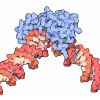
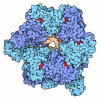
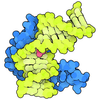
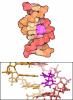
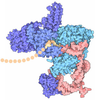
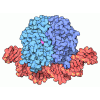
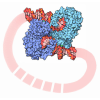
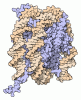

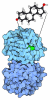
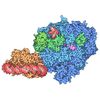
- Assembly
| Deposited unit | 
|
|---|---|
| 1 |
|
-Components
-Protein , 5 types, 8 molecules ABFCGDHE
| #1: Protein | Mass: 18639.531 Da / Num. of mol.: 1 Source method: isolated from a genetically manipulated source Source: (gene. exp.) Homo sapiens (human) / Gene: CENPA / Cell line (production host): Expi293 / Production host: Homo sapiens (human) / References: UniProt: P49450 | ||||||
|---|---|---|---|---|---|---|---|
| #2: Protein | Mass: 11394.426 Da / Num. of mol.: 2 / Source method: isolated from a natural source / Source: (natural) Homo sapiens (human) / References: UniProt: P62805#3: Protein | Mass: 14165.551 Da / Num. of mol.: 2 / Source method: isolated from a natural source / Source: (natural) Homo sapiens (human) / References: UniProt: P04908#4: Protein | Mass: 13935.239 Da / Num. of mol.: 2 / Source method: isolated from a natural source / Source: (natural) Homo sapiens (human) / References: UniProt: P06899#5: Protein | | Mass: 15437.167 Da / Num. of mol.: 1 / Source method: isolated from a natural source / Source: (natural) Homo sapiens (human) / References: UniProt: P68431 |
-DNA chain , 1 types, 2 molecules IJ
| #6: DNA chain | Mass: 21746.656 Da / Num. of mol.: 2 / Source method: isolated from a natural source / Source: (natural) Homo sapiens (human) |
|---|
-Details
| Has ligand of interest | Y |
|---|---|
| Has protein modification | N |
-Experimental details
-Experiment
| Experiment | Method: ELECTRON MICROSCOPY |
|---|---|
| EM experiment | Aggregation state: PARTICLE / 3D reconstruction method: single particle reconstruction |
- Sample preparation
| Component |
| ||||||||||||||||||||||||
|---|---|---|---|---|---|---|---|---|---|---|---|---|---|---|---|---|---|---|---|---|---|---|---|---|---|
| Molecular weight | Experimental value: NO | ||||||||||||||||||||||||
| Source (natural) | Organism: Homo sapiens (human) | ||||||||||||||||||||||||
| Source (recombinant) | Organism: Homo sapiens (human) | ||||||||||||||||||||||||
| Buffer solution | pH: 7.5 | ||||||||||||||||||||||||
| Specimen | Embedding applied: NO / Shadowing applied: NO / Staining applied: NO / Vitrification applied: YES | ||||||||||||||||||||||||
| Vitrification | Cryogen name: ETHANE |
- Electron microscopy imaging
| Experimental equipment |  Model: Titan Krios / Image courtesy: FEI Company |
|---|---|
| Microscopy | Model: TFS KRIOS |
| Electron gun | Electron source:  FIELD EMISSION GUN / Accelerating voltage: 300 kV / Illumination mode: FLOOD BEAM FIELD EMISSION GUN / Accelerating voltage: 300 kV / Illumination mode: FLOOD BEAM |
| Electron lens | Mode: BRIGHT FIELD / Nominal defocus max: 2250 nm / Nominal defocus min: 1250 nm |
| Image recording | Electron dose: 60.7 e/Å2 / Film or detector model: GATAN K3 BIOQUANTUM (6k x 4k) |
- Processing
| EM software |
| ||||||||||||
|---|---|---|---|---|---|---|---|---|---|---|---|---|---|
| CTF correction | Type: PHASE FLIPPING AND AMPLITUDE CORRECTION | ||||||||||||
| 3D reconstruction | Resolution: 3.58 Å / Resolution method: FSC 0.143 CUT-OFF / Num. of particles: 48170 / Symmetry type: POINT |
