National Institutes of Health/National Institute of General Medical Sciences (NIH/NIGMS)
R00GM132496
United States
National Institutes of Health/National Institute of General Medical Sciences (NIH/NIGMS)
R35GM156786
United States
Citation
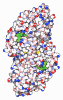
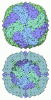
Journal: bioRxiv / Year: 2026 Title: Hsp10: From Single to Double Rings-Structural Basis of Protein Homeostasis. Authors: Abigail Page / Wyatt Hendricks / Aranea Dunckley / Marielle A Wälti Abstract: The human chaperone complex Hsp60/Hsp10 is essential for maintaining cellular proteostasis by preventing protein misfolding and aggregation. Disruption of these processes contributes to ...The human chaperone complex Hsp60/Hsp10 is essential for maintaining cellular proteostasis by preventing protein misfolding and aggregation. Disruption of these processes contributes to neurodegenerative diseases, while overexpression of Hsp60 and Hsp10 is associated with various cancers. Understanding their molecular mechanisms is therefore of fundamental importance. Unlike its bacterial homolog GroEL, human Hsp60 adopts multiple oligomeric states, with both heptameric and tetradecameric forms binding Hsp10 to form a folding cavity for substrate refolding. Here, we determine the cryo-EM structure of apo Hsp10 and find that, in addition to its single-ring form, it also assembles into a compact double-ring state. This reveals that Hsp10, like Hsp60, exhibits structural behavior that differs markedly from its bacterial counterpart. Traditionally viewed as a passive cofactor assisting Hsp60, we show that Hsp10 alone possesses intrinsic chaperone activity: it supports folding of natural substrates such as malate dehydrogenase 1 and manganese superoxide dismutase. NMR analysis further shows that substrate binding occurs primarily at the core of Hsp10 rather than at the loops. Our findings suggest that Hsp10 exists in equilibrium between single- and double-ring complexes in the unbound state, and upon binding as a single-ring complex, it actively guides substrates into the folding chamber.
History
Deposition
May 11, 2026
Deposition site: RCSB / Processing site: RCSB
Revision 1.0
Jul 15, 2026
Provider: repository / Type: Initial release
Revision 1.0
Jul 15, 2026
Data content type: EM metadata / Data content type: EM metadata / Provider: repository / Type: Initial release
Revision 1.0
Jul 15, 2026
Data content type: FSC / Data content type: FSC / Provider: repository / Type: Initial release
Revision 1.0
Jul 15, 2026
Data content type: Half map / Part number: 1 / Data content type: Half map / Provider: repository / Type: Initial release
Revision 1.0
Jul 15, 2026
Data content type: Half map / Part number: 2 / Data content type: Half map / Provider: repository / Type: Initial release
Revision 1.0
Jul 15, 2026
Data content type: Image / Data content type: Image / Provider: repository / Type: Initial release
Revision 1.0
Jul 15, 2026
Data content type: Primary map / Data content type: Primary map / Provider: repository / Type: Initial release
In the structure databanks used in Yorodumi, some data are registered as the other names, "COVID-19 virus" and "2019-nCoV". Here are the details of the virus and the list of structure data.
Jan 31, 2019. EMDB accession codes are about to change! (news from PDBe EMDB page)
EMDB accession codes are about to change! (news from PDBe EMDB page)
The allocation of 4 digits for EMDB accession codes will soon come to an end. Whilst these codes will remain in use, new EMDB accession codes will include an additional digit and will expand incrementally as the available range of codes is exhausted. The current 4-digit format prefixed with “EMD-” (i.e. EMD-XXXX) will advance to a 5-digit format (i.e. EMD-XXXXX), and so on. It is currently estimated that the 4-digit codes will be depleted around Spring 2019, at which point the 5-digit format will come into force.
The EM Navigator/Yorodumi systems omit the EMD- prefix.
Related info.:Q: What is EMD? / ID/Accession-code notation in Yorodumi/EM Navigator
Yorodumi is a browser for structure data from EMDB, PDB, SASBDB, etc.
This page is also the successor to EM Navigator detail page, and also detail information page/front-end page for Omokage search.
The word "yorodu" (or yorozu) is an old Japanese word meaning "ten thousand". "mi" (miru) is to see.
Related info.:EMDB / PDB / SASBDB / Comparison of 3 databanks / Yorodumi Search / Aug 31, 2016. New EM Navigator & Yorodumi / Yorodumi Papers / Jmol/JSmol / Function and homology information / Changes in new EM Navigator and Yorodumi
 Movie
Movie Controller


 Open data
 Basic information
 Components
 Keywords
 Function and homology information
 Homo sapiens (human)
 Authors
 United States, 2items
  Citation
 Structure visualization
 Downloads & links
 Other downloads


 PDBj
PDBj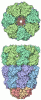
 Assembly

 Escherichia coli (E. coli) / References: UniProt: P61604
 Sample preparation
 Electron microscopy imaging
 FIELD EMISSION GUN / Accelerating voltage: 300 kV / Illumination mode: OTHER
 Processing