 Movie
Movie Controller

[English] 日本語
 Yorodumi
- PDB-10dk: Structure of an adenovirus hexon with Zwitterionic insertion in HVR5 -
+ Open data

- Basic information
| Entry | Database: PDB / ID: 10dk | ||||||||||||||||||||||||
|---|---|---|---|---|---|---|---|---|---|---|---|---|---|---|---|---|---|---|---|---|---|---|---|---|---|
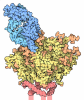
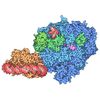
| Title | Structure of an adenovirus hexon with Zwitterionic insertion in HVR5 | ||||||||||||||||||||||||
 Components Components | Hexon protein | ||||||||||||||||||||||||
 Keywords Keywords | VIRAL PROTEIN / Viral vectors / capsid engineering / zwitterionic peptides / adenoviruses / immune stealth / blood factors / neutralizing antibodies / cryo-EM / VIRUS | ||||||||||||||||||||||||
| Function / homology |  Function and homology information Function and homology informationT=25 icosahedral viral capsid / microtubule-dependent intracellular transport of viral material towards nucleus / host cell / symbiont entry into host cell / host cell nucleus / structural molecule activity / metal ion binding Similarity search - Function | ||||||||||||||||||||||||
| Biological species |  Human adenovirus 57 Human adenovirus 57 | ||||||||||||||||||||||||
| Method | ELECTRON MICROSCOPY / single particle reconstruction / cryo EM / Resolution: 3.22 Å | ||||||||||||||||||||||||
 Authors Authors | Reddy, V.S. / Ma, O.X. | ||||||||||||||||||||||||
| Funding support | 1items
| ||||||||||||||||||||||||
 Citation Citation | Journal: Mol Ther Adv / Year: 2026 Title: Immune shielding of viral vectors via capsid engineering with genetically encoded zwitterionic peptides. Authors: Shao-Chia Lu / Olivia X Ma / Alex A Anwar / Dimitrije Ratkov / Janarjan Bhandari / Daniel J Montiel-Garcia / Michael J Hansen / Mary E Barry / Vijay S Reddy / Michael A Barry /  Abstract: Pre-existing neutralizing antibodies (NAbs) and blood proteins can rapidly inactivate therapeutic viral vectors and trigger immune toxicities in patients. To overcome these challenges, we engineered ...Pre-existing neutralizing antibodies (NAbs) and blood proteins can rapidly inactivate therapeutic viral vectors and trigger immune toxicities in patients. To overcome these challenges, we engineered the surfaces of adenovirus (Ad) by incorporating genetically encoded "protective shields" to reduce the recognition by host factors. AlphaFold3 modeling showed that inserting a structured biotin acceptor peptide (BAP) into hypervariable region 5 (HVR5) of the viral capsid protein hexon produced a rigid surface protrusion, whereas inserting a disordered, zwitterionic glutamic acid-lysine (EK) peptide formed a flexible canopy over the hexon. Although inserting EK peptides into the capsid impaired viral entry and intracellular trafficking that led to reduced viral transduction and , this modification decreased binding by coagulation factor X (FX) and complement C3. Importantly, the EK peptide-modified Ad also evaded polyclonal anti-Ad NAbs without the need to change all HVRs. The shielding efficiency of EK peptides was affected by their composition and length. Cryoelectron microscopy (cryo-EM) and neutralization assays further revealed that NAbs primarily target HVR1, a region potentially masked by EK peptides inserted in HVR5. These findings demonstrate an alternative capsid engineering approach using genetically encoded peptides to enhance immune stealth of viral vectors. | ||||||||||||||||||||||||
| History |
|
- Structure visualization
| Structure viewer | Molecule: MolmilJmol/JSmol |
|---|
- Downloads & links
-Download
| PDBx/mmCIF format | 10dk.cif.gz | 539.1 KB | Display | PDBx/mmCIF format |
|---|---|---|---|---|
| PDB format | pdb10dk.ent.gz | 428.6 KB | Display | PDB format |
| PDBx/mmJSON format | 10dk.json.gz | Tree view | PDBx/mmJSON format | |
| Others |  Other downloads Other downloads |
-Validation report
| Arichive directory | https://data.pdbj.org/pub/pdb/validation_reports/0d/10dkftp://data.pdbj.org/pub/pdb/validation_reports/0d/10dk | HTTPS FTP |
|---|
-Related structure data
| Related structure data |  75090MC  10buC  10dpC M: map data used to model this data C: citing same article ( |
|---|---|
| Similar structure data |


-Links
 PDBj
PDBj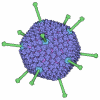
- Assembly
| Deposited unit | 
|
|---|---|
| 1 |
|
-Components
| #1: Protein | Mass: 104375.398 Da / Num. of mol.: 3 Source method: isolated from a genetically manipulated source Source: (gene. exp.) Human adenovirus 57 / Gene: L3 / Production host: Human adenovirus 57 / References: UniProt: A0A348FV85Has protein modification | N | |
|---|
-Experimental details
-Experiment
| Experiment | Method: ELECTRON MICROSCOPY |
|---|---|
| EM experiment | Aggregation state: PARTICLE / 3D reconstruction method: single particle reconstruction |
- Sample preparation
| Component | Name: Human adenovirus 57 / Type: COMPLEX / Entity ID: all / Source: RECOMBINANT |
|---|---|
| Molecular weight | Value: 150 MDa / Experimental value: NO |
| Source (natural) | Organism: Human adenovirus 57 |
| Source (recombinant) | Organism: Human adenovirus 57 |
| Details of virus | Empty: NO / Enveloped: NO / Isolate: SPECIES / Type: VIRION |
| Natural host | Organism: Homo |
| Virus shell | Name: Adenovirus / Diameter: 1000 nm / Triangulation number (T number): 25 |
| Buffer solution | pH: 7.2 / Details: 20mM HEPES pH 7.2 300 mM NaCl |
| Buffer component | Conc.: 20 mM / Name: HEPES |
| Specimen | Conc.: 2 mg/ml / Embedding applied: NO / Shadowing applied: NO / Staining applied: NO / Vitrification applied: YES |
| Specimen support | Grid material: COPPER / Grid mesh size: 300 divisions/in. / Grid type: Quantifoil R1.2/1.3 |
| Vitrification | Instrument: FEI VITROBOT MARK IV / Cryogen name: ETHANE / Humidity: 95 % / Chamber temperature: 277 K |
- Electron microscopy imaging
| Experimental equipment |  Model: Titan Krios / Image courtesy: FEI Company |
|---|---|
| Microscopy | Model: TFS KRIOS |
| Electron gun | Electron source:  FIELD EMISSION GUN / Accelerating voltage: 300 kV / Illumination mode: FLOOD BEAM FIELD EMISSION GUN / Accelerating voltage: 300 kV / Illumination mode: FLOOD BEAM |
| Electron lens | Mode: BRIGHT FIELD / Nominal magnification: 81000 X / Nominal defocus max: 3000 nm / Nominal defocus min: 800 nm / Calibrated defocus min: 1000 nm / Calibrated defocus max: 2000 nm / Cs: 2.7 mm / C2 aperture diameter: 100 µm / Alignment procedure: COMA FREE |
| Specimen holder | Cryogen: NITROGEN / Specimen holder model: FEI TITAN KRIOS AUTOGRID HOLDER / Temperature (max): 80 K / Temperature (min): 75 K |
| Image recording | Average exposure time: 20 sec. / Electron dose: 51 e/Å2 / Film or detector model: GATAN K3 BIOCONTINUUM (6k x 4k) / Num. of grids imaged: 3 / Num. of real images: 6168 |
- Processing
| EM software |
| ||||||||||||||||||||||||||||||||||||||||
|---|---|---|---|---|---|---|---|---|---|---|---|---|---|---|---|---|---|---|---|---|---|---|---|---|---|---|---|---|---|---|---|---|---|---|---|---|---|---|---|---|---|
| CTF correction | Type: PHASE FLIPPING AND AMPLITUDE CORRECTION | ||||||||||||||||||||||||||||||||||||||||
| Particle selection | Num. of particles selected: 55238 | ||||||||||||||||||||||||||||||||||||||||
| 3D reconstruction | Resolution: 3.22 Å / Resolution method: FSC 0.143 CUT-OFF / Num. of particles: 1780537 / Symmetry type: POINT | ||||||||||||||||||||||||||||||||||||||||
| Atomic model building | Protocol: RIGID BODY FIT / Target criteria: Cross-correlation | ||||||||||||||||||||||||||||||||||||||||
| Atomic model building | Source name: AlphaFold / Type: in silico model | ||||||||||||||||||||||||||||||||||||||||
| Refinement | Stereochemistry target values: REAL-SPACE (WEIGHTED MAP SUM AT ATOM CENTERS) | ||||||||||||||||||||||||||||||||||||||||
| Refine LS restraints |
|
