- EMDB-76233: Structure of the Porcine deltacoronavirus (PDCoV) receptor-bindin... -
+
Open data
ID or keywords:
Loading...
-
Basic information
Entry
Database: EMDB / ID: EMD-76233
Title
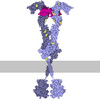
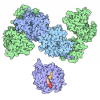
Structure of the Porcine deltacoronavirus (PDCoV) receptor-binding domain bound to the RBD minibinder 11, the PD3 Fab, and the Kappa light chain nanobody
Map data
Unsharpened map
Sample
Complex: Complex of the PDCoV RBD, the RBD minibinder 11, the PD3 Fab, and the kappa light chain nanobody
Protein or peptide: PDCoV IL121_2014 receptor binding domain
Protein or peptide: RBD minibinder 11
Protein or peptide: PD3 Fab fragment heavy chain
Protein or peptide: PD3 Fab fragment light chain
Protein or peptide: Kappa light chain nanobody
Ligand: water
Keywords
porcine deltacoronavirus / minibinder / protein design / Structural Genomics / Seattle Structural Genomics Center for Infectious Disease / SSGCID / VIRAL PROTEIN
Function / homology
Function and homology information
negative regulation of collateral sprouting / negative regulation of dendritic spine development / synaptic membrane adhesion / negative regulation of axon extension / negative regulation of axon regeneration / heparan sulfate proteoglycan binding / peptidyl-tyrosine dephosphorylation / protein-tyrosine-phosphatase / protein tyrosine phosphatase activity / postsynaptic density membrane ...negative regulation of collateral sprouting / negative regulation of dendritic spine development / synaptic membrane adhesion / negative regulation of axon extension / negative regulation of axon regeneration / heparan sulfate proteoglycan binding / peptidyl-tyrosine dephosphorylation / protein-tyrosine-phosphatase / protein tyrosine phosphatase activity / postsynaptic density membrane / synaptic vesicle membrane / heparin binding / growth cone / perikaryon / receptor-mediated virion attachment to host cell / endocytosis involved in viral entry into host cell / fusion of virus membrane with host plasma membrane / axon / fusion of virus membrane with host endosome membrane / viral envelope / virion membrane / signal transduction / protein homodimerization activity / membrane / plasma membrane Similarity search - Function
: / Spike glycoprotein S1, coronavirus / Coronavirus spike glycoprotein S1 / Spike glycoprotein S2, coronavirus, C-terminal / Coronavirus spike glycoprotein S2, intravirion / Immunoglobulin domain / Protein tyrosine phosphatase, catalytic domain / PTP type protein phosphatase domain profile. / Protein-tyrosine phosphatase / Tyrosine-specific protein phosphatase, PTPase domain ...: / Spike glycoprotein S1, coronavirus / Coronavirus spike glycoprotein S1 / Spike glycoprotein S2, coronavirus, C-terminal / Coronavirus spike glycoprotein S2, intravirion / Immunoglobulin domain / Protein tyrosine phosphatase, catalytic domain / PTP type protein phosphatase domain profile. / Protein-tyrosine phosphatase / Tyrosine-specific protein phosphatase, PTPase domain / Immunoglobulin I-set / Immunoglobulin I-set domain / Protein-tyrosine phosphatase, catalytic / Protein tyrosine phosphatase, catalytic domain motif / Tyrosine specific protein phosphatases active site. / Protein-tyrosine phosphatase, active site / Tyrosine specific protein phosphatases domain profile. / Tyrosine-specific protein phosphatases domain / Protein-tyrosine phosphatase-like / Fibronectin type III domain / Fibronectin type 3 domain / Immunoglobulin subtype 2 / Immunoglobulin C-2 Type / Fibronectin type-III domain profile. / Fibronectin type III / Fibronectin type III superfamily / Immunoglobulin subtype / Immunoglobulin / Coronavirus spike glycoprotein S1, C-terminal / Coronavirus spike glycoprotein S1, C-terminal / Spike glycoprotein S2 superfamily, coronavirus / Spike glycoprotein S2, coronavirus, heptad repeat 1 / Spike glycoprotein S2, coronavirus, heptad repeat 2 / Coronavirus spike (S) glycoprotein S2 subunit heptad repeat 1 (HR1) region profile. / Coronavirus spike (S) glycoprotein S2 subunit heptad repeat 2 (HR2) region profile. / Spike glycoprotein S2, coronavirus / Coronavirus spike glycoprotein S2 / Ig-like domain profile. / Immunoglobulin-like domain / Immunoglobulin-like domain superfamily / Immunoglobulin-like fold Similarity search - Domain/homology
National Institutes of Health/National Institute Of Allergy and Infectious Diseases (NIH/NIAID)
United States
Citation
Journal: Proc Natl Acad Sci U S A / Year: 2026 Title: Computational design of an ultrapotent deltacoronavirus miniprotein inhibitor. Authors: Nathan G Avery / Courtney N Yoshiyama / Ashley L Taylor / Young-Jun Park / Daniel Asarnow / Lisa Perruzza / Jack T Brown / Davide Corti / Fabio Benigni / Tyler N Starr / David Veesler / Abstract: Multiple spillovers of porcine deltacoronavirus (PDCoV) into humans in Haiti highlight its zoonotic potential and the need for targeted interventions. No approved vaccines or therapeutics are ...Multiple spillovers of porcine deltacoronavirus (PDCoV) into humans in Haiti highlight its zoonotic potential and the need for targeted interventions. No approved vaccines or therapeutics are available for use in humans against any DCoVs. Here, we report the de novo design of PDCoV miniprotein inhibitors (aka minibinders, MBs) and show that one of them, MB11, binds with picomolar affinity to the PDCoV receptor-binding domain (RBD). MB11 potently inhibits PDCoV, outcompeting monoclonal antibodies, and cross-reacts with and broadly neutralizes a panel of distantly related DCoVs. We determined a cryoelectron microscopy structure of MB11 bound to the PDCoV RBD which reveals the molecular basis of broad DCoV neutralization through interference with host receptor engagement. Deep mutational scanning of the PDCoV RBD reveals that MB11 has a high barrier to viral escape with only few mutations mediating escape without dampening APN receptor binding. MB11 resists stringent biochemical stresses, including high temperature, low pH, and proteolysis, which may enable delivery to various tissues for viral inhibition. This work delineates a prime candidate for clinical evaluation against PDCoV infection and for pandemic preparedness.
Cryogen name: ETHANE / Chamber humidity: 100 % / Instrument: FEI VITROBOT MARK IV
-
Electron microscopy
Microscope
TFS KRIOS
Specialist optics
Energy filter - Name: GIF Bioquantum / Energy filter - Slit width: 20 eV
Image recording
Film or detector model: GATAN K3 BIOQUANTUM (6k x 4k) / Digitization - Dimensions - Width: 5760 pixel / Digitization - Dimensions - Height: 4092 pixel / Number grids imaged: 1 / Number real images: 10236 / Average exposure time: 5.0 sec. / Average electron dose: 52.8 e/Å2
Electron beam
Acceleration voltage: 300 kV / Electron source: FIELD EMISSION GUN
Resolution.type: BY AUTHOR / Resolution: 2.8 Å / Resolution method: FSC 0.143 CUT-OFF / Software - Name: cryoSPARC / Number images used: 512440
Initial angle assignment
Type: MAXIMUM LIKELIHOOD
Final angle assignment
Type: MAXIMUM LIKELIHOOD
Final 3D classification
Number classes: 1
FSC plot (resolution estimation)
-
Atomic model buiding 1
Initial model
Chain - Source name: AlphaFold / Chain - Initial model type: in silico model
Refinement
Space: REAL / Protocol: FLEXIBLE FIT
Output model
PDB-11zw: Structure of the Porcine deltacoronavirus (PDCoV) receptor-binding domain bound to the RBD minibinder 11, the PD3 Fab, and the Kappa light chain nanobody
+
About Yorodumi
-
News
-
Feb 9, 2022. New format data for meta-information of EMDB entries
New format data for meta-information of EMDB entries
Version 3 of the EMDB header file is now the official format.
The previous official version 1.9 will be removed from the archive.
In the structure databanks used in Yorodumi, some data are registered as the other names, "COVID-19 virus" and "2019-nCoV". Here are the details of the virus and the list of structure data.
Jan 31, 2019. EMDB accession codes are about to change! (news from PDBe EMDB page)
EMDB accession codes are about to change! (news from PDBe EMDB page)
The allocation of 4 digits for EMDB accession codes will soon come to an end. Whilst these codes will remain in use, new EMDB accession codes will include an additional digit and will expand incrementally as the available range of codes is exhausted. The current 4-digit format prefixed with “EMD-” (i.e. EMD-XXXX) will advance to a 5-digit format (i.e. EMD-XXXXX), and so on. It is currently estimated that the 4-digit codes will be depleted around Spring 2019, at which point the 5-digit format will come into force.
The EM Navigator/Yorodumi systems omit the EMD- prefix.
Related info.:Q: What is EMD? / ID/Accession-code notation in Yorodumi/EM Navigator
Yorodumi is a browser for structure data from EMDB, PDB, SASBDB, etc.
This page is also the successor to EM Navigator detail page, and also detail information page/front-end page for Omokage search.
The word "yorodu" (or yorozu) is an old Japanese word meaning "ten thousand". "mi" (miru) is to see.
Related info.:EMDB / PDB / SASBDB / Comparison of 3 databanks / Yorodumi Search / Aug 31, 2016. New EM Navigator & Yorodumi / Yorodumi Papers / Jmol/JSmol / Function and homology information / Changes in new EM Navigator and Yorodumi
 Movie
Movie Controller

 Yorodumi
 Open data
 Basic information
 Map data
 Sample
 Keywords
 Function and homology information
 Porcine deltacoronavirus / synthetic construct (others) /
 Mus musculus (house mouse) /
  Lama glama (llama)
 Authors
 United States, 1 items
  Citation
 Structure visualization
 Downloads & links
 emd_76233.png
 http://ftp.pdbj.org/pub/emdb/structures/EMD-76233


 Z (Sec.)
 Y (Row.)
 X (Col.)


 Sample components
 Homo sapiens (human)
 Escherichia coli (E. coli)
 Processing
 Electron microscopy
 FIELD EMISSION GUN

