[English] 日本語
Yorodumi
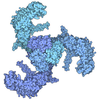
- EMDB-75424: SthK closed state at low temperature, cAMP-bound in DOPC nanodiscs -

+
Open data


ID or keywords:

Loading...

-
Basic information

Entry
Database: EMDB / ID: EMD-75424
TitleSthK closed state at low temperature, cAMP-bound in DOPC nanodiscs
Map data
Sample
  • Complex: tetrameric SthK protein
    • Protein or peptide: Transcriptional regulator, Crp/Fnr family
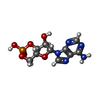
  • Ligand: ADENOSINE-3',5'-CYCLIC-MONOPHOSPHATE
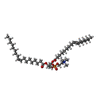
  • Ligand: 1,2-DIOLEOYL-SN-GLYCERO-3-PHOSPHOCHOLINE
Keywordscyclic nucleotide-gated channel / lipid modulation / pacemaker channel / TRANSPORT PROTEIN / potassium channel / thermoreceptor
Function / homology
Function and homology information


intracellularly cyclic nucleotide-activated monoatomic cation channel activity / protein-containing complex binding / membrane
Similarity search - Function
: / Cyclic nucleotide-binding domain signature 2. / Cyclic nucleotide-binding domain signature 1. / Cyclic nucleotide-binding, conserved site / Potassium channel domain / Ion channel / Cyclic nucleotide-monophosphate binding domain / Cyclic nucleotide-binding domain / cAMP/cGMP binding motif profile. / Cyclic nucleotide-binding domain ...: / Cyclic nucleotide-binding domain signature 2. / Cyclic nucleotide-binding domain signature 1. / Cyclic nucleotide-binding, conserved site / Potassium channel domain / Ion channel / Cyclic nucleotide-monophosphate binding domain / Cyclic nucleotide-binding domain / cAMP/cGMP binding motif profile. / Cyclic nucleotide-binding domain / Cyclic nucleotide-binding domain superfamily / RmlC-like jelly roll fold
Similarity search - Domain/homology
Transcriptional regulator, Crp/Fnr family
Similarity search - Component
Biological speciesWinmispira thermophila (bacteria)
Methodsingle particle reconstruction / cryo EM / Resolution: 2.51 Å
AuthorsChieh-Chin L / Nimigean CM
Funding support United States, Taiwan, 2 items
OrganizationGrant numberCountry
National Institutes of Health/National Institute of General Medical Sciences (NIH/NIGMS)GM124451 United States
Ministry of Science and Technology (MoST, Taiwan)111-2917-I-564-001 Taiwan
CitationJournal: Nat Commun / Year: 2026
Title: Mechanism of lipid-dependent cold sensitivity in a model ion channel.
Authors: Chieh-Chin Li / Crina M Nimigean /
Abstract: Temperature sensing enables organisms to detect and respond to environmental changes. While temperature-responsive ion channels are key to this process, the physico-chemical mechanisms by which they ...Temperature sensing enables organisms to detect and respond to environmental changes. While temperature-responsive ion channels are key to this process, the physico-chemical mechanisms by which they sense temperature remain poorly understood. Here, we investigate the molecular details of temperature sensing in the model bacterial channel, SthK from Spirochaeta thermophila. We show that SthK is cold sensitive, displaying higher activity below 30 °C. Remarkably, SthK cold sensitivity depends strongly on membrane lipids, being sensitive in amine-containing lipids but insensitive in anionic lipids. Combining cryo-EM structural analysis, mutagenesis, and functional assays, we identify an intersubunit salt bridge that acts as temperature sensor. This salt bridge forms only in closed states, and determines channel opening by controlling closed-state stability. Lower temperatures weaken salt-bridge interactions, favoring channel opening, and lipid headgroups tune temperature sensitivity by modulating salt-bridge strength. These findings highlight how thermosensitivity can emerge from cooperative interactions between protein and the surrounding membrane.
History
DepositionFeb 4, 2026-
Header (metadata) releaseApr 29, 2026-
Map releaseApr 29, 2026-
UpdateApr 29, 2026-
Current statusApr 29, 2026Processing site: RCSB / Status: Released

-
Structure visualization

Supplemental images

Downloads & links

-
Map

FileDownload / File: emd_75424.map.gz / Format: CCP4 / Size: 166.4 MB / Type: IMAGE STORED AS FLOATING POINT NUMBER (4 BYTES)
Projections & slices

Image control

Size
Brightness
Contrast
Others
AxesZ (Sec.)Y (Row.)X (Col.)
0.9 Å/pix.
x 352 pix.
= 316.8 Å
0.9 Å/pix.
x 352 pix.
= 316.8 Å
0.9 Å/pix.
x 352 pix.
= 316.8 Å

Surface

Projections

Slices (1/3)

Slices (1/2)

Slices (2/3)

Images are generated by Spider.

Voxel sizeX=Y=Z: 0.9 Å
Density
Contour LevelBy AUTHOR: 0.0069
Minimum - Maximum-0.012449839 - 0.038635377
Average (Standard dev.)0.000051814797 (±0.00095438806)
SymmetrySpace group: 1
Details

EMDB XML:

Map geometry
Axis orderXYZ
Origin000
Dimensions352352352
Spacing352352352
CellA=B=C: 316.8 Å
α=β=γ: 90.0 °

-
Supplemental data

-
Mask #1

Fileemd_75424_msk_1.map
Projections & Slices
AxesZYX

Projections

Slices (1/2)
Density Histograms

-
Half map: #2

Fileemd_75424_half_map_1.map
Projections & Slices
AxesZYX

Projections

Slices (1/2)
Density Histograms

-
Half map: #1

Fileemd_75424_half_map_2.map
Projections & Slices
AxesZYX

Projections

Slices (1/2)
Density Histograms

-
Sample components

-
Entire : tetrameric SthK protein

EntireName: tetrameric SthK protein
Components
  • Complex: tetrameric SthK protein
    • Protein or peptide: Transcriptional regulator, Crp/Fnr family
  • Ligand: ADENOSINE-3',5'-CYCLIC-MONOPHOSPHATE
  • Ligand: 1,2-DIOLEOYL-SN-GLYCERO-3-PHOSPHOCHOLINE

-
Supramolecule #1: tetrameric SthK protein

SupramoleculeName: tetrameric SthK protein / type: complex / ID: 1 / Parent: 0 / Macromolecule list: #1
Details: SthK in complex with cAMP reconstituted into MSP1E3 nanodiscs composed of DOPC
Source (natural)Organism: Winmispira thermophila (bacteria)

-
Macromolecule #1: Transcriptional regulator, Crp/Fnr family

MacromoleculeName: Transcriptional regulator, Crp/Fnr family / type: protein_or_peptide / ID: 1 / Details: The same construct as PDB:7tj5 and PDB:9OXL / Number of copies: 4 / Enantiomer: LEVO
Source (natural)Organism: Winmispira thermophila (bacteria)
Molecular weightTheoretical: 51.118574 KDa
Recombinant expressionOrganism: Escherichia coli BL21(DE3) (bacteria)
SequenceString: MAKDIGINSD PNSSSVDKLM KSSGVSNPTY TLVWKVWILA VTLYYAIRIP LTLVFPSLFS PLLPLDILAS LALIADIPLD LAFESRRTS GRKPTLLAPS RLPDLLAALP LDLLVFALHL PSPLSLLSLV RLLKLISVQR SATRILSYRI NPALLRLLSL V GFILLAAH ...String:
MAKDIGINSD PNSSSVDKLM KSSGVSNPTY TLVWKVWILA VTLYYAIRIP LTLVFPSLFS PLLPLDILAS LALIADIPLD LAFESRRTS GRKPTLLAPS RLPDLLAALP LDLLVFALHL PSPLSLLSLV RLLKLISVQR SATRILSYRI NPALLRLLSL V GFILLAAH GIACGWMSLQ PPSENPAGTR YLSAFYWTIT TLTTIGYGDI TPSTPTQTVY TIVIELLGAA MYGLVIGNIA SL VSKLDAA KLLHRERVER VTAFLSYKRI SPELQRRIIE YFDYLWETRR GYEEREVLKE LPHPLRLAVA MEIHGDVIEK VPL FKGAGE EFIRDIILHL EPVIYGPGEY IIRAGEMGSD VYFINRGSVE VLSADEKTRY AILSEGQFFG EMALILRAPR TATV RARAF CDLYRLDKET FDRILSRYPE IAAQIQELAV RRKELESSGL VPRGSVKHHH H

UniProtKB: Transcriptional regulator, Crp/Fnr family

-
Macromolecule #2: ADENOSINE-3',5'-CYCLIC-MONOPHOSPHATE

MacromoleculeName: ADENOSINE-3',5'-CYCLIC-MONOPHOSPHATE / type: ligand / ID: 2 / Number of copies: 4 / Formula: CMP
Molecular weightTheoretical: 329.206 Da
Chemical component information

ChemComp-CMP:
ADENOSINE-3',5'-CYCLIC-MONOPHOSPHATE

-
Macromolecule #3: 1,2-DIOLEOYL-SN-GLYCERO-3-PHOSPHOCHOLINE

MacromoleculeName: 1,2-DIOLEOYL-SN-GLYCERO-3-PHOSPHOCHOLINE / type: ligand / ID: 3 / Number of copies: 32 / Formula: PCW
Molecular weightTheoretical: 787.121 Da
Chemical component information

ChemComp-PCW:
1,2-DIOLEOYL-SN-GLYCERO-3-PHOSPHOCHOLINE / DOPC, phospholipid*YM

-
Experimental details

-
Structure determination

Methodcryo EM
Processingsingle particle reconstruction
Aggregation stateparticle

-
Sample preparation

Concentration8 mg/mL
BufferpH: 7.4
GridModel: UltrAuFoil R1.2/1.3 / Material: GOLD / Mesh: 300
VitrificationCryogen name: ETHANE / Chamber humidity: 100 % / Chamber temperature: 279 K / Instrument: FEI VITROBOT MARK IV

-
Electron microscopy

MicroscopeTFS KRIOS
Image recordingFilm or detector model: GATAN K3 (6k x 4k) / Average electron dose: 48.29 e/Å2
Electron beamAcceleration voltage: 300 kV / Electron source: FIELD EMISSION GUN
Electron opticsIllumination mode: FLOOD BEAM / Imaging mode: BRIGHT FIELD / Nominal defocus max: 2.5 µm / Nominal defocus min: 0.6 µm / Nominal magnification: 105000
Sample stageCooling holder cryogen: NITROGEN
Experimental equipment
Model: Titan Krios / Image courtesy: FEI Company

+
Image processing

Particle selectionNumber selected: 1378978
CTF correctionSoftware - Name: CTFFIND (ver. 4.1) / Type: PHASE FLIPPING AND AMPLITUDE CORRECTION
Startup modelType of model: PDB ENTRY
PDB model - PDB ID:
Final reconstructionResolution.type: BY AUTHOR / Resolution: 2.51 Å / Resolution method: FSC 0.143 CUT-OFF / Software - Name: RELION (ver. 4) / Number images used: 377840
Initial angle assignmentType: MAXIMUM LIKELIHOOD / Software - Name: RELION (ver. 4)
Final angle assignmentType: MAXIMUM LIKELIHOOD / Software - Name: RELION (ver. 4)
FSC plot (resolution estimation)

+
About Yorodumi

-
News

-
Feb 9, 2022. New format data for meta-information of EMDB entries

New format data for meta-information of EMDB entries

  • Version 3 of the EMDB header file is now the official format.
  • The previous official version 1.9 will be removed from the archive.

Related info.:EMDB header

External links:wwPDB to switch to version 3 of the EMDB data model

-
Aug 12, 2020. Covid-19 info

Covid-19 info

URL: https://pdbj.org/emnavi/covid19.php

New page: Covid-19 featured information page in EM Navigator.

Related info.:Covid-19 info / Mar 5, 2020. Novel coronavirus structure data

+
Mar 5, 2020. Novel coronavirus structure data

Novel coronavirus structure data

Related info.:Yorodumi Speices / Aug 12, 2020. Covid-19 info

External links:COVID-19 featured content - PDBj / Molecule of the Month (242):Coronavirus Proteases

+
Jan 31, 2019. EMDB accession codes are about to change! (news from PDBe EMDB page)

EMDB accession codes are about to change! (news from PDBe EMDB page)

  • The allocation of 4 digits for EMDB accession codes will soon come to an end. Whilst these codes will remain in use, new EMDB accession codes will include an additional digit and will expand incrementally as the available range of codes is exhausted. The current 4-digit format prefixed with “EMD-” (i.e. EMD-XXXX) will advance to a 5-digit format (i.e. EMD-XXXXX), and so on. It is currently estimated that the 4-digit codes will be depleted around Spring 2019, at which point the 5-digit format will come into force.
  • The EM Navigator/Yorodumi systems omit the EMD- prefix.

Related info.:Q: What is EMD? / ID/Accession-code notation in Yorodumi/EM Navigator

External links:EMDB Accession Codes are Changing Soon! / Contact to PDBj

+
Jul 12, 2017. Major update of PDB

Major update of PDB

  • wwPDB released updated PDB data conforming to the new PDBx/mmCIF dictionary.
  • This is a major update changing the version number from 4 to 5, and with Remediation, in which all the entries are updated.
  • In this update, many items about electron microscopy experimental information are reorganized (e.g. em_software).
  • Now, EM Navigator and Yorodumi are based on the updated data.

External links:wwPDB Remediation / Enriched Model Files Conforming to OneDep Data Standards Now Available in the PDB FTP Archive

-
Yorodumi

Thousand views of thousand structures

  • Yorodumi is a browser for structure data from EMDB, PDB, SASBDB, etc.
  • This page is also the successor to EM Navigator detail page, and also detail information page/front-end page for Omokage search.
  • The word "yorodu" (or yorozu) is an old Japanese word meaning "ten thousand". "mi" (miru) is to see.

Related info.:EMDB / PDB / SASBDB / Comparison of 3 databanks / Yorodumi Search / Aug 31, 2016. New EM Navigator & Yorodumi / Yorodumi Papers / Jmol/JSmol / Function and homology information / Changes in new EM Navigator and Yorodumi

Read more