National Institutes of Health/National Cancer Institute (NIH/NCI)
R01 CA206573
United States
National Institutes of Health/National Institute of Arthritis and Musculoskeletal and Skin Diseases (NIH/NIAMS)
R01 AR078814
United States
National Institutes of Health/National Institute of Neurological Disorders and Stroke (NIH/NINDS)
R01 NS107253
United States
National Institutes of Health/National Institute of Neurological Disorders and Stroke (NIH/NINDS)
R37 NS083660
United States
Citation
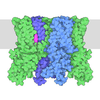
Journal: Nat Commun / Year: 2026 Title: Design, synthesis and structural mechanism of action of TRPV1 agonist MSP20 with long-lasting analgesic effect. Authors: Arthur Neuberger / Isabella Romeo / Francesca Aiello / Alexey Alekseev / Samuele Maramai / Federica Pessina / Chiara Vagaggini / Federica Poggialini / Elena Dreassi / Maria Frosini / Aniello ...Authors: Arthur Neuberger / Isabella Romeo / Francesca Aiello / Alexey Alekseev / Samuele Maramai / Federica Pessina / Chiara Vagaggini / Federica Poggialini / Elena Dreassi / Maria Frosini / Aniello Schiano Moriello / Luciano De Petrocellis / Andrea Maria Morace / Carmela Belardo / Michela Perrone / Roozbe Bonsale / Livio Luongo / Sabatino Maione / Irina A Talyzina / Stefano Alcaro / Anna Artese / Antonella Brizzi / Alexander I Sobolevsky / Abstract: Transient receptor potential vanilloid type-1 (TRPV1) channel is a polymodal receptor involved in pain perception and neuronal signalling that represents a promising target for the development of ...Transient receptor potential vanilloid type-1 (TRPV1) channel is a polymodal receptor involved in pain perception and neuronal signalling that represents a promising target for the development of analgesics and neuroprotective agents. In this study we implement a combination of computational techniques and targeted design of chemical libraries to discover benzothiophene-substituted TRPV1 agonists with high affinity and efficacy toward TRPV1. In vitro functional experiments show that prolonged or repeated exposure to these compounds induce calcium-dependent desensitization of TRPV1, making it insensitive to noxious stimuli. We solve a cryo-electron microscopy (cryo-EM) structure of human TRPV1 (hTRPV1) in complex with the most promising benzothiophene-substituted agonist MSP20. The structure reveals molecular details of MSP20 binding to the vanilloid site and a desensitized conformation of hTRPV1, characterized by the closed ion channel pore, α-helical C-terminus and distinct behaviour of annular lipids. Our in vivo experiments demonstrate that MSP20 exhibits robust and long-lasting antinociceptive activity with ex-vivo neuroprotective effects, supporting the perspective of benzothiophene-substituted vanilloids as future analgesics.
Name: SODIUM ION / type: ligand / ID: 6 / Number of copies: 2
Molecular weight
Theoretical: 22.99 Da
-
Experimental details
-
Structure determination
Method
cryo EM
Processing
single particle reconstruction
Aggregation state
particle
-
Sample preparation
Concentration
3 mg/mL
Buffer
pH: 8 Component:
Concentration
Formula
Name
150.0 mM
NaCl
sodium chloride
20.0 mM
tris(hydroxymethyl)aminomethane
1.0 mM
beta-Mercaptoethanol
0.01 %
glyco-diosgenin
Grid
Model: UltrAuFoil R1.2/1.3 / Material: GOLD / Mesh: 300 / Support film - Material: GOLD / Support film - topology: HOLEY
Vitrification
Cryogen name: ETHANE / Chamber humidity: 100 % / Chamber temperature: 277 K / Instrument: FEI VITROBOT MARK IV
Details
human TRPV1
-
Electron microscopy
Microscope
TFS KRIOS
Image recording
Film or detector model: GATAN K3 (6k x 4k) / Digitization - Dimensions - Width: 5760 pixel / Digitization - Dimensions - Height: 4092 pixel / Number grids imaged: 1 / Number real images: 12312 / Average exposure time: 2.7 sec. / Average electron dose: 60.0 e/Å2
Electron beam
Acceleration voltage: 300 kV / Electron source: FIELD EMISSION GUN
In the structure databanks used in Yorodumi, some data are registered as the other names, "COVID-19 virus" and "2019-nCoV". Here are the details of the virus and the list of structure data.
Jan 31, 2019. EMDB accession codes are about to change! (news from PDBe EMDB page)
EMDB accession codes are about to change! (news from PDBe EMDB page)
The allocation of 4 digits for EMDB accession codes will soon come to an end. Whilst these codes will remain in use, new EMDB accession codes will include an additional digit and will expand incrementally as the available range of codes is exhausted. The current 4-digit format prefixed with “EMD-” (i.e. EMD-XXXX) will advance to a 5-digit format (i.e. EMD-XXXXX), and so on. It is currently estimated that the 4-digit codes will be depleted around Spring 2019, at which point the 5-digit format will come into force.
The EM Navigator/Yorodumi systems omit the EMD- prefix.
Related info.:Q: What is EMD? / ID/Accession-code notation in Yorodumi/EM Navigator
Yorodumi is a browser for structure data from EMDB, PDB, SASBDB, etc.
This page is also the successor to EM Navigator detail page, and also detail information page/front-end page for Omokage search.
The word "yorodu" (or yorozu) is an old Japanese word meaning "ten thousand". "mi" (miru) is to see.
Related info.:EMDB / PDB / SASBDB / Comparison of 3 databanks / Yorodumi Search / Aug 31, 2016. New EM Navigator & Yorodumi / Yorodumi Papers / Jmol/JSmol / Function and homology information / Changes in new EM Navigator and Yorodumi
 Movie
Movie Controller

 Yorodumi
 Open data
 Basic information
 Map data
 Sample
 Keywords
 Function and homology information
 Homo sapiens (human)
 Authors
 United States, 4 items
  Citation
 Structure visualization
 Downloads & links
 emd_71555.png
 http://ftp.pdbj.org/pub/emdb/structures/EMD-71555
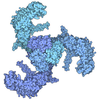
 Z (Sec.)
 Y (Row.)
 X (Col.)


 Sample components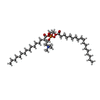
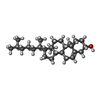
 Processing
 Electron microscopy
 FIELD EMISSION GUN

