molybdenum-iron nitrogenase complex / nitrogenase / nitrogenase activity / regulation of nitrogen utilization / iron-sulfur cluster binding / enzyme regulator activity / DNA-templated transcription / ATP binding / metal ion binding / cytosol Similarity search - Function
Nitrogen regulatory protein PII, conserved site / P-II protein C-terminal region signature. / Nitrogen regulatory protein P-II / P-II protein family profile. / Nitrogen regulatory protein PII / Nitrogen regulatory protein P-II / Nitrogenase molybdenum-iron protein alpha chain / Nitrogenase molybdenum-iron protein beta chain / Nitrogenase component 1, alpha chain / Nitrogenase component 1, conserved site ...Nitrogen regulatory protein PII, conserved site / P-II protein C-terminal region signature. / Nitrogen regulatory protein P-II / P-II protein family profile. / Nitrogen regulatory protein PII / Nitrogen regulatory protein P-II / Nitrogenase molybdenum-iron protein alpha chain / Nitrogenase molybdenum-iron protein beta chain / Nitrogenase component 1, alpha chain / Nitrogenase component 1, conserved site / Nitrogenases component 1 alpha and beta subunits signature 2. / Nitrogenases component 1 alpha and beta subunits signature 1. / Nitrogen regulatory PII-like, alpha/beta / Nitrogen regulatory protein PII/ATP phosphoribosyltransferase, C-terminal / : / Nitrogenase/oxidoreductase, component 1 / Nitrogenase component 1 type Oxidoreductase Similarity search - Domain/homology
Nitrogenase molybdenum-iron protein beta chain / Nitrogenase protein alpha chain / P-II family nitrogen regulatory protein / P-II family nitrogen regulatory protein Similarity search - Component
Biological species
Methanosarcina acetivorans (archaea)
Method
single particle reconstruction / cryo EM / Resolution: 3.16 Å
Journal: To Be Published Title: Cryo-EM structure of Nitrogenase MoFe protein from Methanosarcina acetivorans bound to the NifI inhibitor complex Authors: Kashyap R / Antony E
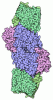
Entire : Trimeric complex of MoFe protein bound to NifI inhibitor complex
Entire
Name: Trimeric complex of MoFe protein bound to NifI inhibitor complex
Components
Complex: Trimeric complex of MoFe protein bound to NifI inhibitor complex
Protein or peptide: Nitrogenase protein alpha chain
Protein or peptide: Nitrogenase molybdenum-iron protein beta chain
Protein or peptide: P-II family nitrogen regulatory protein
Protein or peptide: P-II family nitrogen regulatory protein
Ligand: FE(8)-S(7) CLUSTER
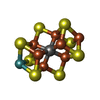
Ligand: iron-sulfur-molybdenum cluster with interstitial carbon
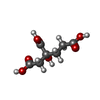
Ligand: 3-HYDROXY-3-CARBOXY-ADIPIC ACID
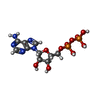
Ligand: ADENOSINE-5'-DIPHOSPHATE
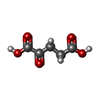
Ligand: 2-OXOGLUTARIC ACID
+
Supramolecule #1: Trimeric complex of MoFe protein bound to NifI inhibitor complex
Supramolecule
Name: Trimeric complex of MoFe protein bound to NifI inhibitor complex type: complex / ID: 1 / Parent: 0 / Macromolecule list: #1-#4
Source (natural)
Organism: Methanosarcina acetivorans (archaea)
+
Macromolecule #1: Nitrogenase protein alpha chain
Macromolecule
Name: Nitrogenase protein alpha chain / type: protein_or_peptide / ID: 1 Details: A Methanosarcina acetivorans strain (DJL70) expressing an N-terminal twin-Strep-tagged NifD was engineered using CRISPR-Cas9. A gRNA targeting nifI2 was designed, and synthetic homology ...Details: A Methanosarcina acetivorans strain (DJL70) expressing an N-terminal twin-Strep-tagged NifD was engineered using CRISPR-Cas9. A gRNA targeting nifI2 was designed, and synthetic homology repair templates introduced the Strep-tag sequence upstream of nifD, along with a silent PAM mutation. The repair construct (pDL707) was assembled through Gibson assembly and Gateway cloning, transformed into M. acetivorans WWM73, and selected with puromycin and 8-ADP to remove the plasmid. PCR and sequencing confirmed successful integration of the Strep-tag at the nifD locus, yielding strain DJL70 which is a natural strain. Number of copies: 6 / Enantiomer: LEVO / EC number: nitrogenase
In the structure databanks used in Yorodumi, some data are registered as the other names, "COVID-19 virus" and "2019-nCoV". Here are the details of the virus and the list of structure data.
Jan 31, 2019. EMDB accession codes are about to change! (news from PDBe EMDB page)
EMDB accession codes are about to change! (news from PDBe EMDB page)
The allocation of 4 digits for EMDB accession codes will soon come to an end. Whilst these codes will remain in use, new EMDB accession codes will include an additional digit and will expand incrementally as the available range of codes is exhausted. The current 4-digit format prefixed with “EMD-” (i.e. EMD-XXXX) will advance to a 5-digit format (i.e. EMD-XXXXX), and so on. It is currently estimated that the 4-digit codes will be depleted around Spring 2019, at which point the 5-digit format will come into force.
The EM Navigator/Yorodumi systems omit the EMD- prefix.
Related info.:Q: What is EMD? / ID/Accession-code notation in Yorodumi/EM Navigator
Yorodumi is a browser for structure data from EMDB, PDB, SASBDB, etc.
This page is also the successor to EM Navigator detail page, and also detail information page/front-end page for Omokage search.
The word "yorodu" (or yorozu) is an old Japanese word meaning "ten thousand". "mi" (miru) is to see.
Related info.:EMDB / PDB / SASBDB / Comparison of 3 databanks / Yorodumi Search / Aug 31, 2016. New EM Navigator & Yorodumi / Yorodumi Papers / Jmol/JSmol / Function and homology information / Changes in new EM Navigator and Yorodumi
 Movie
Movie Controller

 Yorodumi
 Open data
 Basic information
 Map data
 Sample
 Keywords
 Function and homology information
 Methanosarcina acetivorans (archaea)
 Authors
 United States, 1 items
  Citation
 Structure visualization
 Downloads & links
 emd_71144.png
 http://ftp.pdbj.org/pub/emdb/structures/EMD-71144
 Z (Sec.)
 Y (Row.)
 X (Col.)


 Sample components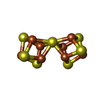
 Processing
 Electron microscopy
 FIELD EMISSION GUN
