 Movie
Movie Controller

[English] 日本語
 Yorodumi
- EMDB-70993: CRYO-EM STRUCTURE OF the human mPSF IN COMPLEX WITH THE AAUAAU po... -
+ Open data

- Basic information
| Entry |  | |||||||||
|---|---|---|---|---|---|---|---|---|---|---|
| Title | CRYO-EM STRUCTURE OF the human mPSF IN COMPLEX WITH THE AAUAAU poly(A) signal | |||||||||
 Map data Map data | primary map | |||||||||
 Sample Sample |
| |||||||||
 Keywords Keywords | polyadenylation signal / RNA BINDING PROTEIN / RNA BINDING PROTEIN-RNA complex | |||||||||
| Function / homology |  Function and homology information Function and homology informationco-transcriptional RNA 3'-end processing, cleavage and polyadenylation pathway / Inhibition of Host mRNA Processing and RNA Silencing / Processing of Intronless Pre-mRNAs / mRNA cleavage and polyadenylation specificity factor complex / Transport of Mature mRNA Derived from an Intronless Transcript / mRNA 3'-end processing / mRNA 3'-UTR AU-rich region binding / DNA damage tolerance / mRNA 3'-end processing / tRNA processing in the nucleus ...co-transcriptional RNA 3'-end processing, cleavage and polyadenylation pathway / Inhibition of Host mRNA Processing and RNA Silencing / Processing of Intronless Pre-mRNAs / mRNA cleavage and polyadenylation specificity factor complex / Transport of Mature mRNA Derived from an Intronless Transcript / mRNA 3'-end processing / mRNA 3'-UTR AU-rich region binding / DNA damage tolerance / mRNA 3'-end processing / tRNA processing in the nucleus / RNA Polymerase II Transcription Termination / fibrillar center / mRNA Polyadenylation / sequence-specific double-stranded DNA binding / Dengue Virus-Host Interactions / spermatogenesis / enzyme binding / RNA binding / nucleoplasm / zinc ion binding / nucleus Similarity search - Function | |||||||||
| Biological species |  Homo sapiens (human) Homo sapiens (human) | |||||||||
| Method | single particle reconstruction / cryo EM / Resolution: 3.07 Å | |||||||||
 Authors Authors | Huang L / Tong L / Chu H-F | |||||||||
| Funding support |  United States, 1 items United States, 1 items
| |||||||||
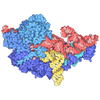
 Citation Citation | Journal: Nucleic Acids Res / Year: 2025 Title: Molecular basis for the recognition of low-frequency polyadenylation signals by mPSF. Authors: Lin Huang / Hsu-Feng Chu / Liang Tong / Abstract: The 3'-end cleavage and polyadenylation of pre-mRNAs is dependent on a key hexanucleotide motif known as the polyadenylation signal (PAS). The PAS hexamer is recognized by the mammalian ...The 3'-end cleavage and polyadenylation of pre-mRNAs is dependent on a key hexanucleotide motif known as the polyadenylation signal (PAS). The PAS hexamer is recognized by the mammalian polyadenylation specificity factor (mPSF). AAUAAA is the most frequent PAS hexamer and together with AUUAAA, the second most frequent hexamer, account for ∼75% of the poly(A) signals. The remaining hexamers are at low frequency (<3%), and the molecular basis for their recognition is still not known. Here, we have determined the binding affinities for most of the PAS hexamers, showing that the Kd values are generally inversely correlated with their frequency. We also observed good cleavage activity for two low-frequency hexamers, AAGAAA and AACAAA. We have determined the cryo-electron microscopy structures of human mPSF in complex with AAUAAU and AGUAAA, at 3.1 and 2.5 Å resolution, respectively. The overall binding modes of the two low-frequency hexamers are similar to that of AAUAAA, although the U3-A6 Hoogsteen base pair is disrupted in the AAUAAU hexamer. For AGUAAA, the G2 base undergoes a large conformational change, which allows it to maintain the hydrogen-bonding interaction with CPSF30 as observed with A2 and establish a new hydrogen bond to CPSF30. | |||||||||
| History |
|
- Structure visualization
| Supplemental images |
|---|

- Downloads & links
-EMDB archive
| Map data | emd_70993.map.gz | 97.2 MB | EMDB map data format | |
|---|---|---|---|---|
| Header (meta data) | emd-70993-v30.xmlemd-70993.xml | 19.7 KB 19.7 KB | Display Display | EMDB header |
| Images |  emd_70993.png emd_70993.png | 58.5 KB | ||
| Filedesc metadata | emd-70993.cif.gz | 7.4 KB | ||
| Others | emd_70993_half_map_1.map.gzemd_70993_half_map_2.map.gz | 95.6 MB 95.6 MB | ||
| Archive directory |  http://ftp.pdbj.org/pub/emdb/structures/EMD-70993ftp://ftp.pdbj.org/pub/emdb/structures/EMD-70993 http://ftp.pdbj.org/pub/emdb/structures/EMD-70993ftp://ftp.pdbj.org/pub/emdb/structures/EMD-70993 | HTTPS FTP |
-Related structure data
| Related structure data |  9oxsMC  9oxeC M: atomic model generated by this map C: citing same article ( |
|---|---|
| Similar structure data |

-Links
| EMDB pages | EMDB (EBI/PDBe) / EMDataResource |
|---|---|
| Related items in Molecule of the Month |
-Map
| File | Download / File: emd_70993.map.gz / Format: CCP4 / Size: 103 MB / Type: IMAGE STORED AS FLOATING POINT NUMBER (4 BYTES) | ||||||||||||||||||||||||||||||||||||
|---|---|---|---|---|---|---|---|---|---|---|---|---|---|---|---|---|---|---|---|---|---|---|---|---|---|---|---|---|---|---|---|---|---|---|---|---|---|
| Annotation | primary map | ||||||||||||||||||||||||||||||||||||
| Projections & slices | Image control
Images are generated by Spider. | ||||||||||||||||||||||||||||||||||||
| Voxel size | X=Y=Z: 0.856 Å | ||||||||||||||||||||||||||||||||||||
| Density |
| ||||||||||||||||||||||||||||||||||||
| Symmetry | Space group: 1 | ||||||||||||||||||||||||||||||||||||
| Details | EMDB XML:
|
 Z (Sec.)
 Y (Row.)
 X (Col.)


-Supplemental data
-Half map: half map B
| File | emd_70993_half_map_1.map | ||||||||||||
|---|---|---|---|---|---|---|---|---|---|---|---|---|---|
| Annotation | half map_B | ||||||||||||
| Projections & Slices |
| ||||||||||||
| Density Histograms |


-Half map: half map A
| File | emd_70993_half_map_2.map | ||||||||||||
|---|---|---|---|---|---|---|---|---|---|---|---|---|---|
| Annotation | half map_A | ||||||||||||
| Projections & Slices |
| ||||||||||||
| Density Histograms |


- Sample components
-Entire : human mPSF in complex with the AAUAAU poly(A) signal
| Entire | Name: human mPSF in complex with the AAUAAU poly(A) signal |
|---|---|
| Components |
|
-Supramolecule #1: human mPSF in complex with the AAUAAU poly(A) signal
| Supramolecule | Name: human mPSF in complex with the AAUAAU poly(A) signal / type: complex / ID: 1 / Parent: 0 / Macromolecule list: #1-#4 |
|---|---|
| Source (natural) | Organism: Homo sapiens (human) |
-Macromolecule #1: Cleavage and polyadenylation specificity factor subunit 1
| Macromolecule | Name: Cleavage and polyadenylation specificity factor subunit 1 type: protein_or_peptide / ID: 1 / Number of copies: 1 / Enantiomer: LEVO |
|---|---|
| Source (natural) | Organism: Homo sapiens (human) |
| Molecular weight | Theoretical: 161.074234 KDa |
| Recombinant expression | Organism:  Trichoplusia ni (cabbage looper) Trichoplusia ni (cabbage looper) |
| Sequence | String: MYAVYKQAHP PTGLEFSMYC NFFNNSERNL VVAGTSQLYV YRLNRDAEAL TKNDRSTEGK AHREKLELAA SFSFFGNVMS MASVQLAGA KRDALLLSFK DAKLSVVEYD PGTHDLKTLS LHYFEEPELR DGFVQNVHTP RVRVDPDGRC AAMLVYGTRL V VLPFRRES ...String: MYAVYKQAHP PTGLEFSMYC NFFNNSERNL VVAGTSQLYV YRLNRDAEAL TKNDRSTEGK AHREKLELAA SFSFFGNVMS MASVQLAGA KRDALLLSFK DAKLSVVEYD PGTHDLKTLS LHYFEEPELR DGFVQNVHTP RVRVDPDGRC AAMLVYGTRL V VLPFRRES LAEEHEGLVG EGQRSSFLPS YIIDVRALDE KLLNIIDLQF LHGYYEPTLL ILFEPNQTWP GRVAVRQDTC SI VAISLNI TQKVHPVIWS LTSLPFDCTQ ALAVPKPIGG VVVFAVNSLL YLNQSVPPYG VALNSLTTGT TAFPLRTQEG VRI TLDCAQ ATFISYDKMV ISLKGGEIYV LTLITDGMRS VRAFHFDKAA ASVLTTSMVT MEPGYLFLGS RLGNSLLLKY TEKL QEPPA SAVREAADKE EPPSKKKRVD ATAGWSAAGK SVPQDEVDEI EVYGSEAQSG TQLATYSFEV CDSILNIGPC ANAAV GEPA FLSEEFQNSP EPDLEIVVCS GHGKNGALSV LQKSIRPQVV TTFELPGCYD MWTVIAPVRK EEEDNPKGEG TEQEPS TTP EADDDGRRHG FLILSREDST MILQTGQEIM ELDTSGFATQ GPTVFAGNIG DNRYIVQVSP LGIRLLEGVN QLHFIPV DL GAPIVQCAVA DPYVVIMSAE GHVTMFLLKS DSYGGRHHRL ALHKPPLHHQ SKVITLCLYR DLSGMFTTES RLGGARDE L GGRSGPEAEG LGSETSPTVD DEEEMLYGDS GSLFSPSKEE ARRSSQPPAD RDPAPFRAEP THWCLLVREN GTMEIYQLP DWRLVFLVKN FPVGQRVLVD SSFGQPTTQG EARREEATRQ GELPLVKEVL LVALGSRQSR PYLLVHVDQE LLIYEAFPHD SQLGQGNLK VRFKKVPHNI NFREKKPKPS KKKAEGGGAE EGAGARGRVA RFRYFEDIYG YSGVFICGPS PHWLLVTGRG A LRLHPMAI DGPVDSFAPF HNVNCPRGFL YFNRQGELRI SVLPAYLSYD APWPVRKIPL RCTAHYVAYH VESKVYAVAT ST NTPCARI PRMTGEEKEF ETIERDERYI HPQQEAFSIQ LISPVSWEAI PNARIELQEW EHVTCMKTVS LRSEETVSGL KGY VAAGTC LMQGEEVTCR GRILIMDVIE VVPEPGQPLT KNKFKVLYEK EQKGPVTALC HCNGHLVSAI GQKIFLWSLR ASEL TGMAF IDTQLYIHQM ISVKNFILAA DVMKSISLLR YQEESKTLSL VSRDAKPLEV YSVDFMVDNA QLGFLVSDRD RNLMV YMYL PEAKESFGGM RLLRRADFHV GAHVNTFWRT PCRGATEGLS KKSVVWENKH ITWFATLDGG IGLLLPMQEK TYRRLL MLQ NALTTMLPHH AGLNPRAFRM LHVDRRTLQN AVRNVLDGEL LNRYLYLSTM ERSELAKKIG TTPDIILDDL LETDRVT AH F UniProtKB: Cleavage and polyadenylation specificity factor subunit 1 |
-Macromolecule #2: pre-mRNA 3' end processing protein WDR33
| Macromolecule | Name: pre-mRNA 3' end processing protein WDR33 / type: protein_or_peptide / ID: 2 / Number of copies: 1 / Enantiomer: LEVO |
|---|---|
| Source (natural) | Organism: Homo sapiens (human) |
| Molecular weight | Theoretical: 66.053102 KDa |
| Recombinant expression | Organism: Trichoplusia ni (cabbage looper) |
| Sequence | String: SNAATEIGSP PRFFHMPRFQ HQAPRQLFYK RPDFAQQQAM QQLTFDGKRM RKAVNRKTID YNPSVIKYLE NRIWQRDQRD MRAIQPDAG YYNDLVPPIG MLNNPMNAVT TKFVRTSTNK VKCPVFVVRW TPEGRRLVTG ASSGEFTLWN GLTFNFETIL Q AHDSPVRA ...String: SNAATEIGSP PRFFHMPRFQ HQAPRQLFYK RPDFAQQQAM QQLTFDGKRM RKAVNRKTID YNPSVIKYLE NRIWQRDQRD MRAIQPDAG YYNDLVPPIG MLNNPMNAVT TKFVRTSTNK VKCPVFVVRW TPEGRRLVTG ASSGEFTLWN GLTFNFETIL Q AHDSPVRA MTWSHNDMWM LTADHGGYVK YWQSNMNNVK MFQAHKEAIR EASFSPTDNK FATCSDDGTV RIWDFLRCHE ER ILRGHGA DVKCVDWHPT KGLVVSGSKD SQQPIKFWDP KTGQSLATLH AHKNTVMEVK LNLNGNWLLT ASRDHLCKLF DIR NLKEEL QVFRGHKKEA TAVAWHPVHE GLFASGGSDG SLLFWHVGVE KEVGGMEMAH EGMIWSLAWH PLGHILCSGS NDHT SKFWT RNRPGDKMRD RYNLNLLPGM SEDGVEYDDL EPNSLAVIPG MGIPEQLKLA MEQEQMGKDE SNEIEMTIPG LDWGM EEVM QKDQKKVPQK KVPYAKPIPA QFQQAWMQNK VPIPAPNEVL NDRKEDIKLE EKKKTQAEIE QEMATLQYTN PQLLEQ LKI ERLAQKQVEQ I UniProtKB: pre-mRNA 3' end processing protein WDR33 |
-Macromolecule #3: Isoform 2 of Cleavage and polyadenylation specificity factor subunit 4
| Macromolecule | Name: Isoform 2 of Cleavage and polyadenylation specificity factor subunit 4 type: protein_or_peptide / ID: 3 / Number of copies: 1 / Enantiomer: LEVO |
|---|---|
| Source (natural) | Organism: Homo sapiens (human) |
| Molecular weight | Theoretical: 27.589004 KDa |
| Recombinant expression | Organism: Trichoplusia ni (cabbage looper) |
| Sequence | String: MQEIIASVDH IKFDLEIAVE QQLGAQPLPF PGMDKSGAAV CEFFLKAACG KGGMCPFRHI SGEKTVVCKH WLRGLCKKGD QCEFLHEYD MTKMPECYFY SKFGECSNKE CPFLHIDPES KIKDCPWYDR GFCKHGPLCR HRHTRRVICV NYLVGFCPEG P SCKFMHPR ...String: MQEIIASVDH IKFDLEIAVE QQLGAQPLPF PGMDKSGAAV CEFFLKAACG KGGMCPFRHI SGEKTVVCKH WLRGLCKKGD QCEFLHEYD MTKMPECYFY SKFGECSNKE CPFLHIDPES KIKDCPWYDR GFCKHGPLCR HRHTRRVICV NYLVGFCPEG P SCKFMHPR FELPMGTTEQ PPLPQQTQPP AKQRTPQVIG VMQSQNSSAG NRGPRPLEQV TCYKCGEKGH YANRCTKGHL AF LSGQ UniProtKB: Cleavage and polyadenylation specificity factor subunit 4 |
-Macromolecule #4: RNA (5'-R(P*AP*AP*UP*AP*AP*UP*C)-3')
| Macromolecule | Name: RNA (5'-R(P*AP*AP*UP*AP*AP*UP*C)-3') / type: rna / ID: 4 / Number of copies: 1 |
|---|---|
| Source (natural) | Organism: Homo sapiens (human) |
| Molecular weight | Theoretical: 3.804344 KDa |
| Sequence | String: UGCAAUAAUC AA |
-Macromolecule #5: ZINC ION
| Macromolecule | Name: ZINC ION / type: ligand / ID: 5 / Number of copies: 3 / Formula: ZN |
|---|---|
| Molecular weight | Theoretical: 65.409 Da |
-Experimental details
-Structure determination
| Method | cryo EM |
|---|---|
 Processing Processing | single particle reconstruction |
| Aggregation state | particle |
-Sample preparation
| Buffer | pH: 8 |
|---|---|
| Vitrification | Cryogen name: ETHANE |
- Electron microscopy
| Microscope | TFS KRIOS |
|---|---|
| Image recording | Film or detector model: GATAN K3 (6k x 4k) / Average electron dose: 51.15 e/Å2 |
| Electron beam | Acceleration voltage: 300 kV / Electron source:  FIELD EMISSION GUN FIELD EMISSION GUN |
| Electron optics | Illumination mode: OTHER / Imaging mode: OTHER / Nominal defocus max: 2.0 µm / Nominal defocus min: 0.5 µm / Nominal magnification: 81000 |
| Experimental equipment |  Model: Titan Krios / Image courtesy: FEI Company |
