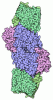
Journal: Proc Natl Acad Sci U S A / Year: 2026 Title: Conformational flexibility of the nitrogenase-like reductase CfbC/D involved in coenzyme F biosynthesis. Authors: Lin Zhang / Florian Schuhmacher / Alena Kussler / Oliver Einsle / Gunhild Layer / Abstract: The nitrogenase-like reductase CfbC/D catalyzes the six-electron reduction of the tetrapyrrole macrocycle of Ni-sirohydrochlorin -diamide during the biosynthesis of coenzyme F, an essential cofactor ...The nitrogenase-like reductase CfbC/D catalyzes the six-electron reduction of the tetrapyrrole macrocycle of Ni-sirohydrochlorin -diamide during the biosynthesis of coenzyme F, an essential cofactor for biological methane formation and consumption. The individual dimeric protein components, CfbC and CfbD, form a complex to allow for electron transfer from the [4Fe:4S] cluster in CfbC to the [4Fe:4S] cluster in CfbD and onto the substrate. The overall process is ATP-dependent. Although CfbC/D belongs to the family of nitrogenase-like enzymes, there are several intriguing differences between CfbC/D, other nitrogenase-like enzymes and nitrogenase itself. In contrast to the other enzymes, CfbC/D exhibits a simpler molecular architecture, forming a heterotetrameric CfbCD assembly. Furthermore, the interaction of the CfbC and CfbD components does not depend on the presence of adenosine triphosphate (ATP). Here we report cryoelectron microscopy structures of the CfbC/D complex prepared in the absence and presence of substrates. These structures not only shed light on the molecular architecture of the CfbC/D complex but also reveal a high degree of structural flexibility within the CfbD component, which undergoes a large conformational change in the presence of an ATP analog and the tetrapyrrole substrate. The interplay of CfbD with its reductase CfbC also strongly suggests an evolutionary pathway toward the modern nitrogenase from methanogenic archaea.
In the structure databanks used in Yorodumi, some data are registered as the other names, "COVID-19 virus" and "2019-nCoV". Here are the details of the virus and the list of structure data.
Jan 31, 2019. EMDB accession codes are about to change! (news from PDBe EMDB page)
EMDB accession codes are about to change! (news from PDBe EMDB page)
The allocation of 4 digits for EMDB accession codes will soon come to an end. Whilst these codes will remain in use, new EMDB accession codes will include an additional digit and will expand incrementally as the available range of codes is exhausted. The current 4-digit format prefixed with “EMD-” (i.e. EMD-XXXX) will advance to a 5-digit format (i.e. EMD-XXXXX), and so on. It is currently estimated that the 4-digit codes will be depleted around Spring 2019, at which point the 5-digit format will come into force.
The EM Navigator/Yorodumi systems omit the EMD- prefix.
Related info.:Q: What is EMD? / ID/Accession-code notation in Yorodumi/EM Navigator
Yorodumi is a browser for structure data from EMDB, PDB, SASBDB, etc.
This page is also the successor to EM Navigator detail page, and also detail information page/front-end page for Omokage search.
The word "yorodu" (or yorozu) is an old Japanese word meaning "ten thousand". "mi" (miru) is to see.
Related info.:EMDB / PDB / SASBDB / Comparison of 3 databanks / Yorodumi Search / Aug 31, 2016. New EM Navigator & Yorodumi / Yorodumi Papers / Jmol/JSmol / Function and homology information / Changes in new EM Navigator and Yorodumi
 Movie
 Controller


 Open data

 Basic information

 Map data
 Sample
 Keywords
 Function and homology information

 Methanocaldococcus jannaschii DSM 2661 (archaea)
 Authors
 Germany, European Union, 6 items
 Citation

 Structure visualization

 Downloads & links
 emd_69985.png
 https://data.pdbj.org/pub/emdb/structures/EMD-69985

 Z (Sec.)
 Y (Row.)
 X (Col.)


 Sample components

 Escherichia coli (E. coli)
 Processing
 Electron microscopy
 FIELD EMISSION GUN