National Natural Science Foundation of China (NSFC)
China
Ministry of Science and Technology (MoST, China)
China
Citation
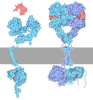
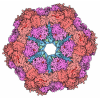
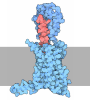
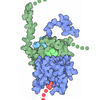
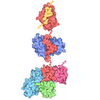
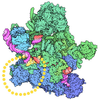
Journal: Cell / Year: 2026 Title: Structural basis of Wnt signalosome extracellular complex assembly. Authors: Dan Yue / Gangyu Sun / Yunlong Cao / Hongyue Li / Yufeng Yang / Zirun Pan / Lulu Xue / Lu Zhang / Zhizhi Wang / Wenqing Xu / Abstract: Recognition of Wnt proteins by Frizzled (Fzd) receptors and the low-density lipoprotein receptor-related protein 5/6 (LRP5/6) co-receptor is essential for canonical Wnt signaling. It remains ...Recognition of Wnt proteins by Frizzled (Fzd) receptors and the low-density lipoprotein receptor-related protein 5/6 (LRP5/6) co-receptor is essential for canonical Wnt signaling. It remains enigmatic how Wnt simultaneously interacts with Fzd and LRP5/6 and activates intracellular Wnt/β-catenin signaling. Here, we report cryo-electron microscopy (cryo-EM) structures of Wnt3a/Fzd8/LRP6 extracellular complexes captured in a 2:4:2 stoichiometry, consisting of a Wnt3a-Wnt3a homodimer, whereby each Wnt3a monomer binds to two Fzd8 receptors and one LRP6 co-receptor. This implies that Wnt3a induces Fzd cystine-rich domain (Fzd-CRD) tetramerization, which in turn could promote recruitment of oligomeric Disheveled (Dvl) to Fzd on the cytoplasmic side. Indeed, mutations of key Wnt3a-Wnt3a interface residues abolish Fzd-LRP clustering and downstream signaling, supporting a critical role of Wnt3a-Wnt3a dimerization in Wnt signalosome assembly and signaling. Our structures also show how the Wnt3a N-helical domain recognizes the LRP6 extracellular domain (LRP6-ECD) E3 β-propeller, while the Wnt3a N-C hairpin interacts with the valley between LRP6-E3 and -E4 propellers, underpinning the development of targeted Wnt therapeutics.
In the structure databanks used in Yorodumi, some data are registered as the other names, "COVID-19 virus" and "2019-nCoV". Here are the details of the virus and the list of structure data.
Jan 31, 2019. EMDB accession codes are about to change! (news from PDBe EMDB page)
EMDB accession codes are about to change! (news from PDBe EMDB page)
The allocation of 4 digits for EMDB accession codes will soon come to an end. Whilst these codes will remain in use, new EMDB accession codes will include an additional digit and will expand incrementally as the available range of codes is exhausted. The current 4-digit format prefixed with “EMD-” (i.e. EMD-XXXX) will advance to a 5-digit format (i.e. EMD-XXXXX), and so on. It is currently estimated that the 4-digit codes will be depleted around Spring 2019, at which point the 5-digit format will come into force.
The EM Navigator/Yorodumi systems omit the EMD- prefix.
Related info.:Q: What is EMD? / ID/Accession-code notation in Yorodumi/EM Navigator
Yorodumi is a browser for structure data from EMDB, PDB, SASBDB, etc.
This page is also the successor to EM Navigator detail page, and also detail information page/front-end page for Omokage search.
The word "yorodu" (or yorozu) is an old Japanese word meaning "ten thousand". "mi" (miru) is to see.
Related info.:EMDB / PDB / SASBDB / Comparison of 3 databanks / Yorodumi Search / Aug 31, 2016. New EM Navigator & Yorodumi / Yorodumi Papers / Jmol/JSmol / Function and homology information / Changes in new EM Navigator and Yorodumi
 Movie
Movie Controller


 Open data
 Basic information
 Map data
 Sample
 Keywords
 Function and homology information
 Mus musculus (house mouse) /
  Homo sapiens (human)
 Authors
 China, 3 items
  Citation
 Structure visualization
 Downloads & links
 emd_67780.png
 http://ftp.pdbj.org/pub/emdb/structures/EMD-67780






 Z (Sec.)
 Y (Row.)
 X (Col.)


 Sample components
 Processing
 Electron microscopy
 FIELD EMISSION GUN

