- EMDB-67613: Cryo-EM structure of monomeric Cu/Zn-superoxide dismutase from do... -
+
Open data
ID or keywords:
Loading...
-
Basic information
Entry
Database: EMDB / ID: EMD-67613
Title
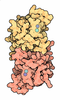
Cryo-EM structure of monomeric Cu/Zn-superoxide dismutase from dog (Canis familiaris) complexed with 19A9 triabody in the open conformation
Map data
Sample
Complex: trivalent antibody fragment (triabody) - Cu/Zn-superoxide dismutase complex
Protein or peptide: trivalent antibody fragment (triabody)
Protein or peptide: Superoxide dismutase [Cu-Zn]
Keywords
Cu/Zn-superoxide dismutase (SOD1) / neurodegenerative disease / antibody / METAL BINDING PROTEIN
Function / homology
Function and homology information
Oxidoreductases; Acting on a sulfur group of donors / superoxide dismutase / superoxide dismutase activity / reactive oxygen species metabolic process / removal of superoxide radicals / peroxisome / copper ion binding / mitochondrion / nucleus / cytosol Similarity search - Function
Journal: Protein Sci / Year: 2026 Title: Structural analysis of Cu/Zn-superoxide dismutase linked to neurodegenerative disease by antibody-guided cryo-EM. Authors: Yuki Shino / Norifumi Muraki / Yui Kobatake / Hiroaki Kamishina / Hirofumi Kosuge / Makoto Nakakido / Kouhei Tsumoto / Yoshiaki Furukawa / Abstract: Accumulation of misfolded proteins is a hallmark of many neurodegenerative diseases. To characterize such misfolded species in vivo, conformation-specific antibodies are widely used; however, limited ...Accumulation of misfolded proteins is a hallmark of many neurodegenerative diseases. To characterize such misfolded species in vivo, conformation-specific antibodies are widely used; however, limited knowledge of antibody-epitope interactions often hampers mechanistic insight. To address this, we determined the cryo-electron microscopy structure of the complex between a monoclonal antibody, 19A9, and Cu/Zn-superoxide dismutase (SOD1), a protein associated with canine degenerative myelopathy (DM), which is related to human amyotrophic lateral sclerosis. Biochemical analyses confirmed that 19A9 specifically recognizes monomeric SOD1, and the structure revealed binding near the interface normally used for homodimerization in native SOD1, with steric hindrance preventing interaction when the protein is in its homodimeric form. Immunofluorescence staining of spinal cord sections revealed that 19A9 stained a subset of motoneurons in DM-affected dogs, but not in asymptomatic controls. Structural characterization of the 19A9-monomeric SOD1 complex enabled us to propose that SOD1 monomers can arise in vivo under pathological conditions.
In the structure databanks used in Yorodumi, some data are registered as the other names, "COVID-19 virus" and "2019-nCoV". Here are the details of the virus and the list of structure data.
Jan 31, 2019. EMDB accession codes are about to change! (news from PDBe EMDB page)
EMDB accession codes are about to change! (news from PDBe EMDB page)
The allocation of 4 digits for EMDB accession codes will soon come to an end. Whilst these codes will remain in use, new EMDB accession codes will include an additional digit and will expand incrementally as the available range of codes is exhausted. The current 4-digit format prefixed with “EMD-” (i.e. EMD-XXXX) will advance to a 5-digit format (i.e. EMD-XXXXX), and so on. It is currently estimated that the 4-digit codes will be depleted around Spring 2019, at which point the 5-digit format will come into force.
The EM Navigator/Yorodumi systems omit the EMD- prefix.
Related info.:Q: What is EMD? / ID/Accession-code notation in Yorodumi/EM Navigator
Yorodumi is a browser for structure data from EMDB, PDB, SASBDB, etc.
This page is also the successor to EM Navigator detail page, and also detail information page/front-end page for Omokage search.
The word "yorodu" (or yorozu) is an old Japanese word meaning "ten thousand". "mi" (miru) is to see.
Related info.:EMDB / PDB / SASBDB / Comparison of 3 databanks / Yorodumi Search / Aug 31, 2016. New EM Navigator & Yorodumi / Yorodumi Papers / Jmol/JSmol / Function and homology information / Changes in new EM Navigator and Yorodumi
 Movie
Movie Controller

 Yorodumi
 Open data
 Basic information
 Map data
 Sample
 Keywords
 Function and homology information
 Canis lupus familiaris (dog) /
  Mus musculus (house mouse)
 Authors
 Japan, 3 items
  Citation
 Structure visualization
 Downloads & links
 emd_67613.png
 http://ftp.pdbj.org/pub/emdb/structures/EMD-67613


 Z (Sec.)
 Y (Row.)
 X (Col.)


 Sample components
 Escherichia coli (E. coli)
 Processing
 Electron microscopy
 FIELD EMISSION GUN
