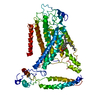
Journal: Nat Commun / Year: 2026 Title: TMEM63 proteins act as mechanically activated cholesterol modulated lipid scramblases contributing to membrane mechano-resilience. Authors: Yiechang Lin / Zijing Zhou / Yaoyao Han / Delfine Cheng / Haoqing Jerry Wang / Lining Arnold Ju / Yixiao Zhang / Charles D Cox / Ben Corry / Abstract: OSCA/TMEM63 mechanosensitive ion channels play critical physiological roles in plants and animals. These channels bear structural homology to the dual functional TMEM16 family, and OSCA1.2 was ...OSCA/TMEM63 mechanosensitive ion channels play critical physiological roles in plants and animals. These channels bear structural homology to the dual functional TMEM16 family, and OSCA1.2 was recently shown to form a lipid-lined ion conduction pathway in the open state. This raised the question of whether members of the OSCA/TMEM63 family may also function as mechanically activated lipid scramblases. Using a combination of in vitro and cellular assays with computational techniques, we show that phospholipids can be translocated through the open pores of OSCA1.1/1.2/2.2 and TMEM63A/B proteins, suggesting a dual ion channel and lipid scramblase function for members of this protein family. We characterize the effects of mutating key groove lining residues demonstrating that different residues form bottlenecks for lipids and ions respectively and show that cholesterol inhibits lipid scrambling by stabilizing the closed state and slowing translocation through the open pore. We show that lipid scrambling in TMEM63 proteins can be activated by mechanical forces in the membrane, making these mechanically activated lipid scramblases. Finally, we demonstrate that this activity is important for the mechanically induced morphological remodeling of biological membranes and the resilience of cells to high mechanical forces.
In the structure databanks used in Yorodumi, some data are registered as the other names, "COVID-19 virus" and "2019-nCoV". Here are the details of the virus and the list of structure data.
Jan 31, 2019. EMDB accession codes are about to change! (news from PDBe EMDB page)
EMDB accession codes are about to change! (news from PDBe EMDB page)
The allocation of 4 digits for EMDB accession codes will soon come to an end. Whilst these codes will remain in use, new EMDB accession codes will include an additional digit and will expand incrementally as the available range of codes is exhausted. The current 4-digit format prefixed with “EMD-” (i.e. EMD-XXXX) will advance to a 5-digit format (i.e. EMD-XXXXX), and so on. It is currently estimated that the 4-digit codes will be depleted around Spring 2019, at which point the 5-digit format will come into force.
The EM Navigator/Yorodumi systems omit the EMD- prefix.
Related info.:Q: What is EMD? / ID/Accession-code notation in Yorodumi/EM Navigator
Yorodumi is a browser for structure data from EMDB, PDB, SASBDB, etc.
This page is also the successor to EM Navigator detail page, and also detail information page/front-end page for Omokage search.
The word "yorodu" (or yorozu) is an old Japanese word meaning "ten thousand". "mi" (miru) is to see.
Related info.:EMDB / PDB / SASBDB / Comparison of 3 databanks / Yorodumi Search / Aug 31, 2016. New EM Navigator & Yorodumi / Yorodumi Papers / Jmol/JSmol / Function and homology information / Changes in new EM Navigator and Yorodumi
 Movie
Movie Controller


 Open data
 Basic information
 Map data
 Sample
 Keywords
 Function and homology information
 Homo sapiens (human)
 Authors
 Australia,
  China, 3 items
  Citation
 Structure visualization
 Downloads & links
 emd_66358.png
 http://ftp.pdbj.org/pub/emdb/structures/EMD-66358
 Z (Sec.)
 Y (Row.)
 X (Col.)


 Sample components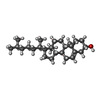
 Processing
 Electron microscopy
 FIELD EMISSION GUN