Journal: Nature / Year: 2026 Title: Plastoglobules compartmentalize nitrogen assimilation in maize. Authors: Di Chen / Lulu Gao / Shujun Li / Yiqiu Cheng / Xiaoxian Wu / Wenhao Li / Jinman Zhang / Xueling Fu / Pan Xiang / Lu Sun / Zhiteng Chen / Hua Zhang / Youliang Li / Shiqi Luo / Chong You / ...Authors: Di Chen / Lulu Gao / Shujun Li / Yiqiu Cheng / Xiaoxian Wu / Wenhao Li / Jinman Zhang / Xueling Fu / Pan Xiang / Lu Sun / Zhiteng Chen / Hua Zhang / Youliang Li / Shiqi Luo / Chong You / Linhan Sun / Xing Huang / Yidong Zhu / Xing Zeng / Wenqin Wang / Yan He / Haihai Wang / Yu Zhang / Xuewei Chen / Yongrui Wu / Yongcai Huang / Abstract: Efficient nitrogen assimilation is important for sustainable agriculture, yet its subcellular organization remains unknown. Here we show that plastoglobules (PGs) in the chloroplasts of mesophyll ...Efficient nitrogen assimilation is important for sustainable agriculture, yet its subcellular organization remains unknown. Here we show that plastoglobules (PGs) in the chloroplasts of mesophyll cells function as a metabolic hub that orchestrates nitrogen utilization in maize. Nitrogen-responsive dynamics of PGs represent a conserved feature across plant species. We identify two key enzymes, nitrite reductase 2 (ZmNIR2) and glutamine synthetase 1 (ZmGLN1), specifically targeted to PGs by a chloroplast transit peptide and hydrophobic region. Cryogenic electron microscopy analysis of recombinant ZmGLN1 shows a decameric complex, enabling a metabolon with ZmNIR2 for enhanced efficiency. Among two NIR and six GLN enzymes, ZmNIR2 and ZmGLN1 are the primary PG-localized components that orchestrate sub-organellar nitrogen assimilation and dictate nitrogen use efficiency. Genetic variation in ZmNIR2 splicing in cultivated germplasm generates a PG-targeted isoform (ZmNIR2) that boosts NUE. Our work establishes PGs as a central compartment for primary nitrogen assimilation, providing a promising strategy to develop high-NUE crops for global food security.
In the structure databanks used in Yorodumi, some data are registered as the other names, "COVID-19 virus" and "2019-nCoV". Here are the details of the virus and the list of structure data.
Jan 31, 2019. EMDB accession codes are about to change! (news from PDBe EMDB page)
EMDB accession codes are about to change! (news from PDBe EMDB page)
The allocation of 4 digits for EMDB accession codes will soon come to an end. Whilst these codes will remain in use, new EMDB accession codes will include an additional digit and will expand incrementally as the available range of codes is exhausted. The current 4-digit format prefixed with “EMD-” (i.e. EMD-XXXX) will advance to a 5-digit format (i.e. EMD-XXXXX), and so on. It is currently estimated that the 4-digit codes will be depleted around Spring 2019, at which point the 5-digit format will come into force.
The EM Navigator/Yorodumi systems omit the EMD- prefix.
Related info.:Q: What is EMD? / ID/Accession-code notation in Yorodumi/EM Navigator
Yorodumi is a browser for structure data from EMDB, PDB, SASBDB, etc.
This page is also the successor to EM Navigator detail page, and also detail information page/front-end page for Omokage search.
The word "yorodu" (or yorozu) is an old Japanese word meaning "ten thousand". "mi" (miru) is to see.
Related info.:EMDB / PDB / SASBDB / Comparison of 3 databanks / Yorodumi Search / Aug 31, 2016. New EM Navigator & Yorodumi / Yorodumi Papers / Jmol/JSmol / Function and homology information / Changes in new EM Navigator and Yorodumi
 Movie
Movie Controller


 Open data
 Basic information
 Map data
 Sample
 Keywords
 Function and homology information
 Zea mays (maize)
 Authors
 China, 1 items
  Citation
 Structure visualization
 Downloads & links
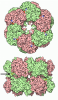
 emd_66135.png
 http://ftp.pdbj.org/pub/emdb/structures/EMD-66135
 Z (Sec.)
 Y (Row.)
 X (Col.)


 Sample components
 Escherichia coli (E. coli)
 Processing
 Electron microscopy
 FIELD EMISSION GUN

