Journal: Nature / Year: 2026 Title: Molecular glue degraders of HuR suppress BRAF-mutant colorectal cancer. Authors: Xiaocui Lu / Xiuyun Wang / Zheng Yang / Xusheng Wang / Lin Wang / Chunhui Xu / I-Chung Lo / Chenlu Geng / Lin Wang / Yisheng Pu / Keyu Zhang / Ziqiang Zhu / Lanxin Ye / Jiayuan Huang / ...Authors: Xiaocui Lu / Xiuyun Wang / Zheng Yang / Xusheng Wang / Lin Wang / Chunhui Xu / I-Chung Lo / Chenlu Geng / Lin Wang / Yisheng Pu / Keyu Zhang / Ziqiang Zhu / Lanxin Ye / Jiayuan Huang / Xiaofan Wei / Fang Bai / Yanan Zhu / Xiaobing Qian / Hao Dou / Hexiu Su / Yong Cang / Abstract: BRAF gain-of-function mutations, particularly BRAF(V600E), affect roughly 10% of all patients with colorectal cancer (CRC), and portend poor prognosis with limited therapeutic interventions. BRAF ...BRAF gain-of-function mutations, particularly BRAF(V600E), affect roughly 10% of all patients with colorectal cancer (CRC), and portend poor prognosis with limited therapeutic interventions. BRAF inhibitors such as encorafenib are ineffective due to MAPK pathway reactivation driven by BRAF dimerization. Combined inhibition of BRAF and EGFR, although approved therapies, results in short survival benefits and frequent treatment resistance and relapse. Here, through rational chemical library design coupled with parallel proteomic screening, we identified dHuR as a molecular glue degrader of human antigen R (HuR), an RNA-binding protein that drives tumour growth, invasion and therapy resistance. dHuR binds to the CRBN ubiquitin ligase to create a unique benzofuran-tethered composite surface to recruit HuR as a neosubstrate by engaging its β-hairpin G-loop degron, as revealed by the cryo-electron microscopy structure of the ternary complex. dHuR abrogated BRAF expression by inducing its exon 18 skipping, and demonstrated superior suppression of BRAF-mutant CRC tumours including those gaining resistance to BRAF inhibitors. Finally, we performed kinome library CRISPR screening and revealed that inactivation of EGFR or MEK enhanced dHuR cytotoxicity, thus establishing a combinatorial strategy to treat patients with refractory BRAF-mutant CRC.
In the structure databanks used in Yorodumi, some data are registered as the other names, "COVID-19 virus" and "2019-nCoV". Here are the details of the virus and the list of structure data.
Jan 31, 2019. EMDB accession codes are about to change! (news from PDBe EMDB page)
EMDB accession codes are about to change! (news from PDBe EMDB page)
The allocation of 4 digits for EMDB accession codes will soon come to an end. Whilst these codes will remain in use, new EMDB accession codes will include an additional digit and will expand incrementally as the available range of codes is exhausted. The current 4-digit format prefixed with “EMD-” (i.e. EMD-XXXX) will advance to a 5-digit format (i.e. EMD-XXXXX), and so on. It is currently estimated that the 4-digit codes will be depleted around Spring 2019, at which point the 5-digit format will come into force.
The EM Navigator/Yorodumi systems omit the EMD- prefix.
Related info.:Q: What is EMD? / ID/Accession-code notation in Yorodumi/EM Navigator
Yorodumi is a browser for structure data from EMDB, PDB, SASBDB, etc.
This page is also the successor to EM Navigator detail page, and also detail information page/front-end page for Omokage search.
The word "yorodu" (or yorozu) is an old Japanese word meaning "ten thousand". "mi" (miru) is to see.
Related info.:EMDB / PDB / SASBDB / Comparison of 3 databanks / Yorodumi Search / Aug 31, 2016. New EM Navigator & Yorodumi / Yorodumi Papers / Jmol/JSmol / Function and homology information / Changes in new EM Navigator and Yorodumi
 Movie
Movie Controller


 Open data
 Basic information
 Map data
 Sample
 Keywords
 Function and homology information
 Homo sapiens (human)
 Authors
 China, 2 items
  Citation
 Structure visualization
 Downloads & links
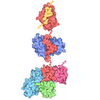
 emd_65569.png
 http://ftp.pdbj.org/pub/emdb/structures/EMD-65569

 Z (Sec.)
 Y (Row.)
 X (Col.)


 Sample components
 Processing
 Electron microscopy
 FIELD EMISSION GUN