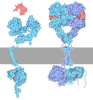
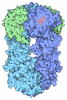
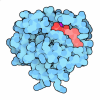
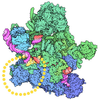
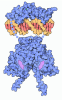
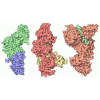
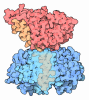
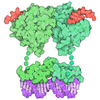
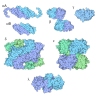
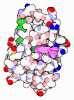
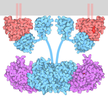
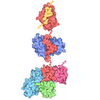
Protein or peptide: Heat shock protein HSP 90-alpha
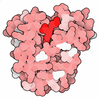
Protein or peptide: Serine/threonine-protein kinase PINK1, mitochondrial
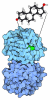
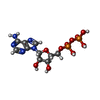
Ligand: ADENOSINE-5'-DIPHOSPHATE
Keywords
Hsp90 / PINK1 / CYTOSOLIC PROTEIN / CHAPERONE
Function / homology
Function and homology information
positive regulation of free ubiquitin chain polymerization / positive regulation of synaptic transmission, dopaminergic / positive regulation of cristae formation / : / mitochondrion to lysosome vesicle-mediated transport / maintenance of protein location in mitochondrion / : / cellular response to hydrogen sulfide / protein kinase B binding / Lewy body ...positive regulation of free ubiquitin chain polymerization / positive regulation of synaptic transmission, dopaminergic / positive regulation of cristae formation / : / mitochondrion to lysosome vesicle-mediated transport / maintenance of protein location in mitochondrion / : / cellular response to hydrogen sulfide / protein kinase B binding / Lewy body / regulation of autophagy of mitochondrion / regulation of synaptic vesicle transport / TORC2 signaling / negative regulation of hypoxia-induced intrinsic apoptotic signaling pathway / positive regulation of mitochondrial electron transport, NADH to ubiquinone / regulation of oxidative phosphorylation / regulation of hydrogen peroxide metabolic process / negative regulation of hydrogen peroxide-induced neuron intrinsic apoptotic signaling pathway / C3HC4-type RING finger domain binding / dopamine secretion / regulation of cellular response to oxidative stress / negative regulation of autophagosome assembly / positive regulation of dopamine secretion / autophagy of mitochondrion / positive regulation of type 2 mitophagy / cellular response to toxic substance / negative regulation of oxidative stress-induced neuron intrinsic apoptotic signaling pathway / regulation of mitochondrion organization / negative regulation of JNK cascade / regulation of reactive oxygen species metabolic process / : / peptidase activator activity / sperm mitochondrial sheath / sulfonylurea receptor binding / dATP binding / CTP binding / positive regulation of protein polymerization / Scavenging by Class F Receptors / vRNP Assembly / UTP binding / astrocyte projection / positive regulation of ubiquitin-protein transferase activity / positive regulation of mitochondrial fission / negative regulation of intrinsic apoptotic signaling pathway in response to hydrogen peroxide / negative regulation of macroautophagy / chaperone-mediated autophagy / sperm plasma membrane / Respiratory syncytial virus genome replication / Rho GDP-dissociation inhibitor binding / telomerase holoenzyme complex assembly / mitochondrial transport / negative regulation of mitophagy / FOXO-mediated transcription of cell death genes / Drug-mediated inhibition of ERBB2 signaling / Resistance of ERBB2 KD mutants to trastuzumab / Resistance of ERBB2 KD mutants to sapitinib / Resistance of ERBB2 KD mutants to tesevatinib / Resistance of ERBB2 KD mutants to neratinib / Resistance of ERBB2 KD mutants to osimertinib / Resistance of ERBB2 KD mutants to afatinib / Resistance of ERBB2 KD mutants to AEE788 / Resistance of ERBB2 KD mutants to lapatinib / Drug resistance in ERBB2 TMD/JMD mutants / Uptake and function of diphtheria toxin / protein import into mitochondrial matrix / negative regulation of intrinsic apoptotic signaling pathway / TPR domain binding / dendritic growth cone / positive regulation of release of cytochrome c from mitochondria / PIWI-interacting RNA (piRNA) biogenesis / Assembly and release of respiratory syncytial virus (RSV) virions / non-chaperonin molecular chaperone ATPase / positive regulation of ATP biosynthetic process / negative regulation of reactive oxygen species metabolic process / hemopoiesis / positive regulation of macroautophagy / protein unfolding / Sema3A PAK dependent Axon repulsion / regulation of protein ubiquitination / positive regulation of cell size / HSF1-dependent transactivation / protein folding chaperone complex / enzyme-substrate adaptor activity / response to unfolded protein / negative regulation of mitochondrial fission / regulation of protein-containing complex assembly / HSF1 activation / Attenuation phase / chaperone-mediated protein complex assembly / neurofibrillary tangle assembly / RHOBTB2 GTPase cycle / regulation of postsynaptic membrane neurotransmitter receptor levels / axonal growth cone / telomere maintenance via telomerase / mitophagy / skeletal muscle contraction / positive regulation of lamellipodium assembly / nitric oxide metabolic process / positive regulation of defense response to virus by host / response to salt stress Similarity search - Function
PINK1, protein kinase domain / : / Heat shock protein Hsp90, conserved site / Heat shock hsp90 proteins family signature. / HSP90, C-terminal domain / Heat shock protein Hsp90, N-terminal / Heat shock protein Hsp90 family / Hsp90 protein / Histidine kinase-, DNA gyrase B-, and HSP90-like ATPase / Histidine kinase/HSP90-like ATPase ...PINK1, protein kinase domain / : / Heat shock protein Hsp90, conserved site / Heat shock hsp90 proteins family signature. / HSP90, C-terminal domain / Heat shock protein Hsp90, N-terminal / Heat shock protein Hsp90 family / Hsp90 protein / Histidine kinase-, DNA gyrase B-, and HSP90-like ATPase / Histidine kinase/HSP90-like ATPase / Histidine kinase-like ATPases / Histidine kinase/HSP90-like ATPase superfamily / Ribosomal protein S5 domain 2-type fold / Serine/threonine-protein kinase, active site / Serine/Threonine protein kinases active-site signature. / Protein kinase domain / Serine/Threonine protein kinases, catalytic domain / Protein kinase domain profile. / Protein kinase domain / Protein kinase-like domain superfamily Similarity search - Domain/homology
In the structure databanks used in Yorodumi, some data are registered as the other names, "COVID-19 virus" and "2019-nCoV". Here are the details of the virus and the list of structure data.
Jan 31, 2019. EMDB accession codes are about to change! (news from PDBe EMDB page)
EMDB accession codes are about to change! (news from PDBe EMDB page)
The allocation of 4 digits for EMDB accession codes will soon come to an end. Whilst these codes will remain in use, new EMDB accession codes will include an additional digit and will expand incrementally as the available range of codes is exhausted. The current 4-digit format prefixed with “EMD-” (i.e. EMD-XXXX) will advance to a 5-digit format (i.e. EMD-XXXXX), and so on. It is currently estimated that the 4-digit codes will be depleted around Spring 2019, at which point the 5-digit format will come into force.
The EM Navigator/Yorodumi systems omit the EMD- prefix.
Related info.:Q: What is EMD? / ID/Accession-code notation in Yorodumi/EM Navigator
Yorodumi is a browser for structure data from EMDB, PDB, SASBDB, etc.
This page is also the successor to EM Navigator detail page, and also detail information page/front-end page for Omokage search.
The word "yorodu" (or yorozu) is an old Japanese word meaning "ten thousand". "mi" (miru) is to see.
Related info.:EMDB / PDB / SASBDB / Comparison of 3 databanks / Yorodumi Search / Aug 31, 2016. New EM Navigator & Yorodumi / Yorodumi Papers / Jmol/JSmol / Function and homology information / Changes in new EM Navigator and Yorodumi