National Natural Science Foundation of China (NSFC)
32170158
中国
引用
ジャーナル: Nature / 年: 2025 タイトル: A MERS-CoV-like mink coronavirus uses ACE2 as an entry receptor. 著者: Ningning Wang / Weiwei Ji / Houqi Jiao / Michael Veit / Ju Sun / Yanjun Wang / Xing Ma / Yu Wang / Yutong Wang / Xin-Xin Li / Xiaoguang Zhang / Jie Chen / Jiayu Wei / Ying Xu / Dawei Guo / ...著者: Ningning Wang / Weiwei Ji / Houqi Jiao / Michael Veit / Ju Sun / Yanjun Wang / Xing Ma / Yu Wang / Yutong Wang / Xin-Xin Li / Xiaoguang Zhang / Jie Chen / Jiayu Wei / Ying Xu / Dawei Guo / Xiaofeng Zhai / Andres Merits / Chang Li / Félix A Rey / Georgi M Dobrikov / George F Gao / Shuijun Zhang / Yuhai Bi / Shuo Su / 要旨: Despite accumulating evidence that bat-derived coronaviruses often require intermediate hosts to facilitate transmission to humans, the potential role of fur animals in zoonotic coronavirus ...Despite accumulating evidence that bat-derived coronaviruses often require intermediate hosts to facilitate transmission to humans, the potential role of fur animals in zoonotic coronavirus spillovers has largely been overlooked. Here we report the isolation and characterization of a previously undescribed mink respiratory coronavirus (MRCoV) from farmed minks with pneumonia. Notably, MRCoV uses angiotensin-converting enzyme 2 (ACE2) as an entry receptor and can infect mink, bat, monkey and human cells. Cryo-electron microscopy analyses revealed that the MRCoV receptor-binding domain (RBD) binds to the same interface on ACE2 receptors as the RBD of severe acute respiratory syndrome coronavirus 2 (SARS-CoV-2) despite structural differences. We identify the key determinants on the RBD of MRCoV and ACE2 that confer efficient binding. HKU5-33S, a bat coronavirus closely related to MRCoV, uses ACE2 of the bat Pipistrellus abramus for cell entry and requires only two amino acid substitutions to adapt to mink ACE2. SARS-CoV-2 protease and polymerase inhibitors potently block MRCoV infection, thereby indicating a potential therapeutic strategy. Collectively, these findings enhance our understanding of coronavirus receptor dynamics and highlight their zoonotic potential. Given the risks posed by fur farms as reservoirs for emerging pathogens, our study underscores the need for enhanced surveillance to mitigate future coronavirus outbreaks.
 ムービー
ムービー コントローラー


 データを開く
 基本情報
基本情報
 マップデータ
 試料
試料 キーワード
キーワード 機能・相同性情報
 Neogale vison (哺乳類) /
  Bat coronavirus HKU5 (ウイルス)
 データ登録者
 中国, 1件
  引用
引用


 構造の表示
構造の表示
 ダウンロードとリンク
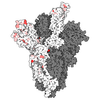
 emd_60524.png
 http://ftp.pdbj.org/pub/emdb/structures/EMD-60524

 Z (Sec.)
 Y (Row.)
 X (Col.)


 試料の構成要素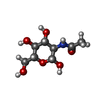
 解析
解析 電子顕微鏡法
 FIELD EMISSION GUN
