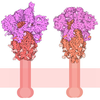
Journal: Proc Natl Acad Sci U S A / Year: 2026 Title: Cryo-EM structure of locked spike glycoprotein from bat SARS-like coronavirus WIV1, molecular dynamics and biophysics across host range. Authors: Chuan Liu / Jingjing Zheng / Yuhan Wang / Florian Beck / István Nagy / Stefan Bohn / Jürgen M Plitzko / Wolfgang Baumeister / Xiaoxiao Zhang / Liping Sun / Luca Zinzula / Abstract: As made evident by severe acute respiratory syndrome coronavirus 1 (SARS-CoV-1) and SARS-CoV-2 pandemics, the possibility of a SARS-like coronavirus (SL-CoV) emerging again in humankind after ...As made evident by severe acute respiratory syndrome coronavirus 1 (SARS-CoV-1) and SARS-CoV-2 pandemics, the possibility of a SARS-like coronavirus (SL-CoV) emerging again in humankind after zoonotic spillover represents a significant global health threat. Given the role of spike (S) glycoprotein in mediating SL-CoV cell entry and cross-species transmission, there remains urgent need of structural information on SL-CoV S to guide therapeutic countermeasure development. Among SL-CoVs, bat-derived WIV1 is capable of using as receptor the angiotensin converting enzyme 2 (ACE2) from a variety of mammals, thereby representing a prototype model for studying SL-CoV precursors to future pandemics. We present a WIV1 S cryo-EM structure in prefusion state which reveals molecular signatures reminiscent of the tightly-packed locked-1 conformation described for SARS-CoV-1 and SARS-CoV-2. To decipher the molecular basis for bat SL-CoV WIV1 host range tropism, we performed molecular dynamics (MD) simulations of WIV1 S-ACE2 interaction across reservoir bat, potentially intermediate hosts civet, raccoon dog and pangolin, and accidental human hosts. We found that, in all interactions, upon complex formation with ACE2, the linoleic acid responsible for locking the S receptor binding domain (RBD) dynamically persists in its binding pocket, however repositioning to potentially unlock the system. Complex formation between WIV1 S-RBD and ACE2 from different hosts was characterized in vitro by mass photometry and microscale thermophoresis, revealing that interaction is stronger with ACE2 from bat and human than other hosts, within the latter stronger for the Thr92Ile polymorphism correlated to higher SARS-CoV-2 infection susceptibility. These findings provide critical insights with crucial implications for pandemic preparedness.
In the structure databanks used in Yorodumi, some data are registered as the other names, "COVID-19 virus" and "2019-nCoV". Here are the details of the virus and the list of structure data.
Jan 31, 2019. EMDB accession codes are about to change! (news from PDBe EMDB page)
EMDB accession codes are about to change! (news from PDBe EMDB page)
The allocation of 4 digits for EMDB accession codes will soon come to an end. Whilst these codes will remain in use, new EMDB accession codes will include an additional digit and will expand incrementally as the available range of codes is exhausted. The current 4-digit format prefixed with “EMD-” (i.e. EMD-XXXX) will advance to a 5-digit format (i.e. EMD-XXXXX), and so on. It is currently estimated that the 4-digit codes will be depleted around Spring 2019, at which point the 5-digit format will come into force.
The EM Navigator/Yorodumi systems omit the EMD- prefix.
Related info.:Q: What is EMD? / ID/Accession-code notation in Yorodumi/EM Navigator
Yorodumi is a browser for structure data from EMDB, PDB, SASBDB, etc.
This page is also the successor to EM Navigator detail page, and also detail information page/front-end page for Omokage search.
The word "yorodu" (or yorozu) is an old Japanese word meaning "ten thousand". "mi" (miru) is to see.
Related info.:EMDB / PDB / SASBDB / Comparison of 3 databanks / Yorodumi Search / Aug 31, 2016. New EM Navigator & Yorodumi / Yorodumi Papers / Jmol/JSmol / Function and homology information / Changes in new EM Navigator and Yorodumi
 Movie
Movie Controller

 Yorodumi
 Open data
 Basic information
 Map data
 Sample
 Keywords
 Function and homology information
 Bat SARS-like coronavirus WIV1
 Authors
 Citation


 Structure visualization
 Downloads & links
 emd_60253.png
 http://ftp.pdbj.org/pub/emdb/structures/EMD-60253
 Z (Sec.)
 Y (Row.)
 X (Col.)


 Sample components
 Spodoptera frugiperda (fall armyworm)
 Processing
 Electron microscopy
 FIELD EMISSION GUN
