 Movie
Movie Controller

[English] 日本語
 Yorodumi
- EMDB-52611: Human TRPM4 ion channel in MAASTY copolymer lipid nanodisc in a c... -
+ Open data

- Basic information
| Entry |  | |||||||||
|---|---|---|---|---|---|---|---|---|---|---|
| Title | Human TRPM4 ion channel in MAASTY copolymer lipid nanodisc in a calcium-bound state | |||||||||
 Map data Map data | Sharpened EM density map of hTRPM4 in MAASTY lipid nanodiscs. | |||||||||
 Sample Sample |
| |||||||||
 Keywords Keywords | Ion Channel / Copolymer / Native Nanodisc / Calcium-bound / TRP Channel / MEMBRANE PROTEIN | |||||||||
| Function / homology |  Function and homology information Function and homology informationpositive regulation of atrial cardiac muscle cell action potential / positive regulation of regulation of vascular associated smooth muscle cell membrane depolarization / sodium channel complex / regulation of T cell cytokine production / negative regulation of bone mineralization / membrane depolarization during AV node cell action potential / membrane depolarization during bundle of His cell action potential / membrane depolarization during Purkinje myocyte cell action potential / regulation of ventricular cardiac muscle cell action potential / metal ion transport ...positive regulation of atrial cardiac muscle cell action potential / positive regulation of regulation of vascular associated smooth muscle cell membrane depolarization / sodium channel complex / regulation of T cell cytokine production / negative regulation of bone mineralization / membrane depolarization during AV node cell action potential / membrane depolarization during bundle of His cell action potential / membrane depolarization during Purkinje myocyte cell action potential / regulation of ventricular cardiac muscle cell action potential / metal ion transport / calcium-activated cation channel activity / sodium ion import across plasma membrane / dendritic cell chemotaxis / sodium channel activity / TRP channels / cellular response to ATP / regulation of heart rate by cardiac conduction / positive regulation of fat cell differentiation / monoatomic cation transmembrane transport / protein sumoylation / positive regulation of vasoconstriction / negative regulation of osteoblast differentiation / positive regulation of heart rate / positive regulation of adipose tissue development / positive regulation of insulin secretion involved in cellular response to glucose stimulus / calcium-mediated signaling / transmembrane transport / calcium channel activity / calcium ion transmembrane transport / positive regulation of canonical Wnt signaling pathway / Sensory perception of sweet, bitter, and umami (glutamate) taste / positive regulation of cytosolic calcium ion concentration / protein homotetramerization / neuronal cell body / positive regulation of cell population proliferation / calcium ion binding / Golgi apparatus / endoplasmic reticulum / ATP binding / membrane / identical protein binding / plasma membrane Similarity search - Function | |||||||||
| Biological species |  Homo sapiens (human) Homo sapiens (human) | |||||||||
| Method | single particle reconstruction / cryo EM / Resolution: 3.46 Å | |||||||||
 Authors Authors | Pugh CF / Feilen LP / Zivkovic D / Praestegaard KF / Sideris C / Borthwick NJ / De Lichtenberg C / Bolla JR / Autzen AAA / Autzen HE | |||||||||
| Funding support |  Denmark, 1 items Denmark, 1 items
| |||||||||
 Citation Citation | Journal: Nat Commun / Year: 2025 Title: MAASTY: a (dis)ordered copolymer for structural determination of human membrane proteins in native nanodiscs. Authors: Ciara F Pugh / Lukas P Feilen / Dušan Živković / Kaia F Præstegaard / Charalampos Sideris / Neil J Borthwick / Casper de Lichtenberg / Jani R Bolla / Anton A A Autzen / Henriette E Autzen /  Abstract: Amphiphilic copolymers capable of extracting membrane proteins directly from cellular membranes into "native nanodiscs" offer a simplified approach for preparing membrane proteins in lipid nanodiscs ...Amphiphilic copolymers capable of extracting membrane proteins directly from cellular membranes into "native nanodiscs" offer a simplified approach for preparing membrane proteins in lipid nanodiscs compared to approaches that rely on detergent. Copolymer amphiphilicity, length, and composition influence their performance, in addition to the protein itself and the purification conditions used. Here, we report a copolymer composed of methacrylic acid and styrene, which we term MAASTY, leveraging the inherent monomer reactivity ratios to create an anionic copolymer with a statistical distribution of monomers. We show that MAASTY can be used for high-resolution structural determination of a human membrane protein by single particle cryo-electron microscopy, preserving endogenous lipids including cholesterol and exhibiting an enrichment of phosphatidylinositol. Moreover, MAASTY copolymers effectively solubilize a broad range of lipid species and a wide range of different, eukaryotic membrane proteins from mammalian cells. We find that MAASTY copolymers are promising as effective solubilizers of membrane proteins and offer a chemical platform for structural and functional characterization of membrane proteins in native nanodiscs. | |||||||||
| History |
|
- Structure visualization
| Supplemental images |
|---|

- Downloads & links
-EMDB archive
| Map data | emd_52611.map.gz | 312 MB | EMDB map data format | |
|---|---|---|---|---|
| Header (meta data) | emd-52611-v30.xmlemd-52611.xml | 22.9 KB 22.9 KB | Display Display | EMDB header |
| FSC (resolution estimation) | emd_52611_fsc.xml | 15.9 KB | Display | FSC data file |
| Images |  emd_52611.png emd_52611.png | 151.1 KB | ||
| Masks | emd_52611_msk_1.map | 343 MB | Mask map | |
| Filedesc metadata | emd-52611.cif.gz | 7.1 KB | ||
| Others | emd_52611_additional_1.map.gzemd_52611_half_map_1.map.gzemd_52611_half_map_2.map.gz | 317.2 MB 306.1 MB 307.8 MB | ||
| Archive directory |  https://data.pdbj.org/pub/emdb/structures/EMD-52611ftp://data.pdbj.org/pub/emdb/structures/EMD-52611 https://data.pdbj.org/pub/emdb/structures/EMD-52611ftp://data.pdbj.org/pub/emdb/structures/EMD-52611 | HTTPS FTP |
-Related structure data
| Related structure data |  9i3rMC  9smkC M: atomic model generated by this map C: citing same article ( |
|---|---|
| Similar structure data |

-Links
| EMDB pages | EMDB (EBI/PDBe) / EMDataResource |
|---|
-Map
| File | Download / File: emd_52611.map.gz / Format: CCP4 / Size: 343 MB / Type: IMAGE STORED AS FLOATING POINT NUMBER (4 BYTES) | ||||||||||||||||||||||||||||||||||||
|---|---|---|---|---|---|---|---|---|---|---|---|---|---|---|---|---|---|---|---|---|---|---|---|---|---|---|---|---|---|---|---|---|---|---|---|---|---|
| Annotation | Sharpened EM density map of hTRPM4 in MAASTY lipid nanodiscs. | ||||||||||||||||||||||||||||||||||||
| Projections & slices | Image control
Images are generated by Spider. | ||||||||||||||||||||||||||||||||||||
| Voxel size | X=Y=Z: 0.725 Å | ||||||||||||||||||||||||||||||||||||
| Density |
| ||||||||||||||||||||||||||||||||||||
| Symmetry | Space group: 1 | ||||||||||||||||||||||||||||||||||||
| Details | EMDB XML:
|
 Z (Sec.)
 Y (Row.)
 X (Col.)


-Supplemental data
-Mask #1
| File | emd_52611_msk_1.map | ||||||||||||
|---|---|---|---|---|---|---|---|---|---|---|---|---|---|
| Projections & Slices |
| ||||||||||||
| Density Histograms |


-Additional map: Unsharpened EM density map of hTRPM4 in MAASTY lipid nanodiscs.
| File | emd_52611_additional_1.map | ||||||||||||
|---|---|---|---|---|---|---|---|---|---|---|---|---|---|
| Annotation | Unsharpened EM density map of hTRPM4 in MAASTY lipid nanodiscs. | ||||||||||||
| Projections & Slices |
| ||||||||||||
| Density Histograms |


-Half map: EM density half map 2 from EM density...
| File | emd_52611_half_map_1.map | ||||||||||||
|---|---|---|---|---|---|---|---|---|---|---|---|---|---|
| Annotation | EM density half map 2 from EM density map of hTRPM4 in MAASTY lipid nanodiscs. | ||||||||||||
| Projections & Slices |
| ||||||||||||
| Density Histograms |


-Half map: EM density half map 1 from EM density...
| File | emd_52611_half_map_2.map | ||||||||||||
|---|---|---|---|---|---|---|---|---|---|---|---|---|---|
| Annotation | EM density half map 1 from EM density map of hTRPM4 in MAASTY lipid nanodiscs. | ||||||||||||
| Projections & Slices |
| ||||||||||||
| Density Histograms |


- Sample components
-Entire : Human TRPM4 transient receptor potential cation channel subfamily...
| Entire | Name: Human TRPM4 transient receptor potential cation channel subfamily M member 4 from Homo sapiens |
|---|---|
| Components |
|
-Supramolecule #1: Human TRPM4 transient receptor potential cation channel subfamily...
| Supramolecule | Name: Human TRPM4 transient receptor potential cation channel subfamily M member 4 from Homo sapiens type: complex / ID: 1 / Parent: 0 / Macromolecule list: #1 |
|---|---|
| Source (natural) | Organism: Homo sapiens (human) |
| Molecular weight | Theoretical: 537.2 KDa |
-Macromolecule #1: Transient receptor potential cation channel subfamily M member 4
| Macromolecule | Name: Transient receptor potential cation channel subfamily M member 4 type: protein_or_peptide / ID: 1 Details: StrepTagII and eGFP fusion proteins in the N-terminus Number of copies: 4 / Enantiomer: LEVO |
|---|---|
| Source (natural) | Organism: Homo sapiens (human) |
| Molecular weight | Theoretical: 134.770734 KDa |
| Recombinant expression | Organism: Homo sapiens (human) |
| Sequence | String: SGRSGVVPEK EQSWIPKIFK KKTCTTFIVD STDPGGTLCQ CGRPRTAHPA VAMEDAFGAA VVTVWDSDAH TTEKPTDAYG ELDFTGAGR KHSNFLRLSD RTDPAAVYSL VTRTWGFRAP NLVVSVLGGS GGPVLQTWLQ DLLRRGLVRA AQSTGAWIVT G GLHTGIGR ...String: SGRSGVVPEK EQSWIPKIFK KKTCTTFIVD STDPGGTLCQ CGRPRTAHPA VAMEDAFGAA VVTVWDSDAH TTEKPTDAYG ELDFTGAGR KHSNFLRLSD RTDPAAVYSL VTRTWGFRAP NLVVSVLGGS GGPVLQTWLQ DLLRRGLVRA AQSTGAWIVT G GLHTGIGR HVGVAVRDHQ MASTGGTKVV AMGVAPWGVV RNRDTLINPK GSFPARYRWR GDPEDGVQFP LDYNYSAFFL VD DGTHGCL GGENRFRLRL ESYISQQKTG VGGTGIDIPV LLLLIDGDEK MLTRIENATQ AQLPCLLVAG SGGAADCLAE TLE DTLAPG SGGARQGEAR DRIRRFFPKG DLEVLQAQVE RIMTRKELLT VYSSEDGSEE FETIVLKALV KACGSSEASA YLDE LRLAV AWNRVDIAQS ELFRGDIQWR SFHLEASLMD ALLNDRPEFV RLLISHGLSL GHFLTPMRLA QLYSAAPSNS LIRNL LDQA SHSAGTKAPA LKGGAAELRP PDVGHVLRML LGKMCAPRYP SGGAWDPHPG QGFGESMYLL SDKATSPLSL DAGLGQ APW SDLLLWALLL NRAQMAMYFW EMGSNAVSSA LGACLLLRVM ARLEPDAEEA ARRKDLAFKF EGMGVDLFGE CYRSSEV RA ARLLLRRCPL WGDATCLQLA MQADARAFFA QDGVQSLLTQ KWWGDMASTT PIWALVLAFF CPPLIYTRLI TFRKSEEE P TREELEFDMD SVINGEGPVG TADPAEKTPL GVPRQSGRPG CCGGRCGGRR CLRRWFHFWG APVTIFMGNV VSYLLFLLL FSRVLLVDFQ PAPPGSLELL LYFWAFTLLC EELRQGLSGG GGSLASGGPG PGHASLSQRL RLYLADSWNQ CDLVALTCFL LGVGCRLTP GLYHLGRTVL CIDFMVFTVR LLHIFTVNKQ LGPKIVIVSK MMKDVFFFLF FLGVWLVAYG VATEGLLRPR D SDFPSILR RVFYRPYLQI FGQIPQEDMD VALMEHSNCS SEPGFWAHPP GAQAGTCVSQ YANWLVVLLL VIFLLVANIL LV NLLIAMF SYTFGKVQGN SDLYWKAQRY RLIREFHSRP ALAPPFIVIS HLRLLLRQLC RRPRSPQPSS PALEHFRVYL SKE AERKLL TWESVHKENF LLARARDKRE SDSERLKRTS QKVDLALKQL GHIREYEQRL KVLEREVQQC SRVLGWVAEA LSRS ALLPP GGPPPPDLPG SKD UniProtKB: Transient receptor potential cation channel subfamily M member 4 |
-Macromolecule #2: CHOLESTEROL
| Macromolecule | Name: CHOLESTEROL / type: ligand / ID: 2 / Number of copies: 12 / Formula: CLR |
|---|---|
| Molecular weight | Theoretical: 386.654 Da |
| Chemical component information | 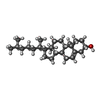 ChemComp-CLR: |
-Macromolecule #3: CALCIUM ION
| Macromolecule | Name: CALCIUM ION / type: ligand / ID: 3 / Number of copies: 4 / Formula: CA |
|---|---|
| Molecular weight | Theoretical: 40.078 Da |
-Experimental details
-Structure determination
| Method | cryo EM |
|---|---|
 Processing Processing | single particle reconstruction |
| Aggregation state | particle |
-Sample preparation
| Concentration | 1.4 mg/mL |
|---|---|
| Buffer | pH: 7.4 |
| Grid | Model: Quantifoil R1.2/1.3 / Material: GOLD / Mesh: 300 / Pretreatment - Type: GLOW DISCHARGE |
| Vitrification | Cryogen name: ETHANE / Chamber humidity: 100 % / Chamber temperature: 277.15 K / Instrument: FEI VITROBOT MARK IV |
- Electron microscopy
| Microscope | TFS KRIOS |
|---|---|
| Specialist optics | Energy filter - Name: TFS Selectris X |
| Image recording | Film or detector model: FEI FALCON IV (4k x 4k) / Number grids imaged: 1 / Number real images: 6308 / Average electron dose: 52.0 e/Å2 |
| Electron beam | Acceleration voltage: 300 kV / Electron source:  FIELD EMISSION GUN FIELD EMISSION GUN |
| Electron optics | Illumination mode: OTHER / Imaging mode: OTHER / Cs: 2.7 mm / Nominal defocus max: 2.5 µm / Nominal defocus min: 0.8 µm / Nominal magnification: 165000 |
| Experimental equipment |  Model: Titan Krios / Image courtesy: FEI Company |
+Image processing

-Atomic model buiding 1
| Refinement | Overall B value: 92 |
|---|---|
| Output model | PDB-9i3r: |
