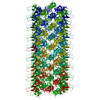
autophagy / filaments / helical reconstruction / PROTEIN FIBRIL
Function / homology
Function and homology information
brown fat cell proliferation / protein localization to perinuclear region of cytoplasm / regulation of Ras protein signal transduction / protein targeting to vacuole involved in autophagy / intracellular membraneless organelle / aggrephagy / negative regulation of toll-like receptor 4 signaling pathway / amphisome / response to mitochondrial depolarisation / regulation of protein complex stability ...brown fat cell proliferation / protein localization to perinuclear region of cytoplasm / regulation of Ras protein signal transduction / protein targeting to vacuole involved in autophagy / intracellular membraneless organelle / aggrephagy / negative regulation of toll-like receptor 4 signaling pathway / amphisome / response to mitochondrial depolarisation / regulation of protein complex stability / autophagy of mitochondrion / endosome organization / pexophagy / aggresome / membraneless organelle assembly / regulation of mitochondrion organization / phagophore assembly site / ubiquitin-modified protein reader activity / Nuclear events mediated by NFE2L2 / regulation of canonical NF-kappaB signal transduction / cellular response to stress / endosomal transport / K63-linked polyubiquitin modification-dependent protein binding / Lewy body / temperature homeostasis / autolysosome / negative regulation of ferroptosis / molecular sequestering activity / energy homeostasis / mitophagy / immune system process / negative regulation of protein ubiquitination / protein catabolic process / response to ischemia / signaling adaptor activity / inclusion body / positive regulation of autophagy / ionotropic glutamate receptor binding / SH2 domain binding / autophagosome / p75NTR recruits signalling complexes / NF-kB is activated and signals survival / Pexophagy / protein kinase C binding / NRIF signals cell death from the nucleus / macroautophagy / positive regulation of long-term synaptic potentiation / positive regulation of protein localization to plasma membrane / sarcomere / PINK1-PRKN Mediated Mitophagy / ubiquitin binding / molecular condensate scaffold activity / protein sequestering activity / protein import into nucleus / P-body / receptor tyrosine kinase binding / PML body / autophagy / Interleukin-1 signaling / intracellular protein localization / sperm midpiece / Signaling by ALK fusions and activated point mutants / late endosome / KEAP1-NFE2L2 pathway / Neddylation / signaling receptor activity / ubiquitin-dependent protein catabolic process / cell differentiation / protein-macromolecule adaptor activity / intracellular signal transduction / positive regulation of apoptotic process / ubiquitin protein ligase binding / apoptotic process / protein kinase binding / protein-containing complex binding / glutamatergic synapse / enzyme binding / endoplasmic reticulum / positive regulation of transcription by RNA polymerase II / mitochondrion / extracellular exosome / nucleoplasm / zinc ion binding / identical protein binding / cytosol / cytoplasm Similarity search - Function
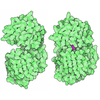
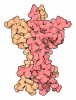
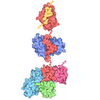
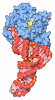
Journal: Nat Commun / Year: 2025 Title: Structural organization of p62 filaments and the cellular ultrastructure of calcium-rich p62-enwrapped lipid droplet cargo. Authors: Sabrina Berkamp / Lisa Jungbluth / Alexandros Katranidis / Siavash Mostafavi / Olivera Korculanin / Peng-Han Lu / Lotte Ickert / Maya M Dierig / Lokesh Sharma / Lipi Thukral / Pitter F ...Authors: Sabrina Berkamp / Lisa Jungbluth / Alexandros Katranidis / Siavash Mostafavi / Olivera Korculanin / Peng-Han Lu / Lotte Ickert / Maya M Dierig / Lokesh Sharma / Lipi Thukral / Pitter F Huesgen / Natalia L Kononenko / Jörg Fitter / Rafal E Dunin-Borkowski / Carsten Sachse / Abstract: The selective autophagy receptor p62/SQSTM1 is known to form higher-order filaments in vitro and to undergo liquid-liquid phase separation when mixed with poly-ubiquitin. Here, we determine the full- ...The selective autophagy receptor p62/SQSTM1 is known to form higher-order filaments in vitro and to undergo liquid-liquid phase separation when mixed with poly-ubiquitin. Here, we determine the full-length cryo-EM structure of p62 and elucidate a structured double helical filament scaffold composed of the PB1-domain associated with the flexible C-terminal part and the solvent-accessible major groove. At different pH values and upon binding to soluble LC3, LC3-conjugated membranes and poly-ubiquitin, we observe p62 filament re-arrangements in the form of structural unwinding, disassembly, lateral association and bundling, respectively. In the cellular environment, under conditions of ATG5 knockdown leading to stalled autophagy, we imaged high-contrast layers consisting of p62 oligomers enwrapping lipid droplets by cryogenic electron tomography in situ, which we identified as calcium as well as phosphorus by compositional spectroscopy analysis. Together, we visualize the cellular ultrastructure of p62 oligomers with high calcium content as a potential early stage of autophagy.
In the structure databanks used in Yorodumi, some data are registered as the other names, "COVID-19 virus" and "2019-nCoV". Here are the details of the virus and the list of structure data.
Jan 31, 2019. EMDB accession codes are about to change! (news from PDBe EMDB page)
EMDB accession codes are about to change! (news from PDBe EMDB page)
The allocation of 4 digits for EMDB accession codes will soon come to an end. Whilst these codes will remain in use, new EMDB accession codes will include an additional digit and will expand incrementally as the available range of codes is exhausted. The current 4-digit format prefixed with “EMD-” (i.e. EMD-XXXX) will advance to a 5-digit format (i.e. EMD-XXXXX), and so on. It is currently estimated that the 4-digit codes will be depleted around Spring 2019, at which point the 5-digit format will come into force.
The EM Navigator/Yorodumi systems omit the EMD- prefix.
Related info.:Q: What is EMD? / ID/Accession-code notation in Yorodumi/EM Navigator
Yorodumi is a browser for structure data from EMDB, PDB, SASBDB, etc.
This page is also the successor to EM Navigator detail page, and also detail information page/front-end page for Omokage search.
The word "yorodu" (or yorozu) is an old Japanese word meaning "ten thousand". "mi" (miru) is to see.
Related info.:EMDB / PDB / SASBDB / Comparison of 3 databanks / Yorodumi Search / Aug 31, 2016. New EM Navigator & Yorodumi / Yorodumi Papers / Jmol/JSmol / Function and homology information / Changes in new EM Navigator and Yorodumi
 Movie
Movie Controller


 Open data
 Basic information
 Map data
 Sample
 Keywords
 Function and homology information
 Homo sapiens (human)
 Authors
 Citation

 Structure visualization
 Downloads & links
 emd_52134.png
 http://ftp.pdbj.org/pub/emdb/structures/EMD-52134

 Z (Sec.)
 Y (Row.)
 X (Col.)


 Sample components
 Escherichia coli BL21(DE3) (bacteria)
 Processing
 Electron microscopy
 FIELD EMISSION GUN