NEK6-subfamily protein kinase / regulation of kinase activity / Activation of NIMA Kinases NEK9, NEK6, NEK7 / Nuclear Pore Complex (NPC) Disassembly / negative regulation of monoatomic ion transmembrane transport / cellular response to potassium ion / positive regulation by virus of viral protein levels in host cell / spindle assembly involved in female meiosis / epigenetic programming in the zygotic pronuclei / UV-damage excision repair ...NEK6-subfamily protein kinase / regulation of kinase activity / Activation of NIMA Kinases NEK9, NEK6, NEK7 / Nuclear Pore Complex (NPC) Disassembly / negative regulation of monoatomic ion transmembrane transport / cellular response to potassium ion / positive regulation by virus of viral protein levels in host cell / spindle assembly involved in female meiosis / epigenetic programming in the zygotic pronuclei / UV-damage excision repair / biological process involved in interaction with symbiont / regulation of mitotic cytokinesis / regulation of mitotic cell cycle phase transition / regulation of miRNA-mediated gene silencing / regulation of natural killer cell activation / WD40-repeat domain binding / locomotory exploration behavior / regulation of cell cycle phase transition / Cul4A-RING E3 ubiquitin ligase complex / Cul4-RING E3 ubiquitin ligase complex / regulation of stem cell population maintenance / Cul4B-RING E3 ubiquitin ligase complex / positive regulation of NLRP3 inflammasome complex assembly / microtubule organizing center / ubiquitin ligase complex scaffold activity / negative regulation of adipose tissue development / positive regulation of telomere maintenance / regulation of cellular response to stress / limb development / viral release from host cell / cullin family protein binding / positive regulation of Wnt signaling pathway / negative regulation of protein-containing complex assembly / regulation of DNA-templated DNA replication initiation / positive regulation of viral genome replication / positive regulation of gluconeogenesis / spindle assembly / EML4 and NUDC in mitotic spindle formation / regulation of embryonic development / replication fork processing / molecular function activator activity / regulation of mitotic cell cycle / proteasomal protein catabolic process / epigenetic regulation of gene expression / positive regulation of protein-containing complex assembly / nucleotide-excision repair / regulation of autophagy / Recognition of DNA damage by PCNA-containing replication complex / regulation of circadian rhythm / cell population proliferation / DNA Damage Recognition in GG-NER / Dual Incision in GG-NER / Transcription-Coupled Nucleotide Excision Repair (TC-NER) / Formation of TC-NER Pre-Incision Complex / spindle pole / Formation of Incision Complex in GG-NER / positive regulation of protein catabolic process / cellular response to UV / Dual incision in TC-NER / Gap-filling DNA repair synthesis and ligation in TC-NER / rhythmic process / regulation of cell population proliferation / site of double-strand break / Neddylation / spermatogenesis / ubiquitin-dependent protein catabolic process / Potential therapeutics for SARS / damaged DNA binding / proteasome-mediated ubiquitin-dependent protein catabolic process / microtubule / regulation of apoptotic process / transmembrane transporter binding / protein-macromolecule adaptor activity / protein phosphorylation / chromosome, telomeric region / protein ubiquitination / protein serine kinase activity / DNA repair / protein serine/threonine kinase activity / centrosome / DNA damage response / nucleolus / protein-containing complex binding / perinuclear region of cytoplasm / protein-containing complex / DNA binding / : / extracellular exosome / nucleoplasm / ATP binding / membrane / metal ion binding / nucleus / cytosol / cytoplasm Similarity search - Function
Yippee/Mis18/Cereblon / Yippee zinc-binding/DNA-binding /Mis18, centromere assembly / CULT domain / CULT domain profile. / Lon N-terminal domain profile. / Lon protease, N-terminal domain / Lon protease, N-terminal domain superfamily / ATP-dependent protease La (LON) substrate-binding domain / Found in ATP-dependent protease La (LON) / : ...Yippee/Mis18/Cereblon / Yippee zinc-binding/DNA-binding /Mis18, centromere assembly / CULT domain / CULT domain profile. / Lon N-terminal domain profile. / Lon protease, N-terminal domain / Lon protease, N-terminal domain superfamily / ATP-dependent protease La (LON) substrate-binding domain / Found in ATP-dependent protease La (LON) / : / RSE1/DDB1/CPSF1 second beta-propeller / Cleavage/polyadenylation specificity factor, A subunit, C-terminal / Cleavage/polyadenylation specificity factor, A subunit, N-terminal / : / CPSF A subunit region / RSE1/DDB1/CPSF1 first beta-propeller / PUA-like superfamily / Serine-threonine/tyrosine-protein kinase, catalytic domain / Serine/threonine-protein kinase, active site / Serine/Threonine protein kinases active-site signature. / Protein kinase domain / Serine/Threonine protein kinases, catalytic domain / WD40-repeat-containing domain superfamily / WD40/YVTN repeat-like-containing domain superfamily / Protein kinase, ATP binding site / Protein kinases ATP-binding region signature. / Protein kinase domain profile. / Protein kinase domain / Protein kinase-like domain superfamily Similarity search - Domain/homology
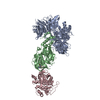
DNA damage-binding protein 1 / Serine/threonine-protein kinase Nek7 / Protein cereblon Similarity search - Component
Biological species
Homo sapiens (human)
Method
single particle reconstruction / cryo EM / Resolution: 3.4 Å
In the structure databanks used in Yorodumi, some data are registered as the other names, "COVID-19 virus" and "2019-nCoV". Here are the details of the virus and the list of structure data.
Jan 31, 2019. EMDB accession codes are about to change! (news from PDBe EMDB page)
EMDB accession codes are about to change! (news from PDBe EMDB page)
The allocation of 4 digits for EMDB accession codes will soon come to an end. Whilst these codes will remain in use, new EMDB accession codes will include an additional digit and will expand incrementally as the available range of codes is exhausted. The current 4-digit format prefixed with “EMD-” (i.e. EMD-XXXX) will advance to a 5-digit format (i.e. EMD-XXXXX), and so on. It is currently estimated that the 4-digit codes will be depleted around Spring 2019, at which point the 5-digit format will come into force.
The EM Navigator/Yorodumi systems omit the EMD- prefix.
Related info.:Q: What is EMD? / ID/Accession-code notation in Yorodumi/EM Navigator
Yorodumi is a browser for structure data from EMDB, PDB, SASBDB, etc.
This page is also the successor to EM Navigator detail page, and also detail information page/front-end page for Omokage search.
The word "yorodu" (or yorozu) is an old Japanese word meaning "ten thousand". "mi" (miru) is to see.
Related info.:EMDB / PDB / SASBDB / Comparison of 3 databanks / Yorodumi Search / Aug 31, 2016. New EM Navigator & Yorodumi / Yorodumi Papers / Jmol/JSmol / Function and homology information / Changes in new EM Navigator and Yorodumi
 Movie
Movie Controller

 Yorodumi
 Open data
 Basic information
 Map data
 Sample
 Keywords
 Function and homology information
 Homo sapiens (human)
 Authors
 Citation
 Structure visualization
 Downloads & links
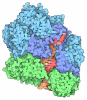
 emd_51881.png
 http://ftp.pdbj.org/pub/emdb/structures/EMD-51881
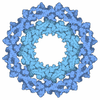
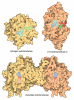
 Z (Sec.)
 Y (Row.)
 X (Col.)


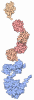
 Sample components
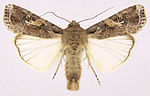 Spodoptera frugiperda (fall armyworm)
 Escherichia coli (E. coli)
 Processing
 Electron microscopy
 FIELD EMISSION GUN