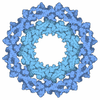
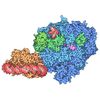
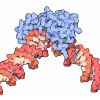
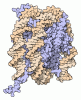
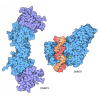
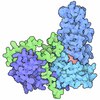
- EMDB-51645: CENP-A/H4 di-tetrasome assembled on alpha-satellite DNA. -
+
Open data
ID or keywords:
Loading...
-
Basic information
Entry
Database: EMDB / ID: EMD-51645
Title
CENP-A/H4 di-tetrasome assembled on alpha-satellite DNA.
Map data
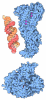
2x(CENP-A/H4)2 di-tetrasome assembled on 147bp alpha-satellite DNA.
Sample
Complex: 2x(CENP-A/H4)2 di-tetrasome assembled on alpha-satellite DNA.
Protein or peptide: Histone H3-like centromeric protein A
Protein or peptide: Histone H4
DNA: 147 bp human alpha-satellite DNA
DNA: 147 bp alpha-satellite DNA
Keywords
CENP-A/H4 / di-tetrasome / nucleosome / centromere / CENP-A / Human / Cell division. / DNA BINDING PROTEIN
Function / homology
Function and homology information
CENP-A containing nucleosome / protein localization to chromosome, centromeric region / CENP-A containing chromatin assembly / condensed chromosome, centromeric region / kinetochore assembly / establishment of mitotic spindle orientation / mitotic cytokinesis / chromosome, centromeric region / mitotic metaphase chromosome alignment / pericentric heterochromatin ...CENP-A containing nucleosome / protein localization to chromosome, centromeric region / CENP-A containing chromatin assembly / condensed chromosome, centromeric region / kinetochore assembly / establishment of mitotic spindle orientation / mitotic cytokinesis / chromosome, centromeric region / mitotic metaphase chromosome alignment / pericentric heterochromatin / negative regulation of megakaryocyte differentiation / protein localization to CENP-A containing chromatin / Replacement of protamines by nucleosomes in the male pronucleus / Amplification of signal from unattached kinetochores via a MAD2 inhibitory signal / Packaging Of Telomere Ends / Mitotic Prometaphase / Recognition and association of DNA glycosylase with site containing an affected purine / Cleavage of the damaged purine / EML4 and NUDC in mitotic spindle formation / telomere organization / Deposition of new CENPA-containing nucleosomes at the centromere / Recognition and association of DNA glycosylase with site containing an affected pyrimidine / Cleavage of the damaged pyrimidine / RNA Polymerase I Promoter Opening / Resolution of Sister Chromatid Cohesion / Inhibition of DNA recombination at telomere / Assembly of the ORC complex at the origin of replication / SUMOylation of chromatin organization proteins / Regulation of endogenous retroelements by the Human Silencing Hub (HUSH) complex / Meiotic synapsis / DNA methylation / Condensation of Prophase Chromosomes / Chromatin modifications during the maternal to zygotic transition (MZT) / SIRT1 negatively regulates rRNA expression / HCMV Late Events / ERCC6 (CSB) and EHMT2 (G9a) positively regulate rRNA expression / PRC2 methylates histones and DNA / Regulation of endogenous retroelements by KRAB-ZFP proteins / Defective pyroptosis / HDACs deacetylate histones / Transcriptional regulation by small RNAs / Regulation of endogenous retroelements by Piwi-interacting RNAs (piRNAs) / RNA Polymerase I Promoter Escape / Nonhomologous End-Joining (NHEJ) / RHO GTPases Activate Formins / HDMs demethylate histones / Activated PKN1 stimulates transcription of AR (androgen receptor) regulated genes KLK2 and KLK3 / RUNX1 regulates genes involved in megakaryocyte differentiation and platelet function / Negative Regulation of CDH1 Gene Transcription / NoRC negatively regulates rRNA expression / PKMTs methylate histone lysines / G2/M DNA damage checkpoint / Formation of the beta-catenin:TCF transactivating complex / B-WICH complex positively regulates rRNA expression / DNA Damage/Telomere Stress Induced Senescence / Meiotic recombination / Pre-NOTCH Transcription and Translation / Activation of anterior HOX genes in hindbrain development during early embryogenesis / Transcriptional regulation of granulopoiesis / nucleosomal DNA binding / kinetochore / RMTs methylate histone arginines / HCMV Early Events / structural constituent of chromatin / Separation of Sister Chromatids / nucleosome / Regulation of PD-L1(CD274) transcription / nucleosome assembly / HATs acetylate histones / Recruitment and ATM-mediated phosphorylation of repair and signaling proteins at DNA double strand breaks / MLL4 and MLL3 complexes regulate expression of PPARG target genes in adipogenesis and hepatic steatosis / RUNX1 regulates transcription of genes involved in differentiation of HSCs / Dengue Virus-Host Interactions / Processing of DNA double-strand break ends / Senescence-Associated Secretory Phenotype (SASP) / heterochromatin formation / Oxidative Stress Induced Senescence / chromatin organization / Estrogen-dependent gene expression / chromosome, telomeric region / protein heterodimerization activity / Amyloid fiber formation / chromatin binding / protein-containing complex / DNA binding / RNA binding / extracellular exosome / extracellular region / nucleoplasm / membrane / nucleus / cytosol Similarity search - Function
Journal: bioRxiv / Year: 2025 Title: Non-nucleosomal (CENP-A/H4) - DNA complexes as a possible platform for centromere organization. Authors: Ahmad Ali-Ahmad / Mira Mors / Manuel Carrer / Xinmeng Li / Silvija Bilokapić / Mario Halić / Michele Cascella / Nikolina Sekulić / Abstract: The centromere is a part of the chromosome that is essential for the even segregation of duplicated chromosomes during cell division. It is epigenetically defined by the presence of the histone H3 ...The centromere is a part of the chromosome that is essential for the even segregation of duplicated chromosomes during cell division. It is epigenetically defined by the presence of the histone H3 variant CENP-A. CENP-A associates specifically with a group of 16 proteins that form the centromere-associated network of proteins (CCAN). In mitosis, the kinetochore forms on the CCAN to connect the duplicated chromosomes to the microtubules protruding from the cell poles. Previous studies have shown that CENP-A replaces H3 in nucleosomes, and recently the structures of CENP-A-containing nucleosomes in complex with CCANs have been revealed, but they show only a limited interaction between CCANs and CENP-A. Here, we report the cryoEM structure of 2x(CENP-A/H4)-di-tetramers assembled on DNA in the absence of H2A/H2B histone dimer and speculate how (CENP-A/H4)-tetramers and -di-tetramers might serve as a platform for CCAN organization.
In the structure databanks used in Yorodumi, some data are registered as the other names, "COVID-19 virus" and "2019-nCoV". Here are the details of the virus and the list of structure data.
Jan 31, 2019. EMDB accession codes are about to change! (news from PDBe EMDB page)
EMDB accession codes are about to change! (news from PDBe EMDB page)
The allocation of 4 digits for EMDB accession codes will soon come to an end. Whilst these codes will remain in use, new EMDB accession codes will include an additional digit and will expand incrementally as the available range of codes is exhausted. The current 4-digit format prefixed with “EMD-” (i.e. EMD-XXXX) will advance to a 5-digit format (i.e. EMD-XXXXX), and so on. It is currently estimated that the 4-digit codes will be depleted around Spring 2019, at which point the 5-digit format will come into force.
The EM Navigator/Yorodumi systems omit the EMD- prefix.
Related info.:Q: What is EMD? / ID/Accession-code notation in Yorodumi/EM Navigator
Yorodumi is a browser for structure data from EMDB, PDB, SASBDB, etc.
This page is also the successor to EM Navigator detail page, and also detail information page/front-end page for Omokage search.
The word "yorodu" (or yorozu) is an old Japanese word meaning "ten thousand". "mi" (miru) is to see.
Related info.:EMDB / PDB / SASBDB / Comparison of 3 databanks / Yorodumi Search / Aug 31, 2016. New EM Navigator & Yorodumi / Yorodumi Papers / Jmol/JSmol / Function and homology information / Changes in new EM Navigator and Yorodumi
 Movie
Movie Controller


 Open data
 Basic information
 Map data
 Sample
 Keywords
 Function and homology information
 Homo sapiens (human)
 Authors
 Norway, 2 items
  Citation
 Structure visualization
 Downloads & links
 emd_51645.png
 http://ftp.pdbj.org/pub/emdb/structures/EMD-51645


 Z (Sec.)
 Y (Row.)
 X (Col.)


 Sample components
 Escherichia coli (E. coli)
 Processing
 Electron microscopy
 FIELD EMISSION GUN

