[English] 日本語
Yorodumi
- EMDB-50743: Cryo-EM structure of the adhesion GPCR ADGRV1 in complex with a n... -

+
Open data


ID or keywords:

Loading...

-
Basic information

Entry
Database: EMDB / ID: EMD-50743
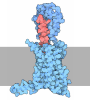
TitleCryo-EM structure of the adhesion GPCR ADGRV1 in complex with a nanobody
Map dataEM map
Sample
  • Complex: Adhesion G-protein coupled receptor V1 beta subunit complexed with RE02 nanobody
    • Complex: RE02 nanobody
      • Protein or peptide: Nanobody RE02
    • Complex: Adhesion G-protein coupled receptor V1 beta subunit
      • Protein or peptide: Adhesion G protein-coupled receptor V1
KeywordsAdhesion GPCR / Signaling / 7TM / Nanobody / MEMBRANE PROTEIN
Function / homology
Function and homology information


maintenance of animal organ identity / stereocilium membrane / sensory perception of light stimulus / photoreceptor cell maintenance / neurogenesis / photoreceptor inner segment / sensory perception of sound / G protein-coupled receptor activity / cell surface receptor signaling pathway / receptor complex ...maintenance of animal organ identity / stereocilium membrane / sensory perception of light stimulus / photoreceptor cell maintenance / neurogenesis / photoreceptor inner segment / sensory perception of sound / G protein-coupled receptor activity / cell surface receptor signaling pathway / receptor complex / hydrolase activity / calcium ion binding / cell surface / cytoplasm
Similarity search - Function
Adhesion G-protein coupled receptor V1 / Leucine-rich glioma-inactivated , EPTP repeat / EAR / EPTP domain / EAR repeat profile. / LamG-like jellyroll fold / LamG-like jellyroll fold domain / Domains in Na-Ca exchangers and integrin-beta4 / Na-Ca exchanger/integrin-beta4 / Calx-beta domain ...Adhesion G-protein coupled receptor V1 / Leucine-rich glioma-inactivated , EPTP repeat / EAR / EPTP domain / EAR repeat profile. / LamG-like jellyroll fold / LamG-like jellyroll fold domain / Domains in Na-Ca exchangers and integrin-beta4 / Na-Ca exchanger/integrin-beta4 / Calx-beta domain / CalX-like domain superfamily / Concanavalin A-like lectin/glucanases superfamily / GAIN domain superfamily / : / GAIN-B domain profile. / GPCR, family 2, secretin-like / 7 transmembrane receptor (Secretin family) / GPCR, family 2-like / G-protein coupled receptors family 2 profile 2. / Concanavalin A-like lectin/glucanase domain superfamily
Similarity search - Domain/homology
Adhesion G-protein coupled receptor V1
Similarity search - Component
Biological speciesMus musculus (house mouse) / Vicugna pacos (alpaca)
Methodsingle particle reconstruction / cryo EM / Resolution: 3.82 Å
AuthorsAchat Y / Prevost M / Mechaly A / Genera M / Colcombet JB / Bezault A / Winter JM / Ayme G / Venien-Bryan C / Wolff N
Funding support France, 2 items
OrganizationGrant numberCountry
Other government2019-0018C1 Fondation pour l'Audition France
Other government4133/2021 Ministere de l'enseignement superieur et de la recherche France
CitationJournal: Acta Crystallogr D Struct Biol / Year: 2018
Title: Real-space refinement in PHENIX for cryo-EM and crystallography.
Authors: Pavel V Afonine / Billy K Poon / Randy J Read / Oleg V Sobolev / Thomas C Terwilliger / Alexandre Urzhumtsev / Paul D Adams /
Abstract: This article describes the implementation of real-space refinement in the phenix.real_space_refine program from the PHENIX suite. The use of a simplified refinement target function enables very fast ...This article describes the implementation of real-space refinement in the phenix.real_space_refine program from the PHENIX suite. The use of a simplified refinement target function enables very fast calculation, which in turn makes it possible to identify optimal data-restraint weights as part of routine refinements with little runtime cost. Refinement of atomic models against low-resolution data benefits from the inclusion of as much additional information as is available. In addition to standard restraints on covalent geometry, phenix.real_space_refine makes use of extra information such as secondary-structure and rotamer-specific restraints, as well as restraints or constraints on internal molecular symmetry. The re-refinement of 385 cryo-EM-derived models available in the Protein Data Bank at resolutions of 6 Å or better shows significant improvement of the models and of the fit of these models to the target maps.
History
DepositionJun 24, 2024-
Header (metadata) releaseJan 14, 2026-
Map releaseJan 14, 2026-
UpdateJan 14, 2026-
Current statusJan 14, 2026Processing site: PDBe / Status: Released

-
Structure visualization

Supplemental images

Downloads & links

-
Map

FileDownload / File: emd_50743.map.gz / Format: CCP4 / Size: 103 MB / Type: IMAGE STORED AS FLOATING POINT NUMBER (4 BYTES)
AnnotationEM map
Projections & slices

Image control

Size
Brightness
Contrast
Others
AxesZ (Sec.)Y (Row.)X (Col.)
1.03 Å/pix.
x 300 pix.
= 308. Å
1.03 Å/pix.
x 300 pix.
= 308. Å
1.03 Å/pix.
x 300 pix.
= 308. Å

Surface

Projections

Slices (1/3)

Slices (1/2)

Slices (2/3)

Images are generated by Spider.

Voxel sizeX=Y=Z: 1.02667 Å
Density
Contour LevelBy AUTHOR: 0.1
Minimum - Maximum-0.6298756 - 0.74843574
Average (Standard dev.)-0.00042834 (±0.010410258)
SymmetrySpace group: 1
Details

EMDB XML:

Map geometry
Axis orderXYZ
Origin000
Dimensions300300300
Spacing300300300
CellA=B=C: 308.0 Å
α=β=γ: 90.0 °

-
Supplemental data

-
Half map: A

Fileemd_50743_half_map_1.map
AnnotationA
Projections & Slices
AxesZYX

Projections

Slices (1/2)
Density Histograms

-
Half map: B

Fileemd_50743_half_map_2.map
AnnotationB
Projections & Slices
AxesZYX

Projections

Slices (1/2)
Density Histograms

-
Sample components

-
Entire : Adhesion G-protein coupled receptor V1 beta subunit complexed wit...

EntireName: Adhesion G-protein coupled receptor V1 beta subunit complexed with RE02 nanobody
Components
  • Complex: Adhesion G-protein coupled receptor V1 beta subunit complexed with RE02 nanobody
    • Complex: RE02 nanobody
      • Protein or peptide: Nanobody RE02
    • Complex: Adhesion G-protein coupled receptor V1 beta subunit
      • Protein or peptide: Adhesion G protein-coupled receptor V1

-
Supramolecule #1: Adhesion G-protein coupled receptor V1 beta subunit complexed wit...

SupramoleculeName: Adhesion G-protein coupled receptor V1 beta subunit complexed with RE02 nanobody
type: complex / ID: 1 / Parent: 0 / Macromolecule list: all
Source (natural)Organism: Mus musculus (house mouse)

-
Supramolecule #2: RE02 nanobody

SupramoleculeName: RE02 nanobody / type: complex / ID: 2 / Parent: 1 / Macromolecule list: #2
Source (natural)Organism: Vicugna pacos (alpaca)

-
Supramolecule #3: Adhesion G-protein coupled receptor V1 beta subunit

SupramoleculeName: Adhesion G-protein coupled receptor V1 beta subunit / type: complex / ID: 3 / Parent: 1 / Macromolecule list: #1
Source (natural)Organism: Mus musculus (house mouse)

-
Macromolecule #1: Adhesion G protein-coupled receptor V1

MacromoleculeName: Adhesion G protein-coupled receptor V1 / type: protein_or_peptide / ID: 1 / Details: 1- / Number of copies: 1 / Enantiomer: LEVO
Source (natural)Organism: Mus musculus (house mouse)
Molecular weightTheoretical: 47.335199 KDa
Recombinant expressionOrganism: Spodoptera frugiperda (fall armyworm)
SequenceString: SVYAVYAQTD NSSSYNEAFF SAGLICISGL CLAVVSHMFC ARHSMFAAKL LTHMMVASLG TQILFLASAY ASPHLSEESC SAVAAVAHY LYLCQFSWML IQSVNFWYVL VVSDEHTERR CLLFCLLSWG LPSFVVILLI LILRGIYHRS MPQIYGLIHG D LCFIPNIY ...String:
SVYAVYAQTD NSSSYNEAFF SAGLICISGL CLAVVSHMFC ARHSMFAAKL LTHMMVASLG TQILFLASAY ASPHLSEESC SAVAAVAHY LYLCQFSWML IQSVNFWYVL VVSDEHTERR CLLFCLLSWG LPSFVVILLI LILRGIYHRS MPQIYGLIHG D LCFIPNIY AALFTAALVP LMCLVVVFVV FIHAYQLKPQ WKGYDDVFRG RTNAAEIPLI LYLFALISMT WLWGGLHMAY RH FWMLVLF VIFNSLQGLY VFVVYFILHN QTCCPMKASY TVEMNGHPGP STAFFTPGSG IPPAGEINKS TQNLINAMEE VPS DWERSS FQQTSQASPD LKTSPQNGAS FPSSGGYGPG SLIADEESQE FDDLIFALKT GAGLSVSDNE SGQGSQEGGT LTDS QIVEL RRIPIADTHL SGRHHHHHHH H

UniProtKB: Adhesion G-protein coupled receptor V1

-
Macromolecule #2: Nanobody RE02

MacromoleculeName: Nanobody RE02 / type: protein_or_peptide / ID: 2 / Details: 128-137 : c-Myc tag 142-147 : 6x His tag / Number of copies: 1 / Enantiomer: LEVO
Source (natural)Organism: Vicugna pacos (alpaca)
Molecular weightTheoretical: 15.764383 KDa
Recombinant expressionOrganism: Escherichia coli (E. coli)
SequenceString:
MAEVQLVESG GGLVQPGGSL RLSCAASGSS FSINAMGWYR QAPGKQRELV AAISRGGSTN YASSVKGRFT ISRDNGKNTV YLQMNSPKP EDTAVYYCNV GSRSTLPIWY DYWGQGTQVT VSSAAAEQKL ISEEDLNGAA HHHHHHGS

-
Experimental details

-
Structure determination

Methodcryo EM
Processingsingle particle reconstruction
Aggregation stateparticle

-
Sample preparation

BufferpH: 7.5
VitrificationCryogen name: ETHANE

-
Electron microscopy

MicroscopeFEI TITAN KRIOS
Image recordingFilm or detector model: TFS FALCON 4i (4k x 4k) / Detector mode: COUNTING / Average electron dose: 40.0 e/Å2
Electron beamAcceleration voltage: 300 kV / Electron source: FIELD EMISSION GUN
Electron opticsIllumination mode: FLOOD BEAM / Imaging mode: BRIGHT FIELD / Nominal defocus max: 2.6 µm / Nominal defocus min: 0.8 µm
Experimental equipment
Model: Titan Krios / Image courtesy: FEI Company

+
Image processing

CTF correctionType: PHASE FLIPPING AND AMPLITUDE CORRECTION
Startup modelType of model: INSILICO MODEL / In silico model: Ab initio model from cryoSPARC
Final reconstructionResolution.type: BY AUTHOR / Resolution: 3.82 Å / Resolution method: FSC 0.143 CUT-OFF / Number images used: 97447
Initial angle assignmentType: ANGULAR RECONSTITUTION
Final angle assignmentType: ANGULAR RECONSTITUTION

+
About Yorodumi

-
News

-
Feb 9, 2022. New format data for meta-information of EMDB entries

New format data for meta-information of EMDB entries

  • Version 3 of the EMDB header file is now the official format.
  • The previous official version 1.9 will be removed from the archive.

Related info.:EMDB header

External links:wwPDB to switch to version 3 of the EMDB data model

-
Aug 12, 2020. Covid-19 info

Covid-19 info

URL: https://pdbj.org/emnavi/covid19.php

New page: Covid-19 featured information page in EM Navigator.

Related info.:Covid-19 info / Mar 5, 2020. Novel coronavirus structure data

+
Mar 5, 2020. Novel coronavirus structure data

Novel coronavirus structure data

Related info.:Yorodumi Speices / Aug 12, 2020. Covid-19 info

External links:COVID-19 featured content - PDBj / Molecule of the Month (242):Coronavirus Proteases

+
Jan 31, 2019. EMDB accession codes are about to change! (news from PDBe EMDB page)

EMDB accession codes are about to change! (news from PDBe EMDB page)

  • The allocation of 4 digits for EMDB accession codes will soon come to an end. Whilst these codes will remain in use, new EMDB accession codes will include an additional digit and will expand incrementally as the available range of codes is exhausted. The current 4-digit format prefixed with “EMD-” (i.e. EMD-XXXX) will advance to a 5-digit format (i.e. EMD-XXXXX), and so on. It is currently estimated that the 4-digit codes will be depleted around Spring 2019, at which point the 5-digit format will come into force.
  • The EM Navigator/Yorodumi systems omit the EMD- prefix.

Related info.:Q: What is EMD? / ID/Accession-code notation in Yorodumi/EM Navigator

External links:EMDB Accession Codes are Changing Soon! / Contact to PDBj

+
Jul 12, 2017. Major update of PDB

Major update of PDB

  • wwPDB released updated PDB data conforming to the new PDBx/mmCIF dictionary.
  • This is a major update changing the version number from 4 to 5, and with Remediation, in which all the entries are updated.
  • In this update, many items about electron microscopy experimental information are reorganized (e.g. em_software).
  • Now, EM Navigator and Yorodumi are based on the updated data.

External links:wwPDB Remediation / Enriched Model Files Conforming to OneDep Data Standards Now Available in the PDB FTP Archive

-
Yorodumi

Thousand views of thousand structures

  • Yorodumi is a browser for structure data from EMDB, PDB, SASBDB, etc.
  • This page is also the successor to EM Navigator detail page, and also detail information page/front-end page for Omokage search.
  • The word "yorodu" (or yorozu) is an old Japanese word meaning "ten thousand". "mi" (miru) is to see.

Related info.:EMDB / PDB / SASBDB / Comparison of 3 databanks / Yorodumi Search / Aug 31, 2016. New EM Navigator & Yorodumi / Yorodumi Papers / Jmol/JSmol / Function and homology information / Changes in new EM Navigator and Yorodumi

Read more