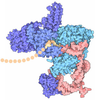
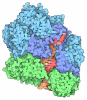
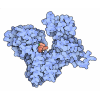
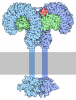
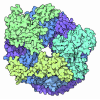
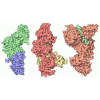
- EMDB-47929: Human LARP1 bound to the 40S small ribosomal subunit -
+
Open data
ID or keywords:
Loading...
-
Basic information
Entry
Database: EMDB / ID: EMD-47929
Title
Human LARP1 bound to the 40S small ribosomal subunit
Map data
Sample
Complex: 40S-LARP1
Protein or peptide: x 30 types
RNA: x 1 types
Protein or peptide: x 5 types
Ligand: x 3 types
Keywords
LARP1 / ribosome / translation / mRNA / TOP
Function / homology
Function and homology information
cellular response to rapamycin / eukaryotic initiation factor 4E binding / translation activator activity / RNA cap binding / response to amino acid starvation / RNA 7-methylguanosine cap binding / TORC1 signaling / negative regulation of endoplasmic reticulum unfolded protein response / oxidized pyrimidine DNA binding / response to TNF agonist ...cellular response to rapamycin / eukaryotic initiation factor 4E binding / translation activator activity / RNA cap binding / response to amino acid starvation / RNA 7-methylguanosine cap binding / TORC1 signaling / negative regulation of endoplasmic reticulum unfolded protein response / oxidized pyrimidine DNA binding / response to TNF agonist / positive regulation of base-excision repair / mRNA stabilization / positive regulation of respiratory burst involved in inflammatory response / regulation of adenylate cyclase-activating G protein-coupled receptor signaling pathway / positive regulation of intrinsic apoptotic signaling pathway in response to DNA damage / positive regulation of gastrulation / protein tyrosine kinase inhibitor activity / IRE1-RACK1-PP2A complex / TNFR1-mediated ceramide production / positive regulation of Golgi to plasma membrane protein transport / nucleolus organization / positive regulation of ubiquitin-protein transferase activity / negative regulation of RNA splicing / positive regulation of DNA-templated transcription initiation / negative regulation of DNA repair / post-transcriptional regulation of gene expression / erythrocyte homeostasis / supercoiled DNA binding / regulation of establishment of cell polarity / rRNA modification in the nucleus and cytosol / oxidized purine DNA binding / NF-kappaB complex / negative regulation of intrinsic apoptotic signaling pathway in response to hydrogen peroxide / negative regulation of phagocytosis / ubiquitin-like protein conjugating enzyme binding / cytoplasmic translational initiation / cytoplasmic side of rough endoplasmic reticulum membrane / ribosomal small subunit binding / Formation of the ternary complex, and subsequently, the 43S complex / ion channel inhibitor activity / laminin receptor activity / negative regulation of myoblast fusion / Ribosomal scanning and start codon recognition / protein kinase A binding / positive regulation of macroautophagy / Translation initiation complex formation / negative regulation of Wnt signaling pathway / fibroblast growth factor binding / BH3 domain binding / Protein hydroxylation / TOR signaling / mTORC1-mediated signalling / negative regulation of translational frameshifting / monocyte chemotaxis / PELO:HBS1L and ABCE1 dissociate a ribosome on a non-stop mRNA / SARS-CoV-1 modulates host translation machinery / regulation of cell division / positive regulation of GTPase activity / positive regulation of translational initiation / Peptide chain elongation / Selenocysteine synthesis / negative regulation of protein binding / Formation of a pool of free 40S subunits / negative regulation of respiratory burst involved in inflammatory response / positive regulation of intrinsic apoptotic signaling pathway by p53 class mediator / protein serine/threonine kinase inhibitor activity / Eukaryotic Translation Termination / Dengue Virus Attachment and Entry / SRP-dependent cotranslational protein targeting to membrane / Response of EIF2AK4 (GCN2) to amino acid deficiency / Viral mRNA Translation / endonucleolytic cleavage to generate mature 3'-end of SSU-rRNA from (SSU-rRNA, 5.8S rRNA, LSU-rRNA) / ubiquitin ligase inhibitor activity / Nonsense Mediated Decay (NMD) independent of the Exon Junction Complex (EJC) / positive regulation of signal transduction by p53 class mediator / GTP hydrolysis and joining of the 60S ribosomal subunit / positive regulation of viral genome replication / L13a-mediated translational silencing of Ceruloplasmin expression / regulation of translational fidelity / Major pathway of rRNA processing in the nucleolus and cytosol / spindle assembly / positive regulation of microtubule polymerization / phagocytic cup / Nonsense Mediated Decay (NMD) enhanced by the Exon Junction Complex (EJC) / negative regulation of ubiquitin-dependent protein catabolic process / Protein methylation / endonucleolytic cleavage in ITS1 to separate SSU-rRNA from 5.8S rRNA and LSU-rRNA from tricistronic rRNA transcript (SSU-rRNA, 5.8S rRNA, LSU-rRNA) / positive regulation of cell cycle / translation regulator activity / Nuclear events stimulated by ALK signaling in cancer / DNA-(apurinic or apyrimidinic site) endonuclease activity / ribosomal small subunit export from nucleus / Amplification of signal from unattached kinetochores via a MAD2 inhibitory signal / negative regulation of protein ubiquitination / rough endoplasmic reticulum / laminin binding / SH2 domain binding / negative regulation of translational initiation / positive regulation of apoptotic signaling pathway / signaling adaptor activity Similarity search - Function
Protein of unknown function DM15 / LARP1 HEAT repeat region / Tandem repeat in fly CG14066 (La related protein), human KIAA0731 and worm R144.7. Unknown function. / La domain containing protein / La domain / Domain in the RNA-binding Lupus La protein; unknown function / La-type HTH domain / La-type HTH domain profile. / 40S ribosomal protein SA / 40S ribosomal protein SA, C-terminal domain ...Protein of unknown function DM15 / LARP1 HEAT repeat region / Tandem repeat in fly CG14066 (La related protein), human KIAA0731 and worm R144.7. Unknown function. / La domain containing protein / La domain / Domain in the RNA-binding Lupus La protein; unknown function / La-type HTH domain / La-type HTH domain profile. / 40S ribosomal protein SA / 40S ribosomal protein SA, C-terminal domain / 40S ribosomal protein SA C-terminus / Ubiquitin-like protein FUBI / : / Ribosomal protein S26e signature. / Ribosomal protein L41 / Ribosomal protein L41 / Ribosomal protein S21e, conserved site / Ribosomal protein S21e signature. / : / Ribosomal protein S12e signature. / Ribosomal protein S12e / Ribosomal protein S26e / Ribosomal protein S26e superfamily / Ribosomal protein S26e / Small (40S) ribosomal subunit Asc1/RACK1 / Ribosomal protein S21e / Ribosomal protein S21e superfamily / Ribosomal protein S21e / Ribosomal protein S19e, conserved site / Ribosomal protein S19e signature. / Ribosomal protein S5, eukaryotic/archaeal / Ribosomal protein S2, eukaryotic / 40S Ribosomal protein S10 / S27a-like superfamily / Plectin/S10, N-terminal / Plectin/S10 domain / Ribosomal protein S30 / Ribosomal protein S30 / Ribosomal protein S10, eukaryotic/archaeal / Ribosomal protein S8e subdomain, eukaryotes / Ribosomal protein S25 / S25 ribosomal protein / : / Ribosomal protein S7e signature. / Ribosomal protein S17e, conserved site / Ribosomal protein S17e signature. / Ribosomal protein S27a / Ribosomal protein S27a / Ribosomal protein S27a / Ribosomal protein S2, eukaryotic/archaeal / 40S ribosomal protein S29/30S ribosomal protein S14 type Z / Ribosomal protein S3, eukaryotic/archaeal / Ribosomal protein S8e, conserved site / Ribosomal protein S8e signature. / Ribosomal protein S3Ae, conserved site / Ribosomal protein S3Ae signature. / 40S ribosomal protein S4, C-terminal domain / 40S ribosomal protein S4 C-terminus / Ribosomal protein S27e signature. / Ribosomal protein S19e / Ribosomal protein S19e / Ribosomal_S19e / Ribosomal protein S19A/S15e / Ribosomal protein S4e, N-terminal, conserved site / Ribosomal protein S4e signature. / Ribosomal protein S6, eukaryotic / Ribosomal protein S17e / Ribosomal protein S17e-like superfamily / Ribosomal S17 / 40S ribosomal protein S1/3, eukaryotes / 40S ribosomal protein S11, N-terminal / Ribosomal_S17 N-terminal / Ribosomal protein S7e / Ribosomal protein S7e / : / Ribosomal S24e conserved site / Ribosomal protein S24e signature. / Ribosomal protein S4e, N-terminal / RS4NT (NUC023) domain / Ribosomal protein S4, KOW domain / Ribosomal protein S4e / Ribosomal protein S4e, central region / Ribosomal protein S4e, central domain superfamily / Ribosomal family S4e / Ribosomal protein S28e conserved site / Ribosomal protein S28e signature. / Ribosomal protein S8e / Ribosomal protein S6/S6e/A/B/2, conserved site / Ribosomal protein S6e signature. / Ribosomal protein S17, archaeal/eukaryotic / Ribosomal protein S23, eukaryotic/archaeal / Ribosomal protein S27 / Ribosomal protein S27, zinc-binding domain superfamily / Ribosomal protein S27 / Ribosomal protein S24e / Ribosomal protein S24e / Ribosomal protein S28e / Ribosomal protein S28e / Ribosomal protein S3Ae / Ribosomal S3Ae family Similarity search - Domain/homology
Small ribosomal subunit protein eS17 / Small ribosomal subunit protein uS2 / Small ribosomal subunit protein uS5 / Small ribosomal subunit protein uS3 / Small ribosomal subunit protein eS12 / Small ribosomal subunit protein eS19 / Small ribosomal subunit protein eS27 / Small ribosomal subunit protein uS4 / Small ribosomal subunit protein uS7 / Small ribosomal subunit protein eS10 ...Small ribosomal subunit protein eS17 / Small ribosomal subunit protein uS2 / Small ribosomal subunit protein uS5 / Small ribosomal subunit protein uS3 / Small ribosomal subunit protein eS12 / Small ribosomal subunit protein eS19 / Small ribosomal subunit protein eS27 / Small ribosomal subunit protein uS4 / Small ribosomal subunit protein uS7 / Small ribosomal subunit protein eS10 / Small ribosomal subunit protein uS10 / Small ribosomal subunit protein eS1 / Small ribosomal subunit protein eS7 / Small ribosomal subunit protein eS8 / Small ribosomal subunit protein uS8 / Small ribosomal subunit protein uS9 / Small ribosomal subunit protein uS11 / Small ribosomal subunit protein uS12 / Small ribosomal subunit protein uS13 / Small ribosomal subunit protein uS14 / Small ribosomal subunit protein uS15 / Small ribosomal subunit protein uS17 / Small ribosomal subunit protein eS4, X isoform / Small ribosomal subunit protein eS6 / Small ribosomal subunit protein uS19 / Small ribosomal subunit protein eS24 / Small ribosomal subunit protein eS25 / Small ribosomal subunit protein eS26 / Small ribosomal subunit protein eS28 / Ubiquitin-like FUBI-ribosomal protein eS30 fusion protein / Small ribosomal subunit protein eS32 / Ubiquitin-ribosomal protein eS31 fusion protein / Small ribosomal subunit protein eS21 / Small ribosomal subunit protein RACK1 / La-related protein 1 Similarity search - Component
Biological species
Homo sapiens (human)
Method
single particle reconstruction / cryo EM / Resolution: 2.8 Å
National Institutes of Health/National Institute of Neurological Disorders and Stroke (NIH/NINDS)
1R01NS140149-01
United States
Citation
Journal: Cell / Year: 2025 Title: SPIDR enables multiplexed mapping of RNA-protein interactions and uncovers a mechanism for selective translational suppression upon cell stress. Authors: Erica Wolin / Jimmy K Guo / Mario R Blanco / Isabel N Goronzy / Darvesh Gorhe / Wenzhao Dong / Andrew A Perez / Abdurrahman Keskin / Elizabeth Valenzuela / Ahmed A Abdou / Carl R Urbinati / ...Authors: Erica Wolin / Jimmy K Guo / Mario R Blanco / Isabel N Goronzy / Darvesh Gorhe / Wenzhao Dong / Andrew A Perez / Abdurrahman Keskin / Elizabeth Valenzuela / Ahmed A Abdou / Carl R Urbinati / Ross Kaufhold / H Tomas Rube / Jailson Brito Querido / Mitchell Guttman / Marko Jovanovic / Abstract: RNA-binding proteins (RBPs) regulate all stages of the mRNA life cycle, yet current methods generally map RNA targets of RBPs one protein at a time. To overcome this limitation, we developed SPIDR ...RNA-binding proteins (RBPs) regulate all stages of the mRNA life cycle, yet current methods generally map RNA targets of RBPs one protein at a time. To overcome this limitation, we developed SPIDR (split-and-pool identification of RBP targets), a highly multiplexed split-pool method that profiles the binding sites of dozens of RBPs simultaneously. SPIDR identifies precise, single-nucleotide binding sites for diverse classes of RBPs. Using SPIDR, we uncovered an interaction between LARP1 and the 18S rRNA and resolved this interaction to the mRNA entry channel of the 40S ribosome using cryoelectron microscopy (cryo-EM), providing a potential mechanistic explanation for LARP1's role in translational suppression. We explored changes in RBP binding upon mTOR inhibition and identified that 4EBP1 preferentially associates with translationally repressed mRNAs upon mTOR inhibition. SPIDR has the potential to significantly advance our understanding of RNA biology by enabling rapid, de novo discovery of RNA-protein interactions at an unprecedented scale.
In the structure databanks used in Yorodumi, some data are registered as the other names, "COVID-19 virus" and "2019-nCoV". Here are the details of the virus and the list of structure data.
Jan 31, 2019. EMDB accession codes are about to change! (news from PDBe EMDB page)
EMDB accession codes are about to change! (news from PDBe EMDB page)
The allocation of 4 digits for EMDB accession codes will soon come to an end. Whilst these codes will remain in use, new EMDB accession codes will include an additional digit and will expand incrementally as the available range of codes is exhausted. The current 4-digit format prefixed with “EMD-” (i.e. EMD-XXXX) will advance to a 5-digit format (i.e. EMD-XXXXX), and so on. It is currently estimated that the 4-digit codes will be depleted around Spring 2019, at which point the 5-digit format will come into force.
The EM Navigator/Yorodumi systems omit the EMD- prefix.
Related info.:Q: What is EMD? / ID/Accession-code notation in Yorodumi/EM Navigator
Yorodumi is a browser for structure data from EMDB, PDB, SASBDB, etc.
This page is also the successor to EM Navigator detail page, and also detail information page/front-end page for Omokage search.
The word "yorodu" (or yorozu) is an old Japanese word meaning "ten thousand". "mi" (miru) is to see.
Related info.:EMDB / PDB / SASBDB / Comparison of 3 databanks / Yorodumi Search / Aug 31, 2016. New EM Navigator & Yorodumi / Yorodumi Papers / Jmol/JSmol / Function and homology information / Changes in new EM Navigator and Yorodumi
 Movie
Movie Controller


 Open data
 Basic information
 Map data
 Sample
 Keywords
 Function and homology information
 Homo sapiens (human)
 Authors
 United States, 1 items
  Citation
 Structure visualization
 Downloads & links
 emd_47929.png
 https://data.pdbj.org/pub/emdb/structures/EMD-47929




 Z (Sec.)
 Y (Row.)
 X (Col.)


 Sample components
 Processing
 Electron microscopy
 FIELD EMISSION GUN


