National Institutes of Health/National Institute of General Medical Sciences (NIH/NIGMS)
United States
Citation
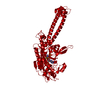
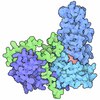
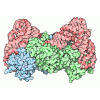
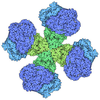
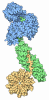
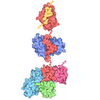
Journal: Nat Commun / Year: 2026 Title: A metabolite-bridged complex between SerRS and SIRT2 couples NAD⁺ metabolism to translation control. Authors: Qian Zhang / Huimin Zhang / Marscha Hirschi / Sheng Li / Gabriel C Lander / Jie Yang / Xiang-Lei Yang / Abstract: Cellular homeostasis requires tight coordination between metabolic and translational networks. Here we identify a direct molecular link between these processes through a cryo-EM structure of human ...Cellular homeostasis requires tight coordination between metabolic and translational networks. Here we identify a direct molecular link between these processes through a cryo-EM structure of human cytosolic seryl-tRNA synthetase (SerRS) in complex with the NAD⁺-dependent deacetylase SIRT2. This interaction is promoted by the NAD⁺ metabolite ADP-ribose (ADPR), which acts as a molecular bridge between the two enzymes. Within the SIRT2 active site, ADPR engages SerRS residue K414 located in a flexible catalytic-domain loop. Acetylation of K414 is dispensable for binding. Functionally, complex formation inhibits SIRT2 deacetylase activity by blocking substrate access, while SIRT2 association suppresses SerRS aminoacylation activity by preventing tRNA binding. Thus, SerRS and SIRT2 mutually regulate each other, with ADPR enhancing while tRNA attenuating their interaction. Oxidative stress promotes this interaction via a PARP1-dependent pathway, revealing an ADPR-responsive regulatory module that couples metabolic state to translational output. This regulatory module is likely conserved across vertebrates.
In the structure databanks used in Yorodumi, some data are registered as the other names, "COVID-19 virus" and "2019-nCoV". Here are the details of the virus and the list of structure data.
Jan 31, 2019. EMDB accession codes are about to change! (news from PDBe EMDB page)
EMDB accession codes are about to change! (news from PDBe EMDB page)
The allocation of 4 digits for EMDB accession codes will soon come to an end. Whilst these codes will remain in use, new EMDB accession codes will include an additional digit and will expand incrementally as the available range of codes is exhausted. The current 4-digit format prefixed with “EMD-” (i.e. EMD-XXXX) will advance to a 5-digit format (i.e. EMD-XXXXX), and so on. It is currently estimated that the 4-digit codes will be depleted around Spring 2019, at which point the 5-digit format will come into force.
The EM Navigator/Yorodumi systems omit the EMD- prefix.
Related info.:Q: What is EMD? / ID/Accession-code notation in Yorodumi/EM Navigator
Yorodumi is a browser for structure data from EMDB, PDB, SASBDB, etc.
This page is also the successor to EM Navigator detail page, and also detail information page/front-end page for Omokage search.
The word "yorodu" (or yorozu) is an old Japanese word meaning "ten thousand". "mi" (miru) is to see.
Related info.:EMDB / PDB / SASBDB / Comparison of 3 databanks / Yorodumi Search / Aug 31, 2016. New EM Navigator & Yorodumi / Yorodumi Papers / Jmol/JSmol / Function and homology information / Changes in new EM Navigator and Yorodumi
 Movie
Movie Controller


 Open data
 Basic information
 Map data
 Sample
 Keywords
 Function and homology information
 Homo sapiens (human)
 Authors
 United States, 1 items
  Citation
 Structure visualization
 Downloads & links
 emd_47103.png
 https://data.pdbj.org/pub/emdb/structures/EMD-47103



 Z (Sec.)
 Y (Row.)
 X (Col.)


 Sample components
 Escherichia coli 'BL21-Gold(DE3)pLysS AG' (bacteria)
 Processing
 Electron microscopy
 FIELD EMISSION GUN