[English] 日本語
Yorodumi
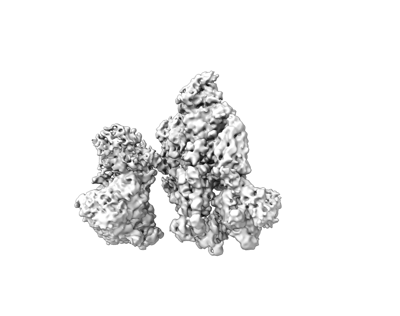
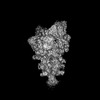
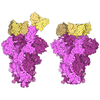
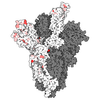
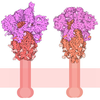
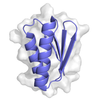
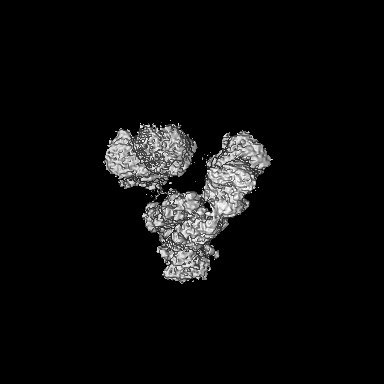
- EMDB-43832: local refinement of XBB.1.5 spike/Nanosota-3C complex -

+
Open data


ID or keywords:

Loading...

-
Basic information

Entry
Database: EMDB / ID: EMD-43832
Titlelocal refinement of XBB.1.5 spike/Nanosota-3C complex
Map dataunsharpened local map of XBB.1.5 spike/Nanosota-3C
Sample
  • Complex: XBB.1.5 spike/Nanosota-3C complex
    • Complex: XBB.1.5 spike
      • Protein or peptide: Spike glycoprotein
    • Complex: Nanosota-3C
      • Protein or peptide: Nanosota-3C
KeywordsSARS-CoV-2 / XBB.1.5 / Nanobody / VIRAL PROTEIN-IMMUNE SYSTEM complex / VIRAL PROTEIN
Function / homology
Function and homology information


symbiont-mediated disruption of host tissue / Maturation of spike protein / Translation of Structural Proteins / Virion Assembly and Release / host cell surface / host extracellular space / symbiont-mediated-mediated suppression of host tetherin activity / Induction of Cell-Cell Fusion / structural constituent of virion / membrane fusion ...symbiont-mediated disruption of host tissue / Maturation of spike protein / Translation of Structural Proteins / Virion Assembly and Release / host cell surface / host extracellular space / symbiont-mediated-mediated suppression of host tetherin activity / Induction of Cell-Cell Fusion / structural constituent of virion / membrane fusion / entry receptor-mediated virion attachment to host cell / Attachment and Entry / host cell endoplasmic reticulum-Golgi intermediate compartment membrane / positive regulation of viral entry into host cell / receptor-mediated virion attachment to host cell / host cell surface receptor binding / symbiont-mediated suppression of host innate immune response / endocytosis involved in viral entry into host cell / receptor ligand activity / fusion of virus membrane with host plasma membrane / fusion of virus membrane with host endosome membrane / viral envelope / symbiont entry into host cell / virion attachment to host cell / SARS-CoV-2 activates/modulates innate and adaptive immune responses / host cell plasma membrane / virion membrane / identical protein binding / membrane / plasma membrane
Similarity search - Function
Spike (S) protein S1 subunit, receptor-binding domain, SARS-CoV-2 / Spike (S) protein S1 subunit, N-terminal domain, SARS-CoV-like / Coronavirus spike glycoprotein S1, C-terminal / Coronavirus spike glycoprotein S1, C-terminal / Spike glycoprotein, N-terminal domain superfamily / Spike S1 subunit, receptor binding domain superfamily, betacoronavirus / Spike glycoprotein, betacoronavirus / Betacoronavirus spike (S) glycoprotein S1 subunit N-terminal (NTD) domain profile. / Betacoronavirus spike (S) glycoprotein S1 subunit C-terminal (CTD) domain profile. / Spike (S) protein S1 subunit, receptor-binding domain, betacoronavirus ...Spike (S) protein S1 subunit, receptor-binding domain, SARS-CoV-2 / Spike (S) protein S1 subunit, N-terminal domain, SARS-CoV-like / Coronavirus spike glycoprotein S1, C-terminal / Coronavirus spike glycoprotein S1, C-terminal / Spike glycoprotein, N-terminal domain superfamily / Spike S1 subunit, receptor binding domain superfamily, betacoronavirus / Spike glycoprotein, betacoronavirus / Betacoronavirus spike (S) glycoprotein S1 subunit N-terminal (NTD) domain profile. / Betacoronavirus spike (S) glycoprotein S1 subunit C-terminal (CTD) domain profile. / Spike (S) protein S1 subunit, receptor-binding domain, betacoronavirus / Betacoronavirus spike glycoprotein S1, receptor binding / Spike glycoprotein S1, N-terminal domain, betacoronavirus-like / Betacoronavirus-like spike glycoprotein S1, N-terminal / Spike glycoprotein S2 superfamily, coronavirus / Spike glycoprotein S2, coronavirus, heptad repeat 1 / Spike glycoprotein S2, coronavirus, heptad repeat 2 / Coronavirus spike (S) glycoprotein S2 subunit heptad repeat 1 (HR1) region profile. / Coronavirus spike (S) glycoprotein S2 subunit heptad repeat 2 (HR2) region profile. / Spike glycoprotein S2, coronavirus / Coronavirus spike glycoprotein S2
Similarity search - Domain/homology
Biological speciesSevere acute respiratory syndrome coronavirus 2 / Vicugna pacos (alpaca)
Methodsingle particle reconstruction / cryo EM / Resolution: 3.5 Å
AuthorsYe G / Bu F / Liu B / Li F
Funding support United States, 3 items
OrganizationGrant numberCountry
National Institutes of Health/National Institute Of Allergy and Infectious Diseases (NIH/NIAID)AI089728 United States
National Institutes of Health/National Institute Of Allergy and Infectious Diseases (NIH/NIAID)AI110700 United States
National Institutes of Health/National Institute Of Allergy and Infectious Diseases (NIH/NIAID)AI171954 United States
CitationJournal: PLoS Pathog / Year: 2024
Title: Structure-guided in vitro evolution of nanobodies targeting new viral variants.
Authors: Gang Ye / Fan Bu / Ruangang Pan / Alise Mendoza / Ge Yang / Benjamin Spiller / Brian E Wadzinski / Lanying Du / Stanley Perlman / Bin Liu / Fang Li /
Abstract: A major challenge in antiviral antibody therapy is keeping up with the rapid evolution of viruses. Our research shows that nanobodies - single-domain antibodies derived from camelids - can be rapidly ...A major challenge in antiviral antibody therapy is keeping up with the rapid evolution of viruses. Our research shows that nanobodies - single-domain antibodies derived from camelids - can be rapidly re-engineered to combat new viral strains through structure-guided in vitro evolution. Specifically, for viral mutations occurring at nanobody-binding sites, we introduce randomized amino acid sequences into nanobody residues near these mutations. We then select nanobody variants that effectively bind to the mutated viral target from a phage display library. As a proof of concept, we used this approach to adapt Nanosota-3, a nanobody originally identified to target the receptor-binding domain (RBD) of early Omicron subvariants, making it highly effective against recent Omicron subvariants. Remarkably, this adaptation process can be completed in less than two weeks, allowing drug development to keep pace with viral evolution and provide timely protection to humans.
History
DepositionFeb 27, 2024-
Header (metadata) releaseSep 18, 2024-
Map releaseSep 18, 2024-
UpdateApr 2, 2025-
Current statusApr 2, 2025Processing site: RCSB / Status: Released

-
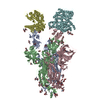
Structure visualization

Supplemental images

Downloads & links

-
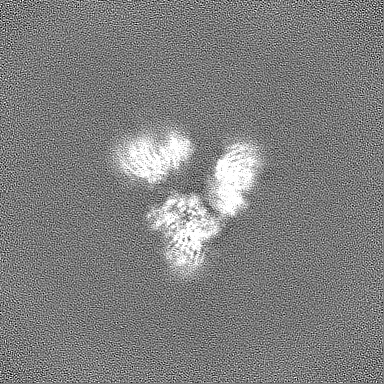
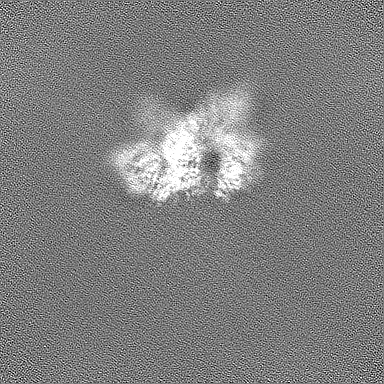
Map

FileDownload / File: emd_43832.map.gz / Format: CCP4 / Size: 216 MB / Type: IMAGE STORED AS FLOATING POINT NUMBER (4 BYTES)
Annotationunsharpened local map of XBB.1.5 spike/Nanosota-3C
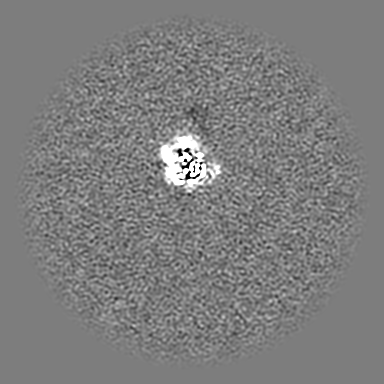
Projections & slices

Image control

Size
Brightness
Contrast
Others
AxesZ (Sec.)Y (Row.)X (Col.)
0.89 Å/pix.
x 384 pix.
= 339.968 Å
0.89 Å/pix.
x 384 pix.
= 339.968 Å
0.89 Å/pix.
x 384 pix.
= 339.968 Å

Surface

Projections

Slices (1/3)

Slices (1/2)

Slices (2/3)

Images are generated by Spider.

Voxel sizeX=Y=Z: 0.88533 Å
Density
Contour LevelBy AUTHOR: 0.0311
Minimum - Maximum-0.36204132 - 0.65511566
Average (Standard dev.)0.0006024632 (±0.010901856)
SymmetrySpace group: 1
Details

EMDB XML:

Map geometry
Axis orderXYZ
Origin000
Dimensions384384384
Spacing384384384
CellA=B=C: 339.96786 Å
α=β=γ: 90.0 °

-
Supplemental data

-
Additional map: sharpened local map of XBB.1.5 spike/Nanosota-3C

Fileemd_43832_additional_1.map
Annotationsharpened local map of XBB.1.5 spike/Nanosota-3C
Projections & Slices
AxesZYX

Projections

Slices (1/2)
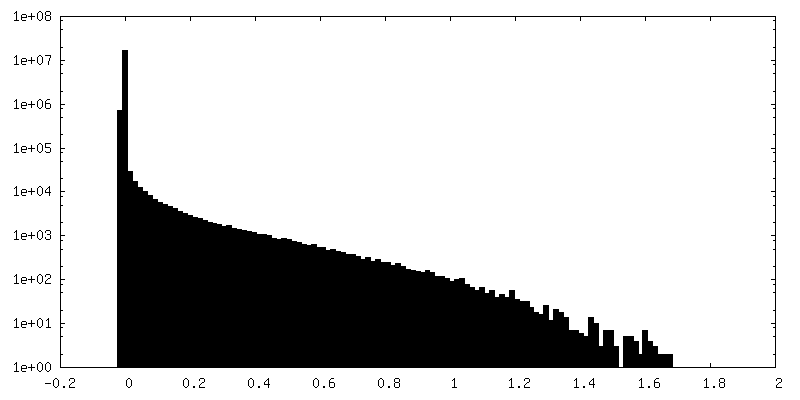
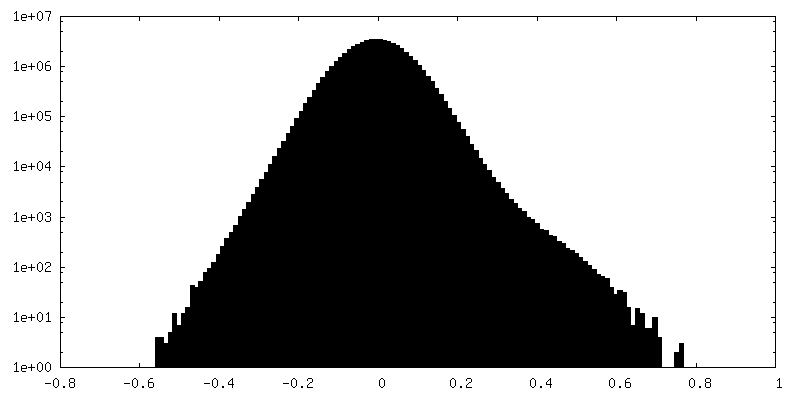
Density Histograms

-
Half map: local map halfA of XBB.1.5 spike/Nanosota-3C

Fileemd_43832_half_map_1.map
Annotationlocal map_halfA of XBB.1.5 spike/Nanosota-3C
Projections & Slices
AxesZYX

Projections

Slices (1/2)
Density Histograms

-
Half map: local map halfB of XBB.1.5 spike/Nanosota-3C

Fileemd_43832_half_map_2.map
Annotationlocal map_halfB of XBB.1.5 spike/Nanosota-3C
Projections & Slices
AxesZYX

Projections

Slices (1/2)
Density Histograms

-
Sample components

-
Entire : XBB.1.5 spike/Nanosota-3C complex

EntireName: XBB.1.5 spike/Nanosota-3C complex
Components
  • Complex: XBB.1.5 spike/Nanosota-3C complex
    • Complex: XBB.1.5 spike
      • Protein or peptide: Spike glycoprotein
    • Complex: Nanosota-3C
      • Protein or peptide: Nanosota-3C

-
Supramolecule #1: XBB.1.5 spike/Nanosota-3C complex

SupramoleculeName: XBB.1.5 spike/Nanosota-3C complex / type: complex / ID: 1 / Parent: 0 / Macromolecule list: all

-
Supramolecule #2: XBB.1.5 spike

SupramoleculeName: XBB.1.5 spike / type: complex / ID: 2 / Parent: 1 / Macromolecule list: #1
Source (natural)Organism: Severe acute respiratory syndrome coronavirus 2

-
Supramolecule #3: Nanosota-3C

SupramoleculeName: Nanosota-3C / type: complex / ID: 3 / Parent: 1 / Macromolecule list: #2
Source (natural)Organism: Vicugna pacos (alpaca)

-
Macromolecule #1: Spike glycoprotein

MacromoleculeName: Spike glycoprotein / type: protein_or_peptide / ID: 1 / Number of copies: 3 / Enantiomer: LEVO
Source (natural)Organism: Severe acute respiratory syndrome coronavirus 2
Molecular weightTheoretical: 136.647484 KDa
Recombinant expressionOrganism: Homo sapiens (human)
SequenceString: QCVNLITRTQ SYTNSFTRGV YYPDKVFRSS VLHSTQDLFL PFFSNVTWFH AIHVSGTNGT KRFDNPALPF NDGVYFASTE KSNIIRGWI FGTTLDSKTQ SLLIVNNATN VVIKVCEFQF CNDPFLDVYQ KNNKSWMESE FRVYSSANNC TFEYVSQPFL M DLEGKEGN ...String:
QCVNLITRTQ SYTNSFTRGV YYPDKVFRSS VLHSTQDLFL PFFSNVTWFH AIHVSGTNGT KRFDNPALPF NDGVYFASTE KSNIIRGWI FGTTLDSKTQ SLLIVNNATN VVIKVCEFQF CNDPFLDVYQ KNNKSWMESE FRVYSSANNC TFEYVSQPFL M DLEGKEGN FKNLREFVFK NIDGYFKIYS KHTPINLERD LPQGFSALEP LVDLPIGINI TRFQTLLALH RSYLTPGDSS SG WTAGAAA YYVGYLQPRT FLLKYNENGT ITDAVDCALD PLSETKCTLK SFTVEKGIYQ TSNFRVQPTE SIVRFPNITN LCP FHEVFN ATTFASVYAW NRKRISNCVA DYSVIYNFAP FFAFKCYGVS PTKLNDLCFT NVYADSFVIR GNEVSQIAPG QTGN IADYN YKLPDDFTGC VIAWNSNKLD SKPSGNYNYL YRLFRKSKLK PFERDISTEI YQAGNKPCNG VAGPNCYSPL QSYGF RPTY GVGHQPYRVV VLSFELLHAP ATVCGPKKST NLVKNKCVNF NFNGLTGTGV LTESNKKFLP FQQFGRDIAD TTDAVR DPQ TLEILDITPC SFGGVSVITP GTNTSNQVAV LYQGVNCTEV PVAIHADQLT PTWRVYSTGS NVFQTRAGCL IGAEYVN NS YECDIPIGAG ICASYQTQTK SHAGARSVAS QSIIAYTMSL GAENSVAYSN NSIAIPTNFT ISVTTEILPV SMTKTSVD C TMYICGDSTE CSNLLLQYGS FCTQLKRALT GIAVEQDKNT QEVFAQVKQI YKTPPIKYFG GFNFSQILPD PSKPSKRSP IEDLLFNKVT LADAGFIKQY GDCLGDIAAR DLICAQKFNG LTVLPPLLTD EMIAQYTSAL LAGTITSGWT FGAGPALQIP FPMQMAYRF NGIGVTQNVL YENQKLIANQ FNSAIGKIQD SLSSTPSALG KLQDVVNHNA QALNTLVKQL SSKFGAISSV L NDILSRLD PPEAEVQIDR LITGRLQSLQ TYVTQQLIRA AEIRASANLA ATKMSECVLG QSKRVDFCGK GYHLMSFPQS AP HGVVFLH VTYVPAQEKN FTTAPAICHD GKAHFPREGV FVSNGTHWFV TQRNFYEPQI ITTDNTFVSG NCDVVIGIVN NTV YDPLQP ELDSFKEELD KYFKNHTSPD VDLGDISGIN ASVVNIQKEI DRLNEVAKNL NESLIDLQEL GKYEQYIKGS GYIP EAPRD GQAYVRKDGE WVLLSTFLGH HHHHH

UniProtKB: Spike glycoprotein

-
Macromolecule #2: Nanosota-3C

MacromoleculeName: Nanosota-3C / type: protein_or_peptide / ID: 2 / Number of copies: 3 / Enantiomer: LEVO
Source (natural)Organism: Vicugna pacos (alpaca)
Molecular weightTheoretical: 14.883413 KDa
Recombinant expressionOrganism: Escherichia coli (E. coli)
SequenceString:
QVQLQESGGG LVQAGGSLRL SCAASGSIFS PNTMGWFRQA LGKQREGVAF ISSIASTSYW LPVKGRFTIT RDNTKNTVHL QMNSLIPED TAVYYCYAVD KSQDYWGQGT QVTVSSGGQH HHHHHGAYPY DVPDYAS

-
Experimental details

-
Structure determination

Methodcryo EM
Processingsingle particle reconstruction
Aggregation stateparticle

-
Sample preparation

BufferpH: 7.4
VitrificationCryogen name: ETHANE

-
Electron microscopy

MicroscopeFEI TITAN KRIOS
Image recordingFilm or detector model: GATAN K3 (6k x 4k) / Average electron dose: 50.0 e/Å2
Electron beamAcceleration voltage: 300 kV / Electron source: FIELD EMISSION GUN
Electron opticsIllumination mode: FLOOD BEAM / Imaging mode: BRIGHT FIELD / Nominal defocus max: 2.0 µm / Nominal defocus min: 1.0 µm
Experimental equipment
Model: Titan Krios / Image courtesy: FEI Company

+
Image processing

Startup modelType of model: NONE
Final reconstructionResolution.type: BY AUTHOR / Resolution: 3.5 Å / Resolution method: FSC 0.143 CUT-OFF / Number images used: 225916
Initial angle assignmentType: MAXIMUM LIKELIHOOD
Final angle assignmentType: MAXIMUM LIKELIHOOD
FSC plot (resolution estimation)

-
Atomic model buiding 1

Initial modelPDB ID:

Chain - Source name: PDB / Chain - Initial model type: experimental model
Output model

PDB-9atp:
local refinement of XBB.1.5 spike/Nanosota-3C complex

+
About Yorodumi

-
News

-
Feb 9, 2022. New format data for meta-information of EMDB entries

New format data for meta-information of EMDB entries

  • Version 3 of the EMDB header file is now the official format.
  • The previous official version 1.9 will be removed from the archive.

Related info.:EMDB header

External links:wwPDB to switch to version 3 of the EMDB data model

-
Aug 12, 2020. Covid-19 info

Covid-19 info

URL: https://pdbj.org/emnavi/covid19.php

New page: Covid-19 featured information page in EM Navigator.

Related info.:Covid-19 info / Mar 5, 2020. Novel coronavirus structure data

+
Mar 5, 2020. Novel coronavirus structure data

Novel coronavirus structure data

Related info.:Yorodumi Speices / Aug 12, 2020. Covid-19 info

External links:COVID-19 featured content - PDBj / Molecule of the Month (242):Coronavirus Proteases

+
Jan 31, 2019. EMDB accession codes are about to change! (news from PDBe EMDB page)

EMDB accession codes are about to change! (news from PDBe EMDB page)

  • The allocation of 4 digits for EMDB accession codes will soon come to an end. Whilst these codes will remain in use, new EMDB accession codes will include an additional digit and will expand incrementally as the available range of codes is exhausted. The current 4-digit format prefixed with “EMD-” (i.e. EMD-XXXX) will advance to a 5-digit format (i.e. EMD-XXXXX), and so on. It is currently estimated that the 4-digit codes will be depleted around Spring 2019, at which point the 5-digit format will come into force.
  • The EM Navigator/Yorodumi systems omit the EMD- prefix.

Related info.:Q: What is EMD? / ID/Accession-code notation in Yorodumi/EM Navigator

External links:EMDB Accession Codes are Changing Soon! / Contact to PDBj

+
Jul 12, 2017. Major update of PDB

Major update of PDB

  • wwPDB released updated PDB data conforming to the new PDBx/mmCIF dictionary.
  • This is a major update changing the version number from 4 to 5, and with Remediation, in which all the entries are updated.
  • In this update, many items about electron microscopy experimental information are reorganized (e.g. em_software).
  • Now, EM Navigator and Yorodumi are based on the updated data.

External links:wwPDB Remediation / Enriched Model Files Conforming to OneDep Data Standards Now Available in the PDB FTP Archive

-
Yorodumi

Thousand views of thousand structures

  • Yorodumi is a browser for structure data from EMDB, PDB, SASBDB, etc.
  • This page is also the successor to EM Navigator detail page, and also detail information page/front-end page for Omokage search.
  • The word "yorodu" (or yorozu) is an old Japanese word meaning "ten thousand". "mi" (miru) is to see.

Related info.:EMDB / PDB / SASBDB / Comparison of 3 databanks / Yorodumi Search / Aug 31, 2016. New EM Navigator & Yorodumi / Yorodumi Papers / Jmol/JSmol / Function and homology information / Changes in new EM Navigator and Yorodumi

Read more