 Movie
Movie Controller


+ Open data

- Basic information
| Entry |  | |||||||||
|---|---|---|---|---|---|---|---|---|---|---|
| Title | M. tuberculosis CTP synthase tetramer bound to CTP | |||||||||
 Map data Map data | ||||||||||
 Sample Sample |
| |||||||||
 Keywords Keywords | metabolic enzyme / LIGASE | |||||||||
| Function / homology |  Function and homology information Function and homology informationCTP synthase (glutamine hydrolysing) / CTP synthase activity / 'de novo' CTP biosynthetic process / cytoophidium / pyrimidine nucleobase biosynthetic process / ATP binding / metal ion binding / identical protein binding / cytosol Similarity search - Function | |||||||||
| Biological species |  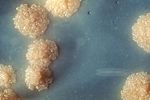 Mycobacterium tuberculosis (bacteria) Mycobacterium tuberculosis (bacteria) | |||||||||
| Method | single particle reconstruction / cryo EM / Resolution: 3.6 Å | |||||||||
 Authors Authors | Lynch EM / Kollman JM | |||||||||
| Funding support |  United States, 1 items United States, 1 items
| |||||||||
 Citation Citation | Journal: Nat Commun / Year: 2025 Title: Evolutionarily divergent Mycobacterium tuberculosis CTP synthase filaments are under selective pressure. Authors: Eric M Lynch / Yao Lu / Jin Ho Park / Lin Shao / Justin M Kollman / E Hesper Rego / Abstract: The final and rate-limiting enzyme in pyrimidine biosynthesis, cytidine triphosphate synthase (CTPS), is essential for the viability of Mycobacterium tuberculosis and other mycobacteria. Its product, ...The final and rate-limiting enzyme in pyrimidine biosynthesis, cytidine triphosphate synthase (CTPS), is essential for the viability of Mycobacterium tuberculosis and other mycobacteria. Its product, cytidine triphosphate (CTP), is critical for RNA, DNA, lipid and cell wall synthesis, and is involved in chromosome segregation. In various organisms across the tree of life, CTPS assembles into higher-order filaments, leading us to hypothesize that M. tuberculosis CTPS (mtCTPS) also forms higher-order structures. Here, we show that mtCTPS does assemble into filaments but with an unusual architecture not seen in other organisms. Through a combination of structural, biochemical, and cellular techniques, we show that polymerization stabilizes the active conformation of the enzyme and resists product inhibition, potentially allowing for the highly localized production of CTP within the cell. Indeed, CTPS filaments localize near the CTP-dependent complex needed for chromosome segregation, and cells expressing mutant enzymes unable to polymerize are altered in their ability to robustly form this complex. Intriguingly, mutants that inhibit filament formation are under positive selection in clinical isolates of M. tuberculosis, pointing to a critical role needed to withstand pressures imposed by the host and/or antibiotics. Taken together, our data reveal an unexpected mechanism for the spatially organized production of a critical nucleotide in M. tuberculosis, which may represent a vulnerability of the pathogen that can be exploited with chemotherapy. | |||||||||
| History |
|
- Structure visualization
| Supplemental images |
|---|

- Downloads & links
-EMDB archive
| Map data | emd_42611.map.gz | 8.1 MB | EMDB map data format | |
|---|---|---|---|---|
| Header (meta data) | emd-42611-v30.xmlemd-42611.xml | 19.4 KB 19.4 KB | Display Display | EMDB header |
| Images |  emd_42611.png emd_42611.png | 59.2 KB | ||
| Filedesc metadata | emd-42611.cif.gz | 6.2 KB | ||
| Others | emd_42611_half_map_1.map.gzemd_42611_half_map_2.map.gz | 79.4 MB 79.4 MB | ||
| Archive directory |  http://ftp.pdbj.org/pub/emdb/structures/EMD-42611ftp://ftp.pdbj.org/pub/emdb/structures/EMD-42611 http://ftp.pdbj.org/pub/emdb/structures/EMD-42611ftp://ftp.pdbj.org/pub/emdb/structures/EMD-42611 | HTTPS FTP |
-Related structure data
| Related structure data |  8uv8MC  8uv4C  8uv9C  8uvaC M: atomic model generated by this map C: citing same article ( |
|---|---|
| Similar structure data |


-Links
| EMDB pages | EMDB (EBI/PDBe) / EMDataResource |
|---|---|
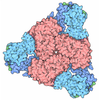
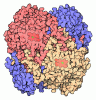
| Related items in Molecule of the Month |
-Map
| File | Download / File: emd_42611.map.gz / Format: CCP4 / Size: 103 MB / Type: IMAGE STORED AS FLOATING POINT NUMBER (4 BYTES) | ||||||||||||||||||||||||||||||||||||
|---|---|---|---|---|---|---|---|---|---|---|---|---|---|---|---|---|---|---|---|---|---|---|---|---|---|---|---|---|---|---|---|---|---|---|---|---|---|
| Projections & slices | Image control
Images are generated by Spider. | ||||||||||||||||||||||||||||||||||||
| Voxel size | X=Y=Z: 1.16 Å | ||||||||||||||||||||||||||||||||||||
| Density |
| ||||||||||||||||||||||||||||||||||||
| Symmetry | Space group: 1 | ||||||||||||||||||||||||||||||||||||
| Details | EMDB XML:
|
 X (Sec.)
 Y (Row.)
 Z (Col.)


-Supplemental data
-Half map: #1
| File | emd_42611_half_map_1.map | ||||||||||||
|---|---|---|---|---|---|---|---|---|---|---|---|---|---|
| Projections & Slices |
| ||||||||||||
| Density Histograms |


-Half map: #2
| File | emd_42611_half_map_2.map | ||||||||||||
|---|---|---|---|---|---|---|---|---|---|---|---|---|---|
| Projections & Slices |
| ||||||||||||
| Density Histograms |


- Sample components
-Entire : CTP synthase tetramer
| Entire | Name: CTP synthase tetramer |
|---|---|
| Components |
|
-Supramolecule #1: CTP synthase tetramer
| Supramolecule | Name: CTP synthase tetramer / type: complex / ID: 1 / Parent: 0 / Macromolecule list: #1 |
|---|---|
| Source (natural) | Organism: Mycobacterium tuberculosis (bacteria) |
-Macromolecule #1: CTP synthase
| Macromolecule | Name: CTP synthase / type: protein_or_peptide / ID: 1 / Number of copies: 4 / Enantiomer: LEVO |
|---|---|
| Source (natural) | Organism: Mycobacterium tuberculosis (bacteria) |
| Molecular weight | Theoretical: 64.542797 KDa |
| Recombinant expression | Organism:  Escherichia coli (E. coli) Escherichia coli (E. coli) |
| Sequence | String: MRKHPQTATK HLFVSGGVAS SLGKGLTASS LGQLLTARGL HVTMQKLDPY LNVDPGTMNP FQHGEVFVTE DGAETDLDVG HYERFLDRN LPGSANVTTG QVYSTVIAKE RRGEYLGDTV QVIPHITDEI KRRILAMAQP DADGNRPDVV ITEIGGTVGD I ESQPFLEA ...String: MRKHPQTATK HLFVSGGVAS SLGKGLTASS LGQLLTARGL HVTMQKLDPY LNVDPGTMNP FQHGEVFVTE DGAETDLDVG HYERFLDRN LPGSANVTTG QVYSTVIAKE RRGEYLGDTV QVIPHITDEI KRRILAMAQP DADGNRPDVV ITEIGGTVGD I ESQPFLEA ARQVRHYLGR EDVFFLHVSL VPYLAPSGEL KTKPTQHSVA ALRSIGITPD ALILRCDRDV PEALKNKIAL MC DVDIDGV ISTPDAPSIY DIPKVLHREE LDAFVVRRLN LPFRDVDWTE WDDLLRRVHE PHETVRIALV GKYVELSDAY LSV AEALRA GGFKHRAKVE ICWVASDGCE TTSGAAAALG DVHGVLIPGG FGIRGIEGKI GAIAYARARG LPVLGLCLGL QCIV IEAAR SVGLTNANSA EFDPDTPDPV IATMPDQEEI VAGEADLGGT MRLGSYPAVL EPDSVVAQAY QTTQVSERHR HRYEV NNAY RDKIAESGLR FSGTSPDGHL VEFVEYPPDR HPFVVGTQAH PELKSRPTRP HPLFVAFVGA AIDYKAGELL PVEIPE IPE HTPNGSSHRD GVGQPLPEPA SRGHHHHHH UniProtKB: CTP synthase |
-Macromolecule #2: CYTIDINE-5'-TRIPHOSPHATE
| Macromolecule | Name: CYTIDINE-5'-TRIPHOSPHATE / type: ligand / ID: 2 / Number of copies: 8 / Formula: CTP |
|---|---|
| Molecular weight | Theoretical: 483.156 Da |
| Chemical component information | 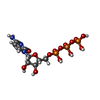 ChemComp-CTP: |
-Macromolecule #3: MAGNESIUM ION
| Macromolecule | Name: MAGNESIUM ION / type: ligand / ID: 3 / Number of copies: 4 / Formula: MG |
|---|---|
| Molecular weight | Theoretical: 24.305 Da |
-Experimental details
-Structure determination
| Method | cryo EM |
|---|---|
 Processing Processing | single particle reconstruction |
| Aggregation state | particle |
-Sample preparation
| Buffer | pH: 8 |
|---|---|
| Vitrification | Cryogen name: ETHANE |
- Electron microscopy
| Microscope | TFS GLACIOS |
|---|---|
| Image recording | Film or detector model: GATAN K2 SUMMIT (4k x 4k) / Detector mode: COUNTING / Average electron dose: 65.0 e/Å2 |
| Electron beam | Acceleration voltage: 200 kV / Electron source:  FIELD EMISSION GUN FIELD EMISSION GUN |
| Electron optics | Illumination mode: FLOOD BEAM / Imaging mode: BRIGHT FIELD / Nominal defocus max: 2.5 µm / Nominal defocus min: 1.0 µm |
+Image processing
-Atomic model buiding 1
| Refinement | Protocol: FLEXIBLE FIT |
|---|---|
| Output model | PDB-8uv8: |
-Atomic model buiding 2
| Refinement | Protocol: FLEXIBLE FIT |
|---|---|
| Output model | PDB-8uv8: |
