regulation of calcium ion transport into cytosol / ubiquitin-like protein ligase activity / negative regulation of translation in response to oxidative stress / positive regulation of protein localization to chromosome, telomeric region / suppression of viral release by host / PML body organization / SUMO binding / positive regulation of apoptotic process involved in mammary gland involution / SMAD protein signal transduction / fibroblast migration ...regulation of calcium ion transport into cytosol / ubiquitin-like protein ligase activity / negative regulation of translation in response to oxidative stress / positive regulation of protein localization to chromosome, telomeric region / suppression of viral release by host / PML body organization / SUMO binding / positive regulation of apoptotic process involved in mammary gland involution / SMAD protein signal transduction / fibroblast migration / myeloid cell differentiation / protein-containing complex localization / maintenance of protein location in nucleus / endoplasmic reticulum calcium ion homeostasis / regulation of double-strand break repair / branching involved in mammary gland duct morphogenesis / oncogene-induced cell senescence / negative regulation of mitotic cell cycle / Transferases; Acyltransferases; Aminoacyltransferases / SUMO transferase activity / Regulation of RUNX1 Expression and Activity / positive regulation of extrinsic apoptotic signaling pathway / cobalt ion binding / intrinsic apoptotic signaling pathway in response to oxidative stress / negative regulation of interleukin-1 beta production / entrainment of circadian clock by photoperiod / SUMOylation of ubiquitinylation proteins / SMAD binding / negative regulation of telomere maintenance via telomerase / positive regulation of telomere maintenance / protein sumoylation / intrinsic apoptotic signaling pathway in response to endoplasmic reticulum stress / intrinsic apoptotic signaling pathway in response to DNA damage by p53 class mediator / cell fate commitment / negative regulation of ubiquitin-dependent protein catabolic process / positive regulation of signal transduction by p53 class mediator / regulation of cell adhesion / SUMOylation of DNA damage response and repair proteins / protein targeting / response to UV / retinoic acid receptor signaling pathway / Regulation of TP53 Activity through Acetylation / extrinsic apoptotic signaling pathway / positive regulation of defense response to virus by host / response to cytokine / transforming growth factor beta receptor signaling pathway / cellular response to interleukin-4 / Regulation of PTEN localization / negative regulation of angiogenesis / cellular response to leukemia inhibitory factor / response to gamma radiation / DNA damage response, signal transduction by p53 class mediator / circadian regulation of gene expression / negative regulation of cell growth / regulation of circadian rhythm / PML body / nuclear matrix / positive regulation of fibroblast proliferation / Transcriptional regulation of granulopoiesis / intrinsic apoptotic signaling pathway in response to DNA damage / Interferon gamma signaling / protein import into nucleus / HCMV Early Events / cellular senescence / protein-containing complex assembly / early endosome membrane / nuclear membrane / molecular adaptor activity / proteasome-mediated ubiquitin-dependent protein catabolic process / response to hypoxia / transcription coactivator activity / chromosome, telomeric region / regulation of cell cycle / protein stabilization / chromatin remodeling / protein heterodimerization activity / negative regulation of cell population proliferation / innate immune response / negative regulation of DNA-templated transcription / apoptotic process / ubiquitin protein ligase binding / regulation of DNA-templated transcription / endoplasmic reticulum membrane / nucleolus / protein homodimerization activity / DNA binding / zinc ion binding / nucleoplasm / identical protein binding / nucleus / cytosol / cytoplasm Similarity search - Function
National Natural Science Foundation of China (NSFC)
20152504
China
Citation
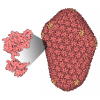
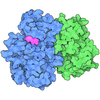
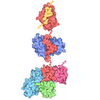
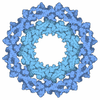
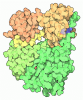
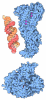
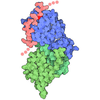
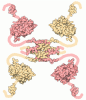
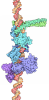
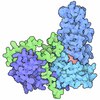
Journal: Cell Discov / Year: 2024 Title: Cryo-EM structure of PML RBCC dimer reveals CC-mediated octopus-like nuclear body assembly mechanism. Authors: Yangxia Tan / Jiawei Li / Shiyan Zhang / Yonglei Zhang / Zhiyi Zhuo / Xiaodan Ma / Yue Yin / Yanling Jiang / Yao Cong / Guoyu Meng / Abstract: Promyelocytic leukemia protein (PML) nuclear bodies (NBs) are essential in regulating tumor suppression, antiviral response, inflammation, metabolism, aging, and other important life processes. The ...Promyelocytic leukemia protein (PML) nuclear bodies (NBs) are essential in regulating tumor suppression, antiviral response, inflammation, metabolism, aging, and other important life processes. The re-assembly of PML NBs might lead to an ~100% cure of acute promyelocytic leukemia. However, until now, the molecular mechanism underpinning PML NB biogenesis remains elusive due to the lack of structural information. In this study, we present the cryo-electron microscopy (cryo-EM) structure of the PML dimer at an overall resolution of 5.3 Å, encompassing the RING, B-box1/2 and part of the coiled-coil (RBCC) domains. The integrated approach, combining crosslinking and mass spectrometry (XL-MS) and functional analyses, enabled us to observe a unique folding event within the RBCC domains. The RING and B-box1/2 domains fold around the α3 helix, and the α6 helix serves as a pivotal interface for PML dimerization. More importantly, further characterizations of the cryo-EM structure in conjugation with AlphaFold2 prediction, XL-MS, and NB formation assays, help unveil an unprecedented octopus-like mechanism in NB assembly, wherein each CC helix of a PML dimer (PML dimer A) interacts with a CC helix from a neighboring PML dimer (PML dimer B) in an anti-parallel configuration, ultimately leading to the formation of a 2 µm membrane-less subcellular organelle.
In the structure databanks used in Yorodumi, some data are registered as the other names, "COVID-19 virus" and "2019-nCoV". Here are the details of the virus and the list of structure data.
Jan 31, 2019. EMDB accession codes are about to change! (news from PDBe EMDB page)
EMDB accession codes are about to change! (news from PDBe EMDB page)
The allocation of 4 digits for EMDB accession codes will soon come to an end. Whilst these codes will remain in use, new EMDB accession codes will include an additional digit and will expand incrementally as the available range of codes is exhausted. The current 4-digit format prefixed with “EMD-” (i.e. EMD-XXXX) will advance to a 5-digit format (i.e. EMD-XXXXX), and so on. It is currently estimated that the 4-digit codes will be depleted around Spring 2019, at which point the 5-digit format will come into force.
The EM Navigator/Yorodumi systems omit the EMD- prefix.
Related info.:Q: What is EMD? / ID/Accession-code notation in Yorodumi/EM Navigator
Yorodumi is a browser for structure data from EMDB, PDB, SASBDB, etc.
This page is also the successor to EM Navigator detail page, and also detail information page/front-end page for Omokage search.
The word "yorodu" (or yorozu) is an old Japanese word meaning "ten thousand". "mi" (miru) is to see.
Related info.:EMDB / PDB / SASBDB / Comparison of 3 databanks / Yorodumi Search / Aug 31, 2016. New EM Navigator & Yorodumi / Yorodumi Papers / Jmol/JSmol / Function and homology information / Changes in new EM Navigator and Yorodumi
 Movie
Movie Controller


 Open data
 Basic information
 Map data
 Sample
 Keywords
 Function and homology information
 Homo sapiens (human)
 Authors
 China, 1 items
  Citation
 Structure visualization
 Downloads & links
 emd_39571.png
 http://ftp.pdbj.org/pub/emdb/structures/EMD-39571

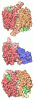
 Z (Sec.)
 Y (Row.)
 X (Col.)


 Sample components
 Escherichia coli (E. coli)
 Processing
 Electron microscopy
 FIELD EMISSION GUN