[English] 日本語
Yorodumi
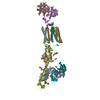
- EMDB-39568: Cryo-EM structure of the dystrophin glycoprotein complex -

+
Open data


ID or keywords:

Loading...

-
Basic information

Entry
Database: EMDB / ID: EMD-39568
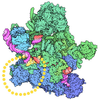
TitleCryo-EM structure of the dystrophin glycoprotein complex
Map data
Sample
  • Complex: dystrophin glycoprotein complex, DGC
    • Protein or peptide: x 9 types
  • Ligand: x 5 types
Keywordscomplex membrane stability signaling / STRUCTURAL PROTEIN
Function / homology
Function and homology information


dystrobrevin complex / olfactory nerve structural organization / sarcoglycan complex / coronary vasculature morphogenesis / DAG1 core M2 glycosylations / DAG1 core M1 glycosylations / DAG1 core M3 glycosylations / establishment of blood-nerve barrier / establishment of glial blood-brain barrier / Matriglycan biosynthesis on DAG1 ...dystrobrevin complex / olfactory nerve structural organization / sarcoglycan complex / coronary vasculature morphogenesis / DAG1 core M2 glycosylations / DAG1 core M1 glycosylations / DAG1 core M3 glycosylations / establishment of blood-nerve barrier / establishment of glial blood-brain barrier / Matriglycan biosynthesis on DAG1 / striated muscle cell development / dystroglycan complex / nerve maturation / muscle attachment / retrograde trans-synaptic signaling by trans-synaptic protein complex / walking behavior / connective tissue development / regulation of muscle system process / regulation of cellular response to growth factor stimulus / Regulation of expression of SLITs and ROBOs / contractile ring / nucleus localization / cardiac muscle cell action potential / calcium-dependent cell-matrix adhesion / morphogenesis of an epithelial sheet / reactive oxygen species biosynthetic process / glucose import in response to insulin stimulus / microtubule anchoring / vascular associated smooth muscle cell development / synaptic assembly at neuromuscular junction / synaptic signaling / dystrophin-associated glycoprotein complex / laminin-1 binding / extracellular matrix assembly / matrix side of mitochondrial inner membrane / response to denervation involved in regulation of muscle adaptation / Formation of the dystrophin-glycoprotein complex (DGC) / cell-substrate junction / negative regulation of synaptic transmission, cholinergic / myotube cell development / neurofilament / postsynaptic specialization / Striated Muscle Contraction / peptide biosynthetic process / photoreceptor ribbon synapse / basement membrane organization / dystroglycan binding / nerve development / regulation of skeletal muscle contraction by regulation of release of sequestered calcium ion / heart process / inhibitory synapse / lamin binding / vinculin binding / positive regulation of myelination / cellular response to cholesterol / branching involved in salivary gland morphogenesis / regulation of sodium ion transmembrane transport / positive regulation of skeletal muscle acetylcholine-gated channel clustering / protein localization to synapse / costamere / myelination in peripheral nervous system / skeletal muscle tissue regeneration / membrane organization / commissural neuron axon guidance / muscle cell development / regulation of calcium ion transmembrane transport / node of Ranvier / intermediate filament cytoskeleton / heparan sulfate proteoglycan binding / filopodium membrane / inhibitory synapse assembly / angiogenesis involved in wound healing / cardiac muscle cell development / axon regeneration / cardiac muscle tissue development / protein-containing complex localization / cardiac muscle cell contraction / structural constituent of muscle / extrinsic component of cytoplasmic side of plasma membrane / positive regulation of cell-matrix adhesion / muscle organ development / astrocyte projection / limb development / negative regulation of neuron differentiation / muscle cell cellular homeostasis / response to muscle activity / myosin binding / epithelial tube branching involved in lung morphogenesis / regulation of synapse organization / heart contraction / laminin receptor activity / myofibril / neuron projection terminus / regulation of neurotransmitter receptor localization to postsynaptic specialization membrane / alpha-actinin binding / membrane protein ectodomain proteolysis / regulation of skeletal muscle contraction / positive regulation of oligodendrocyte differentiation / basement membrane / nitric-oxide synthase binding
Similarity search - Function
Distrobrevin / Sarcoglycan complex subunit protein / Sarcoglycan alpha/epsilon / Beta-sarcoglycan / Sarcospan / Sarcoglycan gamma/delta/zeta / : / : / Sarcoglycan complex subunit protein / Sarcoglycan alpha/epsilon N-terminal domain ...Distrobrevin / Sarcoglycan complex subunit protein / Sarcoglycan alpha/epsilon / Beta-sarcoglycan / Sarcospan / Sarcoglycan gamma/delta/zeta / : / : / Sarcoglycan complex subunit protein / Sarcoglycan alpha/epsilon N-terminal domain / Sarcoglycan alpha/epsilon second domain / Dystroglycan-type cadherin-like / Dystroglycan, C-terminal / Alpha-dystroglycan domain 2 / DG-type SEA domain / Alpha-dystroglycan N-terminal domain 2 / Dystroglycan (Dystrophin-associated glycoprotein 1) / Alpha-Dystroglycan N-terminal domain 2 / DG-type SEA domain profile. / Dystroglycan-type cadherin-like domains. / Putative Ig domain / Dystrophin/utrophin / EF-hand domain, type 1 / EF-hand domain, type 2 / EF hand / EF-hand / CD20-like family / CD20-like family / : / Spectrin repeat / Spectrin repeat / Spectrin/alpha-actinin / Spectrin repeats / Actinin-type actin-binding domain signature 1. / Actinin-type actin-binding domain signature 2. / Actinin-type actin-binding domain, conserved site / Cadherin-like superfamily / Calponin homology domain / Calponin homology (CH) domain / Zinc finger ZZ-type signature. / Zinc finger, ZZ type / Zinc-binding domain, present in Dystrophin, CREB-binding protein. / Zinc finger, ZZ-type / Zinc finger, ZZ-type superfamily / Zinc finger ZZ-type profile. / Calponin homology domain / CH domain superfamily / Calponin homology (CH) domain profile. / WW domain / WW/rsp5/WWP domain signature. / WW domain superfamily / WW/rsp5/WWP domain profile. / Domain with 2 conserved Trp (W) residues / WW domain / EF-hand domain pair / Immunoglobulin-like fold
Similarity search - Domain/homology
Dystrophin / Delta-sarcoglycan / Gamma-sarcoglycan / Beta-sarcoglycan / Alpha-sarcoglycan / Sarcospan / Dystroglycan 1 / Dystrobrevin alpha
Similarity search - Component
Biological speciesMus musculus (house mouse)
Methodsingle particle reconstruction / Resolution: 3.5 Å
AuthorsWu JP / Yan Z / Wan L
Funding support China, 1 items
OrganizationGrant numberCountry
National Natural Science Foundation of China (NSFC)32271261 China
CitationJournal: Nature / Year: 2025
Title: Structure and assembly of the dystrophin glycoprotein complex.
Authors: Li Wan / Xiaofei Ge / Qikui Xu / Gaoxingyu Huang / Tiandi Yang / Kevin P Campbell / Zhen Yan / Jianping Wu /
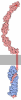
Abstract: The dystrophin glycoprotein complex (DGC) has a crucial role in maintaining cell membrane stability and integrity by connecting the intracellular cytoskeleton with the surrounding extracellular ...The dystrophin glycoprotein complex (DGC) has a crucial role in maintaining cell membrane stability and integrity by connecting the intracellular cytoskeleton with the surrounding extracellular matrix. Dysfunction of dystrophin and its associated proteins results in muscular dystrophy, a disorder characterized by progressive muscle weakness and degeneration. Despite the important roles of the DGC in physiology and pathology, its structural details remain largely unknown, hindering a comprehensive understanding of its assembly and function. Here we isolated the native DGC from mouse skeletal muscle and obtained its high-resolution structure. Our findings unveil a markedly divergent structure from the previous model of DGC assembly. Specifically, on the extracellular side, β-, γ- and δ-sarcoglycans co-fold to form a specialized, extracellular tower-like structure, which has a central role in complex assembly by providing binding sites for α-sarcoglycan and dystroglycan. In the transmembrane region, sarcoglycans and sarcospan flank and stabilize the single transmembrane helix of dystroglycan, rather than forming a subcomplex as previously proposed. On the intracellular side, sarcoglycans and dystroglycan engage in assembly with the dystrophin-dystrobrevin subcomplex through extensive interaction with the ZZ domain of dystrophin. Collectively, these findings enhance our understanding of the structural linkage across the cell membrane and provide a foundation for the molecular interpretation of many muscular dystrophy-related mutations.
History
DepositionMar 25, 2024-
Header (metadata) releaseDec 11, 2024-
Map releaseDec 11, 2024-
UpdateFeb 12, 2025-
Current statusFeb 12, 2025Processing site: PDBc / Status: Released

-
Structure visualization

Supplemental images

Downloads & links

-
Map

FileDownload / File: emd_39568.map.gz / Format: CCP4 / Size: 307.5 MB / Type: IMAGE STORED AS FLOATING POINT NUMBER (4 BYTES)
Projections & slices

Image control

Size
Brightness
Contrast
Others
AxesZ (Sec.)Y (Row.)X (Col.)
1.09 Å/pix.
x 432 pix.
= 469.584 Å
1.09 Å/pix.
x 432 pix.
= 469.584 Å
1.09 Å/pix.
x 432 pix.
= 469.584 Å

Surface

Projections

Slices (1/3)

Slices (1/2)

Slices (2/3)

Images are generated by Spider.

Voxel sizeX=Y=Z: 1.087 Å
Density
Contour LevelBy AUTHOR: 0.28
Minimum - Maximum-1.9093491 - 3.340943
Average (Standard dev.)-0.0012319844 (±0.043488972)
SymmetrySpace group: 1
Details

EMDB XML:

Map geometry
Axis orderXYZ
Origin000
Dimensions432432432
Spacing432432432
CellA=B=C: 469.584 Å
α=β=γ: 90.0 °

-
Supplemental data

-
Half map: #2

Fileemd_39568_half_map_1.map
Projections & Slices
AxesZYX

Projections

Slices (1/2)
Density Histograms

-
Half map: #1

Fileemd_39568_half_map_2.map
Projections & Slices
AxesZYX

Projections

Slices (1/2)
Density Histograms

-
Sample components

+
Entire : dystrophin glycoprotein complex, DGC

EntireName: dystrophin glycoprotein complex, DGC
Components
  • Complex: dystrophin glycoprotein complex, DGC
    • Protein or peptide: Alpha-sarcoglycan
    • Protein or peptide: Beta-sarcoglycan
    • Protein or peptide: Dystrobrevin alpha
    • Protein or peptide: Delta-sarcoglycan
    • Protein or peptide: Dystrophin
    • Protein or peptide: Gamma-sarcoglycan
    • Protein or peptide: unknown segment
    • Protein or peptide: Beta-dystroglycan
    • Protein or peptide: Sarcospan
  • Ligand: 2-acetamido-2-deoxy-beta-D-glucopyranose
  • Ligand: CHOLESTEROL
  • Ligand: ZINC ION
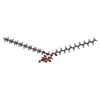
  • Ligand: O-[(R)-{[(2R)-2,3-bis(octadecanoyloxy)propyl]oxy}(hydroxy)phosphoryl]-L-serine
  • Ligand: CALCIUM ION

+
Supramolecule #1: dystrophin glycoprotein complex, DGC

SupramoleculeName: dystrophin glycoprotein complex, DGC / type: complex / ID: 1 / Parent: 0 / Macromolecule list: #1-#9
Source (natural)Organism: Mus musculus (house mouse)

+
Macromolecule #1: Alpha-sarcoglycan

MacromoleculeName: Alpha-sarcoglycan / type: protein_or_peptide / ID: 1 / Number of copies: 1 / Enantiomer: LEVO
Source (natural)Organism: Mus musculus (house mouse)
Molecular weightTheoretical: 32.539186 KDa
SequenceString: QQTTLHLLVG RVFVHPLEHA TFLRLPEHVA VPPTVRLTYH AHLQGHPDLP RWLHYTQRSP YNPGFLYGSP TPEDRGYQVI EVTAYNRDS FDTTRQRLLL LIGDPEGPRL PYQAEFLVRS HDVEEVLPTT PANRFLTALG GLWEPGELQL LNITSALDRG G RVPLPIEG ...String:
QQTTLHLLVG RVFVHPLEHA TFLRLPEHVA VPPTVRLTYH AHLQGHPDLP RWLHYTQRSP YNPGFLYGSP TPEDRGYQVI EVTAYNRDS FDTTRQRLLL LIGDPEGPRL PYQAEFLVRS HDVEEVLPTT PANRFLTALG GLWEPGELQL LNITSALDRG G RVPLPIEG RKEGVYIKVG SATPFSTCLK MVASPDSYAR CAQGQPPLLS CYDTLAPHFR VDWCNVSLVD KSVPEPLDEV PT PGDGILE HDPFFCPPTE ATDRDFLTDA LVTLLVPLLV ALLLTLLLAY IMCF

UniProtKB: Alpha-sarcoglycan

+
Macromolecule #2: Beta-sarcoglycan

MacromoleculeName: Beta-sarcoglycan / type: protein_or_peptide / ID: 2 / Number of copies: 1 / Enantiomer: LEVO
Source (natural)Organism: Mus musculus (house mouse)
Molecular weightTheoretical: 28.729967 KDa
SequenceString: HKTGLRGRKG NLAICVIVLL FILAVINLLI TLVIWAVIRI GPNGCDSMEF HESGLLRFKQ VSDMGVIHPL YKSTVGGRRN ENLVITGNN QPIVFQQGTT KLSVEKNKTS ITSDIGMQFF DPRTHNILFS TDYETHEFHL PSGVKSLNVQ KASTERITSN A TSDLNIKV ...String:
HKTGLRGRKG NLAICVIVLL FILAVINLLI TLVIWAVIRI GPNGCDSMEF HESGLLRFKQ VSDMGVIHPL YKSTVGGRRN ENLVITGNN QPIVFQQGTT KLSVEKNKTS ITSDIGMQFF DPRTHNILFS TDYETHEFHL PSGVKSLNVQ KASTERITSN A TSDLNIKV DGRAIVRGNE GVFIMGKTIE FHMGGDVELK AENSIILNGT VMVSPTRLPS SSSGDQSGSG DWVRYKLCMC AD GTLFKVQ VTGHNMGCQV SDNPCG

UniProtKB: Beta-sarcoglycan

+
Macromolecule #3: Dystrobrevin alpha

MacromoleculeName: Dystrobrevin alpha / type: protein_or_peptide / ID: 3 / Number of copies: 1 / Enantiomer: LEVO
Source (natural)Organism: Mus musculus (house mouse)
Molecular weightTheoretical: 23.363234 KDa
SequenceString: LSTYRTACKL RFVQKKCNLH LVDIWNVIEA LRENALNNLD PNIELNVARL EAVLSTIFYQ LNKRMPTTHQ IHVEQSISLL LNFLLAAFD PEGHGKISVF AVKMALATLC GGKIMDKLRY IFSMISDSSG VMVYGRYDQF LREVLKLPTA VFEGPSFGYT E QSARSCFS ...String:
LSTYRTACKL RFVQKKCNLH LVDIWNVIEA LRENALNNLD PNIELNVARL EAVLSTIFYQ LNKRMPTTHQ IHVEQSISLL LNFLLAAFD PEGHGKISVF AVKMALATLC GGKIMDKLRY IFSMISDSSG VMVYGRYDQF LREVLKLPTA VFEGPSFGYT E QSARSCFS QQKKVTLNGF LDTLMSDPPP QCLVWLPLLH RLANVENV

UniProtKB: Dystrobrevin alpha

+
Macromolecule #4: Delta-sarcoglycan

MacromoleculeName: Delta-sarcoglycan / type: protein_or_peptide / ID: 4 / Number of copies: 1 / Enantiomer: LEVO
Source (natural)Organism: Mus musculus (house mouse)
Molecular weightTheoretical: 29.1911 KDa
SequenceString: YGWRKRCLYF FVLLLMILIL VNLAMTIWIL KVMNFTIDGM GNLRITEKGL KLEGDSEFLQ PLYAKEIKSR PGNALYFKSA RNVTVNILN DQTKVLTQLV TGPKAVEAYG KRFEVKTVSG KLLFSADDSE VVVGAERLRV LGAEGTVFPK SIETPNVRAD P FKELRLES ...String:
YGWRKRCLYF FVLLLMILIL VNLAMTIWIL KVMNFTIDGM GNLRITEKGL KLEGDSEFLQ PLYAKEIKSR PGNALYFKSA RNVTVNILN DQTKVLTQLV TGPKAVEAYG KRFEVKTVSG KLLFSADDSE VVVGAERLRV LGAEGTVFPK SIETPNVRAD P FKELRLES PTRSLVMEAP KGVEINAEAG NMEAICRSEL RLESKDGEIK LDAAKIKLPR LPRGSYTPTG TRQKVFEVCV CA NGRLFLS QAGTGSTCQI NTSVCL

UniProtKB: Delta-sarcoglycan

+
Macromolecule #5: Dystrophin

MacromoleculeName: Dystrophin / type: protein_or_peptide / ID: 5 / Number of copies: 1 / Enantiomer: LEVO
Source (natural)Organism: Mus musculus (house mouse)
Molecular weightTheoretical: 38.371391 KDa
SequenceString: YYINHETQTT CWDHPKMTEL YQSLADLNNV RFSAYRTAMK LRRLQKALCL DLLSLSAACD ALDQHNLKQN DQPMDILQII NCLTTIYDR LEQEHNNLVN VPLCVDMCLN WLLNVYDTGR TGRIRVLSFK TGIISLCKAH LEDKYRYLFK QVASSTGFCD Q RRLGLLLH ...String:
YYINHETQTT CWDHPKMTEL YQSLADLNNV RFSAYRTAMK LRRLQKALCL DLLSLSAACD ALDQHNLKQN DQPMDILQII NCLTTIYDR LEQEHNNLVN VPLCVDMCLN WLLNVYDTGR TGRIRVLSFK TGIISLCKAH LEDKYRYLFK QVASSTGFCD Q RRLGLLLH DSIQIPRQLG EVASFGGSNI EPSVRSCFQF ANNKPEIEAA LFLDWMRLEP QSMVWLPVLH RVAAAETAKH QA KCNICKE CPIIGFRYRS LKHFNYDICQ SCFFSGRVAK GHKMHYPMVE YCTPTTSGED VRDFAKVLKN KFRTKRYFAK HPR MGYLPV QTVLE

UniProtKB: Dystrophin

+
Macromolecule #6: Gamma-sarcoglycan

MacromoleculeName: Gamma-sarcoglycan / type: protein_or_peptide / ID: 6 / Number of copies: 1 / Enantiomer: LEVO
Source (natural)Organism: Mus musculus (house mouse)
Molecular weightTheoretical: 28.956158 KDa
SequenceString: GIYGWRKRCL YLFVLLLLAI LVVNLALTIW ILKVMWFSPI GMGHLHVTAD GLRLEGESEF LFPLYAKEIR SRVDSSLLLQ STQNVTVSA RNSEGEVTGR VKVGAQMVEV QSQHFQINSE DGKPLFSAEE QDVVVGTGRL RVTGPEGALF EHSVETPLVR A DPFQDLRL ...String:
GIYGWRKRCL YLFVLLLLAI LVVNLALTIW ILKVMWFSPI GMGHLHVTAD GLRLEGESEF LFPLYAKEIR SRVDSSLLLQ STQNVTVSA RNSEGEVTGR VKVGAQMVEV QSQHFQINSE DGKPLFSAEE QDVVVGTGRL RVTGPEGALF EHSVETPLVR A DPFQDLRL ESPTRSLSMD APRGVHVKAN AGKLEALSQM DIILQSSEGV LVLDAETVGL TKLKQGTQGP AGSSNGFYEI CA CPDGKLY LSMAGEVTTC EEHSHVCL

UniProtKB: Gamma-sarcoglycan

+
Macromolecule #7: unknown segment

MacromoleculeName: unknown segment / type: protein_or_peptide / ID: 7 / Details: unassigned / Number of copies: 1 / Enantiomer: LEVO
Source (natural)Organism: Mus musculus (house mouse)
Molecular weightTheoretical: 559.741 Da
SequenceString:
ALPKM

+
Macromolecule #8: Beta-dystroglycan

MacromoleculeName: Beta-dystroglycan / type: protein_or_peptide / ID: 8 / Number of copies: 1 / Enantiomer: LEVO
Source (natural)Organism: Mus musculus (house mouse)
Molecular weightTheoretical: 31.934459 KDa
SequenceString: NQRPELKNHI DRVDAWVGTY FEVKIPSDTF YDNEDTTTDK LKLTLKLREQ QLVGEKSWVQ FNSNSQLMYG LPDSSHVGKH EYFMHATDK GGLSAVDAFE IHVHKRPQGD KAPARFKARL AGDPAPVVND IHKKIALVKK LAFAFGDRNC SSITLQNITR G SIVVEWTN ...String:
NQRPELKNHI DRVDAWVGTY FEVKIPSDTF YDNEDTTTDK LKLTLKLREQ QLVGEKSWVQ FNSNSQLMYG LPDSSHVGKH EYFMHATDK GGLSAVDAFE IHVHKRPQGD KAPARFKARL AGDPAPVVND IHKKIALVKK LAFAFGDRNC SSITLQNITR G SIVVEWTN NTLPLEPCPK EQIIGLSRRI ADENGKPRPA FSNALEPDFK ALSIAVTGSG SCRHLQFIPV APPSPGSSAA PA TEVPDRD PEKSSEDDVY LHTVIPAVVV AAILLIAGII AMICYRKKRK GK

UniProtKB: Dystroglycan 1

+
Macromolecule #9: Sarcospan

MacromoleculeName: Sarcospan / type: protein_or_peptide / ID: 9 / Number of copies: 1 / Enantiomer: LEVO
Source (natural)Organism: Mus musculus (house mouse)
Molecular weightTheoretical: 19.917953 KDa
SequenceString:
CRFPLLLALL QLALGIAVTV LGFLMASISP SLLVRDTPFW AGSIVCVVAY LGLFMLCVSY QVDERTCVQF SMKVFYFLLS ALGLMVCML AVAFAAHHYS LLAQFTCETS LDSCQCKLPS SEPLSRAFVY RDVTDCTSVT GTFKLFLIIQ MVLNLVCGLV C LLACFVMW KHRYQVFYVG V

UniProtKB: Sarcospan

+
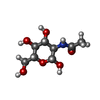
Macromolecule #14: 2-acetamido-2-deoxy-beta-D-glucopyranose

MacromoleculeName: 2-acetamido-2-deoxy-beta-D-glucopyranose / type: ligand / ID: 14 / Number of copies: 3 / Formula: NAG
Molecular weightTheoretical: 221.208 Da
Chemical component information

ChemComp-NAG:
2-acetamido-2-deoxy-beta-D-glucopyranose

+
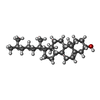
Macromolecule #15: CHOLESTEROL

MacromoleculeName: CHOLESTEROL / type: ligand / ID: 15 / Number of copies: 3 / Formula: CLR
Molecular weightTheoretical: 386.654 Da
Chemical component information

ChemComp-CLR:
CHOLESTEROL

+
Macromolecule #16: ZINC ION

MacromoleculeName: ZINC ION / type: ligand / ID: 16 / Number of copies: 1 / Formula: ZN
Molecular weightTheoretical: 65.409 Da

+
Macromolecule #17: O-[(R)-{[(2R)-2,3-bis(octadecanoyloxy)propyl]oxy}(hydroxy)phospho...

MacromoleculeName: O-[(R)-{[(2R)-2,3-bis(octadecanoyloxy)propyl]oxy}(hydroxy)phosphoryl]-L-serine
type: ligand / ID: 17 / Number of copies: 1 / Formula: P5S
Molecular weightTheoretical: 792.075 Da
Chemical component information

ChemComp-P5S:
O-[(R)-{[(2R)-2,3-bis(octadecanoyloxy)propyl]oxy}(hydroxy)phosphoryl]-L-serine

+
Macromolecule #18: CALCIUM ION

MacromoleculeName: CALCIUM ION / type: ligand / ID: 18 / Number of copies: 1 / Formula: CA
Molecular weightTheoretical: 40.078 Da

-
Experimental details

-
Structure determination

Processingsingle particle reconstruction
Aggregation stateparticle

-
Sample preparation

BufferpH: 7.4 / Details: 25 mM MOPS-Na, 150 mM NaCl, 2 mM CaCl2, 0.01% GDN

-
Electron microscopy

MicroscopeFEI TITAN KRIOS
Image recordingFilm or detector model: GATAN K3 BIOQUANTUM (6k x 4k) / Average electron dose: 50.0 e/Å2
Electron beamAcceleration voltage: 300 kV / Electron source: FIELD EMISSION GUN
Electron opticsIllumination mode: FLOOD BEAM / Imaging mode: BRIGHT FIELD / Nominal defocus max: 1.9000000000000001 µm / Nominal defocus min: 1.4000000000000001 µm
Experimental equipment
Model: Titan Krios / Image courtesy: FEI Company

+
Image processing

Startup modelType of model: INSILICO MODEL
Final reconstructionResolution.type: BY AUTHOR / Resolution: 3.5 Å / Resolution method: FSC 0.143 CUT-OFF / Number images used: 499658
Initial angle assignmentType: ANGULAR RECONSTITUTION
Final angle assignmentType: ANGULAR RECONSTITUTION
FSC plot (resolution estimation)

-
Atomic model buiding 1

RefinementProtocol: FLEXIBLE FIT
Output model

PDB-8yt8:
Cryo-EM structure of the dystrophin glycoprotein complex

+
About Yorodumi

-
News

-
Feb 9, 2022. New format data for meta-information of EMDB entries

New format data for meta-information of EMDB entries

  • Version 3 of the EMDB header file is now the official format.
  • The previous official version 1.9 will be removed from the archive.

Related info.:EMDB header

External links:wwPDB to switch to version 3 of the EMDB data model

-
Aug 12, 2020. Covid-19 info

Covid-19 info

URL: https://pdbj.org/emnavi/covid19.php

New page: Covid-19 featured information page in EM Navigator.

Related info.:Covid-19 info / Mar 5, 2020. Novel coronavirus structure data

+
Mar 5, 2020. Novel coronavirus structure data

Novel coronavirus structure data

Related info.:Yorodumi Speices / Aug 12, 2020. Covid-19 info

External links:COVID-19 featured content - PDBj / Molecule of the Month (242):Coronavirus Proteases

+
Jan 31, 2019. EMDB accession codes are about to change! (news from PDBe EMDB page)

EMDB accession codes are about to change! (news from PDBe EMDB page)

  • The allocation of 4 digits for EMDB accession codes will soon come to an end. Whilst these codes will remain in use, new EMDB accession codes will include an additional digit and will expand incrementally as the available range of codes is exhausted. The current 4-digit format prefixed with “EMD-” (i.e. EMD-XXXX) will advance to a 5-digit format (i.e. EMD-XXXXX), and so on. It is currently estimated that the 4-digit codes will be depleted around Spring 2019, at which point the 5-digit format will come into force.
  • The EM Navigator/Yorodumi systems omit the EMD- prefix.

Related info.:Q: What is EMD? / ID/Accession-code notation in Yorodumi/EM Navigator

External links:EMDB Accession Codes are Changing Soon! / Contact to PDBj

+
Jul 12, 2017. Major update of PDB

Major update of PDB

  • wwPDB released updated PDB data conforming to the new PDBx/mmCIF dictionary.
  • This is a major update changing the version number from 4 to 5, and with Remediation, in which all the entries are updated.
  • In this update, many items about electron microscopy experimental information are reorganized (e.g. em_software).
  • Now, EM Navigator and Yorodumi are based on the updated data.

External links:wwPDB Remediation / Enriched Model Files Conforming to OneDep Data Standards Now Available in the PDB FTP Archive

-
Yorodumi

Thousand views of thousand structures

  • Yorodumi is a browser for structure data from EMDB, PDB, SASBDB, etc.
  • This page is also the successor to EM Navigator detail page, and also detail information page/front-end page for Omokage search.
  • The word "yorodu" (or yorozu) is an old Japanese word meaning "ten thousand". "mi" (miru) is to see.

Related info.:EMDB / PDB / SASBDB / Comparison of 3 databanks / Yorodumi Search / Aug 31, 2016. New EM Navigator & Yorodumi / Yorodumi Papers / Jmol/JSmol / Function and homology information / Changes in new EM Navigator and Yorodumi

Read more