: / symbiont-mediated suppression of host transcription / regulation of ubiquitin-dependent protein catabolic process / symbiont-mediated suppression of host apoptosis / HECT-type E3 ubiquitin transferase / transcription regulator activator activity / negative regulation of helicase activity / signal transduction by p53 class mediator / Loss of function of TP53 in cancer due to loss of tetramerization ability / Regulation of TP53 Expression ...: / symbiont-mediated suppression of host transcription / regulation of ubiquitin-dependent protein catabolic process / symbiont-mediated suppression of host apoptosis / HECT-type E3 ubiquitin transferase / transcription regulator activator activity / negative regulation of helicase activity / signal transduction by p53 class mediator / Loss of function of TP53 in cancer due to loss of tetramerization ability / Regulation of TP53 Expression / regulation of cell cycle G2/M phase transition / negative regulation of G1 to G0 transition / Transcriptional activation of cell cycle inhibitor p21 / negative regulation of pentose-phosphate shunt / Activation of NOXA and translocation to mitochondria / ATP-dependent DNA/DNA annealing activity / oligodendrocyte apoptotic process / positive regulation of thymocyte apoptotic process / oxidative stress-induced premature senescence / bone marrow development / cellular response to actinomycin D / circadian behavior / regulation of Cdc42 protein signal transduction / positive regulation of programmed necrotic cell death / RUNX3 regulates CDKN1A transcription / TP53 Regulates Transcription of Death Receptors and Ligands / Activation of PUMA and translocation to mitochondria / TP53 regulates transcription of additional cell cycle genes whose exact role in the p53 pathway remain uncertain / mRNA transcription / Regulation of TP53 Activity through Association with Co-factors / Urea cycle / ER overload response / hematopoietic stem cell differentiation / Formation of Senescence-Associated Heterochromatin Foci (SAHF) / TP53 Regulates Transcription of Caspase Activators and Caspases / intrinsic apoptotic signaling pathway by p53 class mediator / entrainment of circadian clock by photoperiod / Zygotic genome activation (ZGA) / TP53 Regulates Transcription of Genes Involved in Cytochrome C Release / PI5P Regulates TP53 Acetylation / positive regulation of release of cytochrome c from mitochondria / Association of TriC/CCT with target proteins during biosynthesis / hematopoietic progenitor cell differentiation / negative regulation of telomere maintenance via telomerase / progesterone receptor signaling pathway / SUMOylation of transcription factors / TP53 regulates transcription of several additional cell death genes whose specific roles in p53-dependent apoptosis remain uncertain / response to progesterone / intrinsic apoptotic signaling pathway in response to DNA damage by p53 class mediator / replicative senescence / Transcriptional Regulation by VENTX / TFIID-class transcription factor complex binding / viral process / regulation of proteolysis / intrinsic apoptotic signaling pathway in response to endoplasmic reticulum stress / Pyroptosis / determination of adult lifespan / positive regulation of RNA polymerase II transcription preinitiation complex assembly / general transcription initiation factor binding / negative regulation of fibroblast proliferation / positive regulation of execution phase of apoptosis / carbohydrate transmembrane transporter activity / type II interferon-mediated signaling pathway / TP53 Regulates Transcription of Genes Involved in G1 Cell Cycle Arrest / maltose binding / maltose transport / maltodextrin transmembrane transport / postsynaptic cytosol / cellular response to glucose starvation / ATP-binding cassette (ABC) transporter complex, substrate-binding subunit-containing / core promoter sequence-specific DNA binding / cis-regulatory region sequence-specific DNA binding / protein autoubiquitination / Regulation of TP53 Activity through Acetylation / intrinsic apoptotic signaling pathway / mitotic G1 DNA damage checkpoint signaling / proteasome complex / positive regulation of intrinsic apoptotic signaling pathway / negative regulation of TORC1 signaling / 14-3-3 protein binding / response to gamma radiation / protein K48-linked ubiquitination / MDM2/MDM4 family protein binding / TP53 Regulates Transcription of Genes Involved in G2 Cell Cycle Arrest / protein phosphatase 2A binding / DNA damage response, signal transduction by p53 class mediator / positive regulation of protein ubiquitination / transcription initiation-coupled chromatin remodeling / molecular function activator activity / Regulation of PTEN gene transcription / tumor necrosis factor-mediated signaling pathway / cellular response to ionizing radiation / cellular response to xenobiotic stimulus / TP53 Regulates Metabolic Genes / brain development / PDZ domain binding / TP53 Regulates Transcription of DNA Repair Genes / cellular response to gamma radiation / mRNA 3'-UTR binding / Regulation of NF-kappa B signaling Similarity search - Function
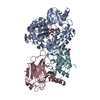
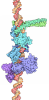
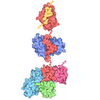
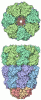
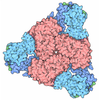
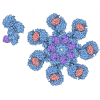
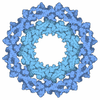
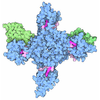
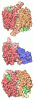
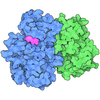
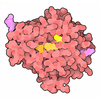
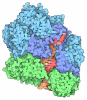
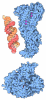
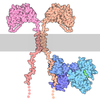
Journal: Nat Commun / Year: 2024 Title: Structure of the p53 degradation complex from HPV16. Authors: John C K Wang / Hannah T Baddock / Amirhossein Mafi / Ian T Foe / Matthew Bratkowski / Ting-Yu Lin / Zena D Jensvold / Magdalena Preciado López / David Stokoe / Dan Eaton / Qi Hao / Aaron H Nile / Abstract: Human papillomavirus (HPV) is a significant contributor to the global cancer burden, and its carcinogenic activity is facilitated in part by the HPV early protein 6 (E6), which interacts with the E3- ...Human papillomavirus (HPV) is a significant contributor to the global cancer burden, and its carcinogenic activity is facilitated in part by the HPV early protein 6 (E6), which interacts with the E3-ligase E6AP, also known as UBE3A, to promote degradation of the tumor suppressor, p53. In this study, we present a single-particle cryoEM structure of the full-length E6AP protein in complex with HPV16 E6 (16E6) and p53, determined at a resolution of ~3.3 Å. Our structure reveals extensive protein-protein interactions between 16E6 and E6AP, explaining their picomolar binding affinity. These findings shed light on the molecular basis of the ternary complex, which has been pursued as a potential therapeutic target for HPV-driven cervical, anal, and oropharyngeal cancers over the last two decades. Understanding the structural and mechanistic underpinnings of this complex is crucial for developing effective therapies to combat HPV-induced cancers. Our findings may help to explain why previous attempts to disrupt this complex have failed to generate therapeutic modalities and suggest that current strategies should be reevaluated.
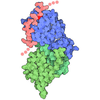
Name: Maltose/maltodextrin-binding periplasmic protein,Protein E6 type: protein_or_peptide / ID: 1 Details: The cysteine to serine mutations are in the protein E6 portion of the chimeric construct.,The cysteine to serine mutations are in the protein E6 portion of the chimeric construct. Number of copies: 1 / Enantiomer: LEVO
Name: ZINC ION / type: ligand / ID: 4 / Number of copies: 3 / Formula: ZN
Molecular weight
Theoretical: 65.409 Da
-
Experimental details
-
Structure determination
Method
cryo EM
Processing
single particle reconstruction
Aggregation state
particle
-
Sample preparation
Concentration
2.15 mg/mL
Buffer
pH: 7 Component:
Concentration
Formula
Name
50.0 mM
C4H11NO3
Tris
150.0 mM
NaCl
Sodium Chloride
5.0 mM
C4H10O2S2
DTT
0.01 Percent
C32H58N2O8S
CHAPSO
Grid
Model: Quantifoil R1.2/1.3 / Support film - Material: CARBON / Support film - topology: HOLEY / Support film - Film thickness: 30 / Pretreatment - Type: GLOW DISCHARGE / Pretreatment - Time: 60 sec.
Vitrification
Cryogen name: ETHANE / Chamber humidity: 100 % / Chamber temperature: 277.15 K / Instrument: FEI VITROBOT MARK IV
-
Electron microscopy
Microscope
FEI TITAN KRIOS
Image recording
Film or detector model: GATAN K3 (6k x 4k) / Average electron dose: 80.5 e/Å2
Electron beam
Acceleration voltage: 300 kV / Electron source: FIELD EMISSION GUN
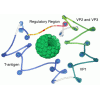
In the structure databanks used in Yorodumi, some data are registered as the other names, "COVID-19 virus" and "2019-nCoV". Here are the details of the virus and the list of structure data.
Jan 31, 2019. EMDB accession codes are about to change! (news from PDBe EMDB page)
EMDB accession codes are about to change! (news from PDBe EMDB page)
The allocation of 4 digits for EMDB accession codes will soon come to an end. Whilst these codes will remain in use, new EMDB accession codes will include an additional digit and will expand incrementally as the available range of codes is exhausted. The current 4-digit format prefixed with “EMD-” (i.e. EMD-XXXX) will advance to a 5-digit format (i.e. EMD-XXXXX), and so on. It is currently estimated that the 4-digit codes will be depleted around Spring 2019, at which point the 5-digit format will come into force.
The EM Navigator/Yorodumi systems omit the EMD- prefix.
Related info.:Q: What is EMD? / ID/Accession-code notation in Yorodumi/EM Navigator
Yorodumi is a browser for structure data from EMDB, PDB, SASBDB, etc.
This page is also the successor to EM Navigator detail page, and also detail information page/front-end page for Omokage search.
The word "yorodu" (or yorozu) is an old Japanese word meaning "ten thousand". "mi" (miru) is to see.
Related info.:EMDB / PDB / SASBDB / Comparison of 3 databanks / Yorodumi Search / Aug 31, 2016. New EM Navigator & Yorodumi / Yorodumi Papers / Jmol/JSmol / Function and homology information / Changes in new EM Navigator and Yorodumi
 Movie
Movie Controller


 Open data
 Basic information
 Map data
 Sample
 Keywords
 Function and homology information
 Escherichia coli (E. coli) /
  Homo sapiens (human) /
  Human papillomavirus type 16
 Authors
 United States, 1 items
  Citation
 Structure visualization
 Downloads & links
 emd_29941.png
 http://ftp.pdbj.org/pub/emdb/structures/EMD-29941
 Z (Sec.)
 Y (Row.)
 X (Col.)















 Sample components
 Spodoptera frugiperda (fall armyworm)
 Processing
 Electron microscopy
 FIELD EMISSION GUN