National Institutes of Health/National Institute of General Medical Sciences (NIH/NIGMS)
R35GM128777
United States
The Pew Charitable Trusts
00033055
United States
National Institutes of Health/National Cancer Institute (NIH/NCI)
P30CA016087
United States
Simons Foundation
SF349247
United States
Citation
Journal: bioRxiv / Year: 2026 Title: Interactions of outer membrane lipoproteins PA3214 and PqiC with their MCE protein binding partners, PA3213 and PqiB. Authors: Sabrina I Giacometti / Nicolas Coudray / Rachel L Redler / Gira Bhabha / Damian C Ekiert Abstract: Members of the Mammalian Cell Entry (MCE) superfamily interact with other proteins to form diverse architectures for the transport of hydrophobic molecules across the cell envelope in Gram-negative ...Members of the Mammalian Cell Entry (MCE) superfamily interact with other proteins to form diverse architectures for the transport of hydrophobic molecules across the cell envelope in Gram-negative bacteria. Some of these trans-envelope MCE protein complexes include a PqiC-like outer membrane (OM) lipoprotein component. The best-studied member of this group of OM lipoproteins is PqiC, from the PqiABC system, which can form an octameric ring. How PqiC-like lipoproteins interact with their MCE protein binding partners to facilitate transport is not well understood. Here we report the cryo-electron microscopy structures of PA3214, a homolog of PqiC, in the context of the full MCE transport PA3211-PA3214 system. Our structure provides insight into the biological assembly of the lipoprotein and interactions with its binding partner, MCE protein PA3213. We utilize deep mutational scanning to identify functionally important sites in PqiC in an unbiased manner. Through phenotypic and biochemical experiments, we characterize the interactions of the lipoproteins PqiC and PA3214 with their associated MCE proteins PqiB and PA3213, thus providing a model for how some MCE proteins employ a C-terminal peptide to mediate key interactions with their cognate lipoproteins at the OM.
Model: Quantifoil R2/2 / Material: COPPER / Mesh: 300 / Support film - Material: CARBON / Support film - topology: CONTINUOUS / Support film - Film thickness: 2 / Pretreatment - Type: GLOW DISCHARGE / Pretreatment - Time: 5 sec.
Vitrification
Cryogen name: ETHANE / Chamber humidity: 100 % / Chamber temperature: 277.15 K / Instrument: FEI VITROBOT MARK IV
-
Electron microscopy
Microscope
TFS KRIOS
Software
Name: Leginon
Image recording
#0 - Image recording ID: 1 / #0 - Film or detector model: GATAN K3 BIOQUANTUM (6k x 4k) / #0 - Number grids imaged: 1 / #0 - Number real images: 6057 / #0 - Average electron dose: 51.51 e/Å2 / #1 - Image recording ID: 2 / #1 - Film or detector model: GATAN K3 BIOQUANTUM (6k x 4k) / #1 - Number grids imaged: 1 / #1 - Number real images: 3929 / #1 - Average electron dose: 51.43 e/Å2 / #1 - Details: collected at 30 degree tilt
Electron beam
Acceleration voltage: 300 kV / Electron source: FIELD EMISSION GUN
In the structure databanks used in Yorodumi, some data are registered as the other names, "COVID-19 virus" and "2019-nCoV". Here are the details of the virus and the list of structure data.
Jan 31, 2019. EMDB accession codes are about to change! (news from PDBe EMDB page)
EMDB accession codes are about to change! (news from PDBe EMDB page)
The allocation of 4 digits for EMDB accession codes will soon come to an end. Whilst these codes will remain in use, new EMDB accession codes will include an additional digit and will expand incrementally as the available range of codes is exhausted. The current 4-digit format prefixed with “EMD-” (i.e. EMD-XXXX) will advance to a 5-digit format (i.e. EMD-XXXXX), and so on. It is currently estimated that the 4-digit codes will be depleted around Spring 2019, at which point the 5-digit format will come into force.
The EM Navigator/Yorodumi systems omit the EMD- prefix.
Related info.:Q: What is EMD? / ID/Accession-code notation in Yorodumi/EM Navigator
Yorodumi is a browser for structure data from EMDB, PDB, SASBDB, etc.
This page is also the successor to EM Navigator detail page, and also detail information page/front-end page for Omokage search.
The word "yorodu" (or yorozu) is an old Japanese word meaning "ten thousand". "mi" (miru) is to see.
Related info.:EMDB / PDB / SASBDB / Comparison of 3 databanks / Yorodumi Search / Aug 31, 2016. New EM Navigator & Yorodumi / Yorodumi Papers / Jmol/JSmol / Function and homology information / Changes in new EM Navigator and Yorodumi
 Movie
Movie Controller


 Open data
 Basic information
 Map data
 Sample
 Keywords
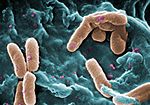 Pseudomonas aeruginosa (bacteria)
 Authors
 United States, 5 items
  Citation
 Structure visualization
 Downloads & links
 EMDB map data format
 emd_77074.png
 https://data.pdbj.org/pub/emdb/structures/EMD-77074


 Z (Sec.)
 Y (Row.)
 X (Col.)


 Sample components
 Processing
 Electron microscopy
 FIELD EMISSION GUN
