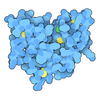
- EMDB-70956: In situ microtubule structure in the axon of a human neuron -
+
Open data
ID or keywords:
Loading...
-
Basic information
Entry
Database: EMDB / ID: EMD-70956
Title
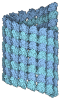
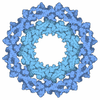
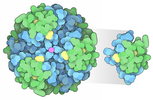
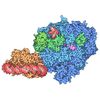
In situ microtubule structure in the axon of a human neuron
Map data
Post-processed full map.
Sample
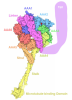
Complex: Axonal alpha1A and betaIIB microtubule
Protein or peptide: Tubulin beta-2B chain
Protein or peptide: Tubulin alpha-1A chain
Ligand: GUANOSINE-5'-DIPHOSPHATE
Ligand: MAGNESIUM ION
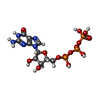
Ligand: GUANOSINE-5'-TRIPHOSPHATE
Ligand: water
Keywords
Human in-situ microtubule / axon / cytoskeleton / STRUCTURAL PROTEIN
Function / homology
Function and homology information
pyramidal neuron differentiation / glial cell differentiation / Post-chaperonin tubulin folding pathway / cytoskeleton-dependent intracellular transport / Cargo trafficking to the periciliary membrane / dentate gyrus development / Carboxyterminal post-translational modifications of tubulin / Microtubule-dependent trafficking of connexons from Golgi to the plasma membrane / axonemal microtubule / organelle transport along microtubule ...pyramidal neuron differentiation / glial cell differentiation / Post-chaperonin tubulin folding pathway / cytoskeleton-dependent intracellular transport / Cargo trafficking to the periciliary membrane / dentate gyrus development / Carboxyterminal post-translational modifications of tubulin / Microtubule-dependent trafficking of connexons from Golgi to the plasma membrane / axonemal microtubule / organelle transport along microtubule / forebrain morphogenesis / cerebellar cortex morphogenesis / Sealing of the nuclear envelope (NE) by ESCRT-III / microtubule plus-end / Intraflagellar transport / neuron projection arborization / Formation of tubulin folding intermediates by CCT/TriC / Gap junction assembly / smoothened signaling pathway / homeostasis of number of cells within a tissue / motor behavior / positive regulation of axon guidance / Kinesins / Prefoldin mediated transfer of substrate to CCT/TriC / response to L-glutamate / Assembly and cell surface presentation of NMDA receptors / COPI-independent Golgi-to-ER retrograde traffic / centrosome cycle / sperm principal piece / COPI-dependent Golgi-to-ER retrograde traffic / startle response / 'de novo' protein folding / intercellular bridge / flagellated sperm motility / regulation of synapse organization / locomotory exploration behavior / sperm end piece / Recycling pathway of L1 / microtubule polymerization / response to tumor necrosis factor / ciliary tip / response to mechanical stimulus / neuron apoptotic process / sperm flagellum / adult locomotory behavior / Hedgehog 'off' state / RHO GTPases activate IQGAPs / COPI-mediated anterograde transport / microtubule-based process / condensed chromosome / Activation of AMPK downstream of NMDARs / Loss of Nlp from mitotic centrosomes / Loss of proteins required for interphase microtubule organization from the centrosome / Recruitment of mitotic centrosome proteins and complexes / MHC class II antigen presentation / Recruitment of NuMA to mitotic centrosomes / Anchoring of the basal body to the plasma membrane / visual learning / cellular response to calcium ion / HSP90 chaperone cycle for steroid hormone receptors (SHR) in the presence of ligand / Mitotic Prometaphase / EML4 and NUDC in mitotic spindle formation / AURKA Activation by TPX2 / Resolution of Sister Chromatid Cohesion / Translocation of SLC2A4 (GLUT4) to the plasma membrane / neuromuscular junction / neuron migration / intracellular protein transport / memory / RHO GTPases Activate Formins / cerebral cortex development / microtubule cytoskeleton organization / synapse organization / PKR-mediated signaling / mitotic spindle / recycling endosome / modulation of chemical synaptic transmission / Schaffer collateral - CA1 synapse / structural constituent of cytoskeleton / cytoplasmic ribonucleoprotein granule / HCMV Early Events / Aggrephagy / microtubule cytoskeleton / The role of GTSE1 in G2/M progression after G2 checkpoint / Separation of Sister Chromatids / Regulation of PLK1 Activity at G2/M Transition / cilium / mitotic cell cycle / neuron differentiation / protein-folding chaperone binding / microtubule / microtubule binding / Hydrolases; Acting on acid anhydrides; Acting on GTP to facilitate cellular and subcellular movement / cell division / protein stabilization / protein heterodimerization activity / GTPase activity / GTP binding / protein-containing complex binding / structural molecule activity Similarity search - Function
National Institutes of Health/National Institute of Neurological Disorders and Stroke (NIH/NINDS)
1ZIANS003164
United States
Citation
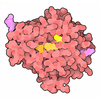
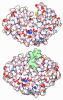
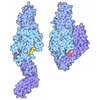
Journal: Nat Struct Mol Biol / Year: 2026 Title: Microtubules in the axon are GDP bound but adopt a stable GTP-like expanded state. Authors: Elena A Zehr / Shufeng Sun / Stephanie L Sarbanes / Antonina Roll-Mecak / Abstract: Microtubules scaffold cells, supporting signaling and cargo transport. They assemble from GTP-tubulin, which hydrolyzes to GDP-tubulin during polymerization. GTP-microtubule lattices are stable; GDP ...Microtubules scaffold cells, supporting signaling and cargo transport. They assemble from GTP-tubulin, which hydrolyzes to GDP-tubulin during polymerization. GTP-microtubule lattices are stable; GDP lattices depolymerize rapidly. In vitro, hydrolysis triggers lattice compaction. Lattice spacing regulates motors and microtubule-associated proteins; however, the conformation of tubulin in microtubules in cells is unknown. Here, we present the atomic-resolution cryo-electron microscopy structure of human microtubules in situ, in the axons of human cortical neurons derived from induced pluripotent stem cells (iPS cells). Our 2.7-Å-resolution reconstruction delineates bound water molecules and reveals that axonal microtubules adopt an expanded GTP-like lattice, despite being GDP bound. Using cryo-electron tomography and power spectrum analysis, we find that, unlike in axons, microtubules in undifferentiated iPS cells are compacted. Therefore, lattice expansion is part of neuronal differentiation. Our work provides molecular insights into neurogenesis and has implications for understanding microtubule stability and effector recruitment in neurons.
Model: Quantifoil R2/2 / Material: GOLD / Mesh: 200 / Support film - Material: CARBON / Support film - topology: HOLEY / Support film - Film thickness: 100 / Pretreatment - Type: GLOW DISCHARGE / Pretreatment - Time: 30 sec. / Pretreatment - Atmosphere: AIR / Pretreatment - Pressure: 0.039 kPa
Vitrification
Cryogen name: ETHANE / Chamber humidity: 85 % / Chamber temperature: 303 K / Instrument: FEI VITROBOT MARK II
-
Electron microscopy
Microscope
TFS KRIOS
Specialist optics
Energy filter - Name: GIF Bioquantum / Energy filter - Slit width: 20 eV
Software
Name: SerialEM
Image recording
Film or detector model: GATAN K3 (6k x 4k) / Number grids imaged: 6 / Number real images: 3017 / Average exposure time: 2.03 sec. / Average electron dose: 56.57 e/Å2
Electron beam
Acceleration voltage: 300 kV / Electron source: FIELD EMISSION GUN
In the structure databanks used in Yorodumi, some data are registered as the other names, "COVID-19 virus" and "2019-nCoV". Here are the details of the virus and the list of structure data.
Jan 31, 2019. EMDB accession codes are about to change! (news from PDBe EMDB page)
EMDB accession codes are about to change! (news from PDBe EMDB page)
The allocation of 4 digits for EMDB accession codes will soon come to an end. Whilst these codes will remain in use, new EMDB accession codes will include an additional digit and will expand incrementally as the available range of codes is exhausted. The current 4-digit format prefixed with “EMD-” (i.e. EMD-XXXX) will advance to a 5-digit format (i.e. EMD-XXXXX), and so on. It is currently estimated that the 4-digit codes will be depleted around Spring 2019, at which point the 5-digit format will come into force.
The EM Navigator/Yorodumi systems omit the EMD- prefix.
Related info.:Q: What is EMD? / ID/Accession-code notation in Yorodumi/EM Navigator
Yorodumi is a browser for structure data from EMDB, PDB, SASBDB, etc.
This page is also the successor to EM Navigator detail page, and also detail information page/front-end page for Omokage search.
The word "yorodu" (or yorozu) is an old Japanese word meaning "ten thousand". "mi" (miru) is to see.
Related info.:EMDB / PDB / SASBDB / Comparison of 3 databanks / Yorodumi Search / Aug 31, 2016. New EM Navigator & Yorodumi / Yorodumi Papers / Jmol/JSmol / Function and homology information / Changes in new EM Navigator and Yorodumi
 Movie
Movie Controller


 Open data
 Basic information
 Map data
 Sample
 Keywords
 Function and homology information
 Homo sapiens (human)
 Authors
 United States, 1 items
  Citation
 Structure visualization
 Downloads & links
 emd_70956.png
 https://data.pdbj.org/pub/emdb/structures/EMD-70956

 Z (Sec.)
 Y (Row.)
 X (Col.)


 Sample components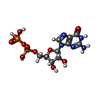
 Processing
 Electron microscopy
 FIELD EMISSION GUN


