 Movie
Movie Controller


+ Open data

- Basic information
| Entry |  | |||||||||
|---|---|---|---|---|---|---|---|---|---|---|
| Title | CryoEM structure of cyclised H-pilus (D69G) | |||||||||
 Map data Map data | sharpening map | |||||||||
 Sample Sample |
| |||||||||
 Keywords Keywords | pilus / conjugation / filament / PROTEIN FIBRIL | |||||||||
| Function / homology | Pilin Function and homology information Function and homology information | |||||||||
| Biological species |  Salmonella enterica subsp. enterica serovar Typhi (bacteria) Salmonella enterica subsp. enterica serovar Typhi (bacteria) | |||||||||
| Method | helical reconstruction / cryo EM / Resolution: 3.11 Å | |||||||||
 Authors Authors | Ishimoto N / Beis K | |||||||||
| Funding support | 1 items
| |||||||||
 Citation Citation | Journal: Nat Commun / Year: 2026 Title: H pilin cyclisation and pilus biogenesis are promiscuous but electrostatic perturbations impair conjugation efficiency. Authors: Shan He / Naito Ishimoto / Joshua L C Wong / Sophia David / Julia Sanchez-Garrido / Mikhail Bogdanov / Konstantinos Beis / Gad Frankel /    Abstract: During conjugation, plasmid DNA is transferred from donor to recipient bacteria via the plasmid-encoded mating pilus, formed as thin helical assemblies of polymerised pilin subunits. In the IncHI1 ...During conjugation, plasmid DNA is transferred from donor to recipient bacteria via the plasmid-encoded mating pilus, formed as thin helical assemblies of polymerised pilin subunits. In the IncHI1 R27 plasmid-encoded pilus, the TrhA pilin undergoes cyclisation (via a peptide bond between Gly1 and Asp69), essential for conjugation. Gly1 and Asp69 are exposed on the pilus surface and conserved in all TrhA pilins in the Plascad database. Substituting Asp69 with Asn, Ala, Gly, or Arg does not prevent cyclisation or pilus formation, which remains structurally indistinguishable from the wild type. Conjugation efficiency of the Asp69 substitutions across multiple recipient species correlates with side chain size, in the order Asp69Asn > Asp69Ala > Asp69Gly. However, Asp69Arg, as well as Asp69Lys and Gly1Lys substitutions abolish conjugation, likely due to the positively charged pilus surface (opposite to the wild-type negative charge) forming unfavourable electrostatic interactions with the recipient outer membrane's inner leaflet, composed solely of zwitterionic phosphatidylethanolamine (PE). Consistently, conjugation is rescued in recipients lacking PE. These findings indicate strong selective pressure to maintain Gly1 and Asp69, as efficient DNA transfer depends on precise electrostatic and steric constraints of the pilus surface. | |||||||||
| History |
|
- Structure visualization
| Supplemental images |
|---|

- Downloads & links
-EMDB archive
| Map data | emd_65250.map.gz | 6.9 MB | EMDB map data format | |
|---|---|---|---|---|
| Header (meta data) | emd-65250-v30.xmlemd-65250.xml | 22.6 KB 22.6 KB | Display Display | EMDB header |
| FSC (resolution estimation) | emd_65250_fsc.xml | 8.4 KB | Display | FSC data file |
| Images |  emd_65250.png emd_65250.png | 129.3 KB | ||
| Masks | emd_65250_msk_1.map | 64 MB | Mask map | |
| Filedesc metadata | emd-65250.cif.gz | 6.2 KB | ||
| Others | emd_65250_additional_1.map.gzemd_65250_half_map_1.map.gzemd_65250_half_map_2.map.gz | 6.9 MB 58.4 MB 58.4 MB | ||
| Archive directory |  https://data.pdbj.org/pub/emdb/structures/EMD-65250ftp://data.pdbj.org/pub/emdb/structures/EMD-65250 https://data.pdbj.org/pub/emdb/structures/EMD-65250ftp://data.pdbj.org/pub/emdb/structures/EMD-65250 | HTTPS FTP |
-Related structure data
| Related structure data |  9vpeMC  9vp2C  9vp3C  9vp4C M: atomic model generated by this map C: citing same article ( |
|---|---|
| Similar structure data |


-Links
| EMDB pages | EMDB (EBI/PDBe) / EMDataResource |
|---|
-Map
| File | Download / File: emd_65250.map.gz / Format: CCP4 / Size: 64 MB / Type: IMAGE STORED AS FLOATING POINT NUMBER (4 BYTES) | ||||||||||||||||||||||||||||||||||||
|---|---|---|---|---|---|---|---|---|---|---|---|---|---|---|---|---|---|---|---|---|---|---|---|---|---|---|---|---|---|---|---|---|---|---|---|---|---|
| Annotation | sharpening map | ||||||||||||||||||||||||||||||||||||
| Projections & slices | Image control
Images are generated by Spider. | ||||||||||||||||||||||||||||||||||||
| Voxel size | X=Y=Z: 1.192 Å | ||||||||||||||||||||||||||||||||||||
| Density |
| ||||||||||||||||||||||||||||||||||||
| Symmetry | Space group: 1 | ||||||||||||||||||||||||||||||||||||
| Details | EMDB XML:
|
 Z (Sec.)
 Y (Row.)
 X (Col.)


-Supplemental data
-Mask #1
| File | emd_65250_msk_1.map | ||||||||||||
|---|---|---|---|---|---|---|---|---|---|---|---|---|---|
| Projections & Slices |
| ||||||||||||
| Density Histograms |


-Additional map: map
| File | emd_65250_additional_1.map | ||||||||||||
|---|---|---|---|---|---|---|---|---|---|---|---|---|---|
| Annotation | map | ||||||||||||
| Projections & Slices |
| ||||||||||||
| Density Histograms |


-Half map: half map 2
| File | emd_65250_half_map_1.map | ||||||||||||
|---|---|---|---|---|---|---|---|---|---|---|---|---|---|
| Annotation | half map 2 | ||||||||||||
| Projections & Slices |
| ||||||||||||
| Density Histograms |


-Half map: half map 1
| File | emd_65250_half_map_2.map | ||||||||||||
|---|---|---|---|---|---|---|---|---|---|---|---|---|---|
| Annotation | half map 1 | ||||||||||||
| Projections & Slices |
| ||||||||||||
| Density Histograms |


- Sample components
-Entire : H-Pilus (D69G)
| Entire | Name: H-Pilus (D69G) |
|---|---|
| Components |
|
-Supramolecule #1: H-Pilus (D69G)
| Supramolecule | Name: H-Pilus (D69G) / type: organelle_or_cellular_component / ID: 1 / Parent: 0 / Macromolecule list: #1 |
|---|---|
| Source (natural) | Organism: Salmonella enterica subsp. enterica serovar Typhi (bacteria) |
| Molecular weight | Theoretical: 7.1 kDa/nm |
-Macromolecule #1: Pilin
| Macromolecule | Name: Pilin / type: protein_or_peptide / ID: 1 Details: The last five residues of AGIPL are cleaved when H-pilus make cyclisation. Number of copies: 1 / Enantiomer: LEVO |
|---|---|
| Source (natural) | Organism: Salmonella enterica subsp. enterica serovar Typhi (bacteria) |
| Molecular weight | Theoretical: 7.543906 KDa |
| Recombinant expression | Organism:  Escherichia coli (E. coli) Escherichia coli (E. coli) |
| Sequence | String: GSDDGAFGDI WAYMSEALTG APGKIIACGM LFSVAYFGVV KPNLGLALVS ALMMLVMANG EKIISSFLGA GIPL UniProtKB: Pilin |
-Macromolecule #2: 1,2-DIPALMITOYL-PHOSPHATIDYL-GLYCEROLE
| Macromolecule | Name: 1,2-DIPALMITOYL-PHOSPHATIDYL-GLYCEROLE / type: ligand / ID: 2 / Number of copies: 1 / Formula: LHG |
|---|---|
| Molecular weight | Theoretical: 722.97 Da |
| Chemical component information | 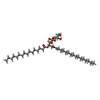 ChemComp-LHG: |
-Experimental details
-Structure determination
| Method | cryo EM |
|---|---|
 Processing Processing | helical reconstruction |
| Aggregation state | filament |
-Sample preparation
| Buffer | pH: 8 |
|---|---|
| Vitrification | Cryogen name: ETHANE |
- Electron microscopy
| Microscope | TFS GLACIOS |
|---|---|
| Image recording | Film or detector model: FEI FALCON IV (4k x 4k) / Average electron dose: 46.0 e/Å2 |
| Electron beam | Acceleration voltage: 200 kV / Electron source:  FIELD EMISSION GUN FIELD EMISSION GUN |
| Electron optics | Illumination mode: FLOOD BEAM / Imaging mode: BRIGHT FIELD / Cs: 2.7 mm / Nominal defocus max: 1.8 µm / Nominal defocus min: 0.8 µm |
| Sample stage | Specimen holder model: FEI TITAN KRIOS AUTOGRID HOLDER / Cooling holder cryogen: NITROGEN |

