Journal: Acta Crystallogr D Struct Biol / Year: 2026 Title: LowDoseWizard: rapid and standardized setup of low-dose cryo-TEM imaging in SerialEM. Authors: Simon A Fromm / Simone Mattei / Abstract: Structure elucidation of biological macromolecules by single-particle cryogenic electron microscopy (SPA cryo-EM) or cryogenic electron tomography (cryo-ET) relies on low-dose imaging on cryogenic ...Structure elucidation of biological macromolecules by single-particle cryogenic electron microscopy (SPA cryo-EM) or cryogenic electron tomography (cryo-ET) relies on low-dose imaging on cryogenic transmission electron microscopes (cryo-TEMs). Routine microscope setup remains technically demanding and can be time-consuming, particularly for inexperienced or infrequent users. We present LowDoseWizard, a guided workflow implemented in SerialEM that enables rapid and standardized setup of cryo-TEM imaging conditions. From minimal user input, the workflow configures microscope optics, camera parameters and image-shift settings for all low-dose states, and guides the user through key daily alignment procedures, including beam-shift offset calibration, objective-lens astigmatism correction and coma-free alignment. The workflow is organized into modular routines that can be executed sequentially or independently, while microscope-specific acquisition parameters are defined in editable configuration files, allowing flexible adaptation to different instruments without modification of the core scripts. Across user sessions on three microscopes at EMBL Heidelberg, the complete setup required on average less than 15 min. To assess whether predefined imaging conditions generated by the workflow are compatible with high-resolution data collection, we acquired apoferritin data on a 200 kV Glacios and a 300 kV Titan Krios. These datasets yielded reconstructions at 1.62 and 1.09 Å resolution, respectively, demonstrating that rapid, guided setup can support near-atomic and atomic-resolution SPA cryo-EM. LowDoseWizard lowers the barrier to robust cryo-TEM setup, reduces the time spent on routine parameter selection and alignment, and helps users focus on sample-specific aspects of data acquisition such as target selection. The workflow should be particularly valuable in shared instrumentation environments, where accessibility, reproducibility and efficient microscope use are critical.
Model: Quantifoil R2/1 / Material: COPPER / Mesh: 300 / Support film - Material: CARBON / Support film - topology: CONTINUOUS / Support film - Film thickness: 2 / Pretreatment - Type: GLOW DISCHARGE / Pretreatment - Time: 10 sec. / Pretreatment - Atmosphere: AIR / Details: Quorum GloQube, 25 mA, neg polarity
Vitrification
Cryogen name: ETHANE / Chamber humidity: 99 % / Chamber temperature: 281 K / Instrument: LEICA EM GP / Details: front side blotting.
-
Electron microscopy
Microscope
TFS KRIOS
Specialist optics
Energy filter - Name: TFS Selectris X / Energy filter - Slit width: 10 eV
Image recording
Film or detector model: FEI FALCON IV (4k x 4k) / Number grids imaged: 1 / Number real images: 3417 / Average exposure time: 1.3 sec. / Average electron dose: 40.0 e/Å2 / Details: saved as EER
Electron beam
Acceleration voltage: 300 kV / Electron source: FIELD EMISSION GUN
In the structure databanks used in Yorodumi, some data are registered as the other names, "COVID-19 virus" and "2019-nCoV". Here are the details of the virus and the list of structure data.
Jan 31, 2019. EMDB accession codes are about to change! (news from PDBe EMDB page)
EMDB accession codes are about to change! (news from PDBe EMDB page)
The allocation of 4 digits for EMDB accession codes will soon come to an end. Whilst these codes will remain in use, new EMDB accession codes will include an additional digit and will expand incrementally as the available range of codes is exhausted. The current 4-digit format prefixed with “EMD-” (i.e. EMD-XXXX) will advance to a 5-digit format (i.e. EMD-XXXXX), and so on. It is currently estimated that the 4-digit codes will be depleted around Spring 2019, at which point the 5-digit format will come into force.
The EM Navigator/Yorodumi systems omit the EMD- prefix.
Related info.:Q: What is EMD? / ID/Accession-code notation in Yorodumi/EM Navigator
Yorodumi is a browser for structure data from EMDB, PDB, SASBDB, etc.
This page is also the successor to EM Navigator detail page, and also detail information page/front-end page for Omokage search.
The word "yorodu" (or yorozu) is an old Japanese word meaning "ten thousand". "mi" (miru) is to see.
Related info.:EMDB / PDB / SASBDB / Comparison of 3 databanks / Yorodumi Search / Aug 31, 2016. New EM Navigator & Yorodumi / Yorodumi Papers / Jmol/JSmol / Function and homology information / Changes in new EM Navigator and Yorodumi
 Movie
Movie Controller

 Yorodumi
 Open data
 Basic information
 Map data
 Sample
 Keywords
 Function and homology information
 Mus musculus (house mouse)
 Authors
 Germany, 1 items
  Citation
 Structure visualization
 Downloads & links
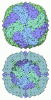
 emd_57470.png
 https://data.pdbj.org/pub/emdb/structures/EMD-57470
 Z (Sec.)
 Y (Row.)
 X (Col.)


 Sample components
 Escherichia coli (E. coli)
 Processing
 Electron microscopy
 FIELD EMISSION GUN

