Journal: Science / Year: 2026 Title: Polymerase trapping as the mechanism of H5 highly pathogenic avian influenza virus genesis. Authors: Mathis Funk / Monique I Spronken / Roy M Hutchinson / Benoit Arragain / Pauline Juyoux / Theo M Bestebroer / Anja C M de Bruin / Alexander P Gultyaev / Ron A M Fouchier / Stephen Cusack / ...Authors: Mathis Funk / Monique I Spronken / Roy M Hutchinson / Benoit Arragain / Pauline Juyoux / Theo M Bestebroer / Anja C M de Bruin / Alexander P Gultyaev / Ron A M Fouchier / Stephen Cusack / Aartjan J W Te Velthuis / Mathilde Richard / Abstract: Highly pathogenic avian influenza viruses (HPAIVs) derive from H5 and H7 low pathogenic avian influenza viruses (LPAIVs). Although insertion of a furin-cleavable multibasic cleavage site (MBCS) in ...Highly pathogenic avian influenza viruses (HPAIVs) derive from H5 and H7 low pathogenic avian influenza viruses (LPAIVs). Although insertion of a furin-cleavable multibasic cleavage site (MBCS) in the hemagglutinin gene was identified decades ago as the genetic basis for the LPAIV-to-HPAIV transition, the mechanisms underlying the occurrence of insertion are unknown. Here, we show that transient H5 RNA structures, predicted to trap the influenza virus polymerase on purine-rich sequences, drive nucleotide insertions, providing empirical evidence of RNA structure involvement in MBCS acquisition. Introduction of H5-like sequences and structures into an H6 hemagglutinin resulted in MBCS-yielding insertions. Our results show that nucleotide insertions that underlie H5 HPAIV emergence result from an RNA structure-driven diversity-generating mechanism, which could also occur in other RNA viruses.
In the structure databanks used in Yorodumi, some data are registered as the other names, "COVID-19 virus" and "2019-nCoV". Here are the details of the virus and the list of structure data.
Jan 31, 2019. EMDB accession codes are about to change! (news from PDBe EMDB page)
EMDB accession codes are about to change! (news from PDBe EMDB page)
The allocation of 4 digits for EMDB accession codes will soon come to an end. Whilst these codes will remain in use, new EMDB accession codes will include an additional digit and will expand incrementally as the available range of codes is exhausted. The current 4-digit format prefixed with “EMD-” (i.e. EMD-XXXX) will advance to a 5-digit format (i.e. EMD-XXXXX), and so on. It is currently estimated that the 4-digit codes will be depleted around Spring 2019, at which point the 5-digit format will come into force.
The EM Navigator/Yorodumi systems omit the EMD- prefix.
Related info.:Q: What is EMD? / ID/Accession-code notation in Yorodumi/EM Navigator
Yorodumi is a browser for structure data from EMDB, PDB, SASBDB, etc.
This page is also the successor to EM Navigator detail page, and also detail information page/front-end page for Omokage search.
The word "yorodu" (or yorozu) is an old Japanese word meaning "ten thousand". "mi" (miru) is to see.
Related info.:EMDB / PDB / SASBDB / Comparison of 3 databanks / Yorodumi Search / Aug 31, 2016. New EM Navigator & Yorodumi / Yorodumi Papers / Jmol/JSmol / Function and homology information / Changes in new EM Navigator and Yorodumi
 Movie
Movie Controller

 Yorodumi
 Open data
 Basic information
 Map data
 Sample
 Keywords
 Function and homology information
 Influenza A virus (A/Zhejiang/DTID-ZJU01/2013(H7N9)) /
  Homo sapiens (human)
 Authors
 Citation


 Structure visualization
 Downloads & links
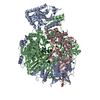
 emd_53877.png
 http://ftp.pdbj.org/pub/emdb/structures/EMD-53877

 Z (Sec.)
 Y (Row.)
 X (Col.)


 Sample components
 Trichoplusia ni (cabbage looper)
 Processing
 Electron microscopy
 FIELD EMISSION GUN

