National Institutes of Health/National Institute Of Allergy and Infectious Diseases (NIH/NIAID)
AI168178
United States
Citation
Journal: Cell Rep / Year: 2025 Title: Clonotype-enriched somatic hypermutations drive affinity maturation of a public human antibody targeting an occluded sarbecovirus epitope. Authors: Vishal N Rao / Iden A Sapse / Hallie Cohn / Duck-Kyun Yoo / Pei Tong / Jordan J Clark / Bailey Bozarth / Yuexing Chen / Komal Srivastava / Gagandeep Singh / Florian Krammer / Viviana Simon / ...Authors: Vishal N Rao / Iden A Sapse / Hallie Cohn / Duck-Kyun Yoo / Pei Tong / Jordan J Clark / Bailey Bozarth / Yuexing Chen / Komal Srivastava / Gagandeep Singh / Florian Krammer / Viviana Simon / Duane R Wesemann / Goran Bajic / Camila H Coelho / Abstract: Investigating public antibodies that recognize conserved epitopes is critical for vaccine development. Identifying somatic hypermutations (SHMs) that enhance antigen affinity in these public ...Investigating public antibodies that recognize conserved epitopes is critical for vaccine development. Identifying somatic hypermutations (SHMs) that enhance antigen affinity in these public antibodies is key to guiding vaccine design for better protection against pathogens. We propose that affinity-enhancing SHMs are selectively enriched in public antibody clonotypes, surpassing the background frequency seen in antibodies carrying the same V genes but with different epitope specificities. Using M15, a human IGHV4-59/IGKV3-20 public antibody as a model, we compare SHM signatures in antibodies that use the same V genes but recognize other epitopes. We identified clonotype-enriched mutations in the light chain of M15 and showed that, in combination, these SHMs enhance binding to a previously uncharacterized Sarbecovirus epitope, with antibody responses to it increasing after sequential vaccination. Our findings identify convergence and clonotype enrichment as features of affinity-enhancing SHMs in public antibodies, which can help guide vaccine design aimed at eliciting such antibodies.
In the structure databanks used in Yorodumi, some data are registered as the other names, "COVID-19 virus" and "2019-nCoV". Here are the details of the virus and the list of structure data.
Jan 31, 2019. EMDB accession codes are about to change! (news from PDBe EMDB page)
EMDB accession codes are about to change! (news from PDBe EMDB page)
The allocation of 4 digits for EMDB accession codes will soon come to an end. Whilst these codes will remain in use, new EMDB accession codes will include an additional digit and will expand incrementally as the available range of codes is exhausted. The current 4-digit format prefixed with “EMD-” (i.e. EMD-XXXX) will advance to a 5-digit format (i.e. EMD-XXXXX), and so on. It is currently estimated that the 4-digit codes will be depleted around Spring 2019, at which point the 5-digit format will come into force.
The EM Navigator/Yorodumi systems omit the EMD- prefix.
Related info.:Q: What is EMD? / ID/Accession-code notation in Yorodumi/EM Navigator
Yorodumi is a browser for structure data from EMDB, PDB, SASBDB, etc.
This page is also the successor to EM Navigator detail page, and also detail information page/front-end page for Omokage search.
The word "yorodu" (or yorozu) is an old Japanese word meaning "ten thousand". "mi" (miru) is to see.
Related info.:EMDB / PDB / SASBDB / Comparison of 3 databanks / Yorodumi Search / Aug 31, 2016. New EM Navigator & Yorodumi / Yorodumi Papers / Jmol/JSmol / Function and homology information / Changes in new EM Navigator and Yorodumi
 Movie
Movie Controller

 Yorodumi
 Open data
 Basic information
 Map data
 Sample
 Keywords
 Function and homology information
 Homo sapiens (human) /
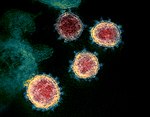 Severe acute respiratory syndrome coronavirus 2
 Authors
 United States, 1 items
  Citation
 Structure visualization
 Downloads & links
 emd_48507.png
 https://data.pdbj.org/pub/emdb/structures/EMD-48507
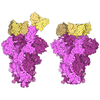
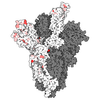
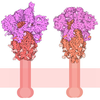
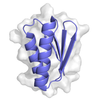
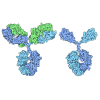
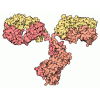
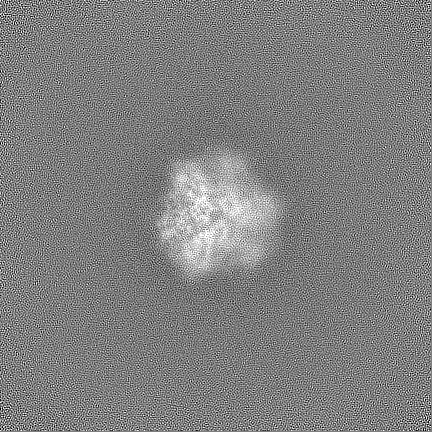
 Z (Sec.)
 Y (Row.)
 X (Col.)




 Sample components
 Processing
 Electron microscopy
 FIELD EMISSION GUN

