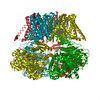
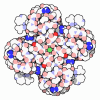
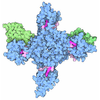
ion channel / K+ channel / Ca2+ bound / high conductance / MEMBRANE PROTEIN
機能・相同性
機能・相同性情報
large conductance calcium-activated potassium channel activity / monoatomic ion channel complex / modulation of chemical synaptic transmission / postsynaptic membrane / response to xenobiotic stimulus / metal ion binding 類似検索 - 分子機能
: / Ca2+-activated K+ channel Slowpoke, TrkA_C like domain / Calcium-activated potassium channel BK, alpha subunit / : / Calcium-activated BK potassium channel alpha subunit / Calcium-activated potassium channel slowpoke-like RCK domain / Regulator of K+ conductance, N-terminal / RCK N-terminal domain profile. / Voltage-dependent channel domain superfamily / Ion transport domain ...: / Ca2+-activated K+ channel Slowpoke, TrkA_C like domain / Calcium-activated potassium channel BK, alpha subunit / : / Calcium-activated BK potassium channel alpha subunit / Calcium-activated potassium channel slowpoke-like RCK domain / Regulator of K+ conductance, N-terminal / RCK N-terminal domain profile. / Voltage-dependent channel domain superfamily / Ion transport domain / Ion transport protein / NAD(P)-binding domain superfamily 類似検索 - ドメイン・相同性
National Institutes of Health/National Institute of General Medical Sciences (NIH/NIGMS)
GM43949
米国
Howard Hughes Medical Institute (HHMI)
米国
引用
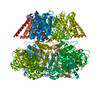
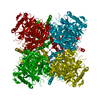
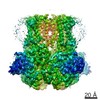
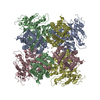
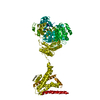
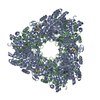
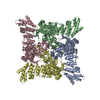
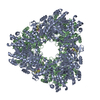
ジャーナル: Nature / 年: 2017 タイトル: Cryo-EM structure of the open high-conductance Ca-activated K channel. 著者: Xiao Tao / Richard K Hite / Roderick MacKinnon / 要旨: The Ca-activated K channel, Slo1, has an unusually large conductance and contains a voltage sensor and multiple chemical sensors. Dual activation by membrane voltage and Ca renders Slo1 central to ...The Ca-activated K channel, Slo1, has an unusually large conductance and contains a voltage sensor and multiple chemical sensors. Dual activation by membrane voltage and Ca renders Slo1 central to processes that couple electrical signalling to Ca-mediated events such as muscle contraction and neuronal excitability. Here we present the cryo-electron microscopy structure of a full-length Slo1 channel from Aplysia californica in the presence of Ca and Mg at a resolution of 3.5 Å. The channel adopts an open conformation. Its voltage-sensor domain adopts a non-domain-swapped attachment to the pore and contacts the cytoplasmic Ca-binding domain from a neighbouring subunit. Unique structural features of the Slo1 voltage sensor suggest that it undergoes different conformational changes than other known voltage sensors. The structure reveals the molecular details of three distinct divalent cation-binding sites identified through electrophysiological studies of mutant Slo1 channels.
 ムービー
ムービー コントローラー


 データを開く
 基本情報
基本情報 マップデータ
 試料
試料 キーワード
キーワード 機能・相同性情報
 Aplysia californica (無脊椎動物)
 データ登録者
 米国, 2件
  引用
引用 構造の表示
構造の表示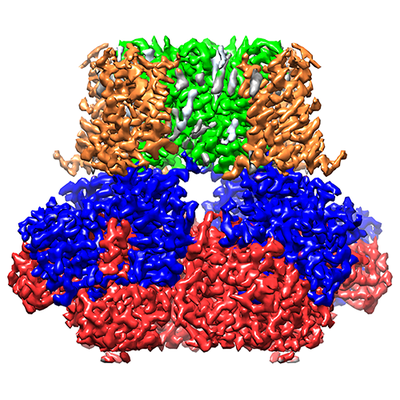
 ダウンロードとリンク
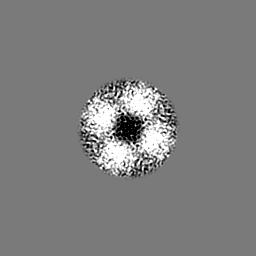
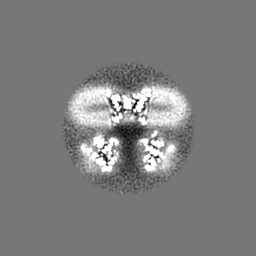
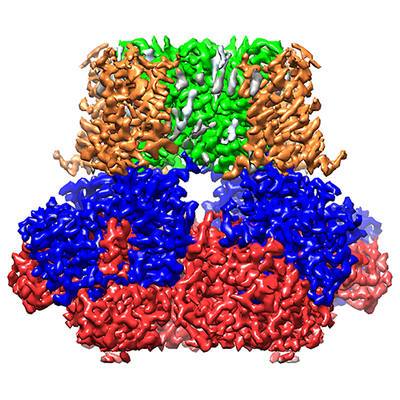 emd_8410.png
 http://ftp.pdbj.org/pub/emdb/structures/EMD-8410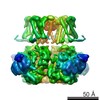
 Z (Sec.)
 Y (Row.)
 X (Col.)









 試料の構成要素
 Trichoplusia ni (イラクサキンウワバ)
 解析
解析 電子顕微鏡法
 FIELD EMISSION GUN