[English] 日本語
Yorodumi Papers
- Database of articles cited by EMDB/PDB/SASBDB data -

+
Search query

Keywords
Structure methods
Author
Journal
IF

-
Structure paper

TitlePol γ possesses separate metal binding sites for polymerase and strand displacement functions.
Journal, issue, pagesbioRxiv, Year 2026
Publish dateJan 25, 2026
PubMed AbstractAccurate replication of mitochondrial genome (mtDNA) integrity, which is essential for cellular metabolism and energy supply, relies primarily on DNA polymerase gamma (Pol γ), Twinkle helicase, and ...Accurate replication of mitochondrial genome (mtDNA) integrity, which is essential for cellular metabolism and energy supply, relies primarily on DNA polymerase gamma (Pol γ), Twinkle helicase, and mitochondrial single-stranded DNA binding protein (mtSSB). Twinkle alone exhibits little helicase activity while reports indicate that Pol γ displays from modest to limited unwinding activity. This led us to dissect Pol γ strand displacement activity using structural, biochemical and in silico approaches. Here, we show that human Pol γ carries out robust strand displacement synthesis at physiological concentrations of divalent metal ions which reveals that distinct metal-binding sites can independently regulate DNA synthesis and unwinding activities. We further showed that Pol γ can displace RNA/DNA hybrid with comparable efficiency as DNA/DNA duplex, representing a key implication on RNA primer removal to preserve mtDNA integrity. Our cryo-electron microscopy structures of Pol γ complexed with a template containing downstream dsDNA and an incoming nucleotide revealed the structural mechanism for the strand displacement activity. We identified four conformational states that represent successive stages of DNA unwinding, accompanied by coordinated rearrangement of the downstream DNA and Pol γ elements that mediate strand displacement. This work establishes biochemical and structural mechanisms of Pol γ strand displacement activity, providing fundamental insight into human mitochondrial DNA replication and integrity.
External linksbioRxiv / PubMed:41648309 / PubMed Central
MethodsEM (single particle)
Resolution2.62 - 3.23 Å
Structure data

EMDB-72478, PDB-9y4c:
Strand displacement state I of Human mitochondrial DNA polymerase gamma ternary complex
Method: EM (single particle) / Resolution: 3.23 Å

EMDB-72479, PDB-9y4d:
Strand displacement state II of Human mitochondrial DNA polymerase gamma ternary complex
Method: EM (single particle) / Resolution: 2.94 Å

EMDB-72480, PDB-9y4e:
Strand displacement state III of Human mitochondrial DNA polymerase gamma ternary complex
Method: EM (single particle) / Resolution: 3.05 Å

EMDB-72481, PDB-9y4f:
Strand displacement state IV of Human mitochondrial DNA polymerase gamma ternary complex
Method: EM (single particle) / Resolution: 2.62 Å

Chemicals

ChemComp-CA:
Unknown entry

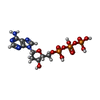
ChemComp-DTP:
2'-DEOXYADENOSINE 5'-TRIPHOSPHATE

Source
  • homo sapiens (human)
  • synthetic construct (others)
KeywordsTRANSFERASE/DNA / DNA polymerase gamma / strand displacement / mitochondria / TRANSFERASE-DNA complex

+
About Yorodumi Papers

-
News

-
Feb 9, 2022. New format data for meta-information of EMDB entries

New format data for meta-information of EMDB entries

  • Version 3 of the EMDB header file is now the official format.
  • The previous official version 1.9 will be removed from the archive.

Related info.:EMDB header

External links:wwPDB to switch to version 3 of the EMDB data model

-
Aug 12, 2020. Covid-19 info

Covid-19 info

URL: https://pdbj.org/emnavi/covid19.php

New page: Covid-19 featured information page in EM Navigator.

Related info.:Covid-19 info / Mar 5, 2020. Novel coronavirus structure data

+
Mar 5, 2020. Novel coronavirus structure data

Novel coronavirus structure data

Related info.:Yorodumi Speices / Aug 12, 2020. Covid-19 info

External links:COVID-19 featured content - PDBj / Molecule of the Month (242):Coronavirus Proteases

+
Jan 31, 2019. EMDB accession codes are about to change! (news from PDBe EMDB page)

EMDB accession codes are about to change! (news from PDBe EMDB page)

  • The allocation of 4 digits for EMDB accession codes will soon come to an end. Whilst these codes will remain in use, new EMDB accession codes will include an additional digit and will expand incrementally as the available range of codes is exhausted. The current 4-digit format prefixed with “EMD-” (i.e. EMD-XXXX) will advance to a 5-digit format (i.e. EMD-XXXXX), and so on. It is currently estimated that the 4-digit codes will be depleted around Spring 2019, at which point the 5-digit format will come into force.
  • The EM Navigator/Yorodumi systems omit the EMD- prefix.

Related info.:Q: What is EMD? / ID/Accession-code notation in Yorodumi/EM Navigator

External links:EMDB Accession Codes are Changing Soon! / Contact to PDBj

+
Jul 12, 2017. Major update of PDB

Major update of PDB

  • wwPDB released updated PDB data conforming to the new PDBx/mmCIF dictionary.
  • This is a major update changing the version number from 4 to 5, and with Remediation, in which all the entries are updated.
  • In this update, many items about electron microscopy experimental information are reorganized (e.g. em_software).
  • Now, EM Navigator and Yorodumi are based on the updated data.

External links:wwPDB Remediation / Enriched Model Files Conforming to OneDep Data Standards Now Available in the PDB FTP Archive

-
Yorodumi Papers

Database of articles cited by EMDB/PDB/SASBDB data

  • Database of articles cited by EMDB, PDB, and SASBDB entries
  • Using PubMed data

Related info.:EMDB / PDB / SASBDB / Yorodumi / EMN Papers / Changes in new EM Navigator and Yorodumi

Read more