[English] 日本語
Yorodumi Papers
- Database of articles cited by EMDB/PDB/SASBDB data -

+
Search query

Keywords
Structure methods
Author
Journal
IF

-
Structure paper

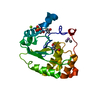
TitleA unique inhibitor conformation selectively targets the DNA polymerase PolC of Gram-positive priority pathogens.
Journal, issue, pagesNat Commun, Vol. 16, Issue 1, Page 9784, Year 2025
Publish dateNov 6, 2025
AuthorsMia Urem / Annemieke H Friggen / Nina Musch / Michael H Silverman / Christopher J Swain / Michael R Barbachyn / Lawrence I Mortin / Xiang Yu / Robert J DeLuccia / Meindert H Lamers / Wiep Klaas Smits /
PubMed AbstractInfections with antimicrobial resistant pathogens are a major threat to human health. Inhibitors of the replicative polymerase PolC are a promising novel class of antimicrobials against Gram-positive ...Infections with antimicrobial resistant pathogens are a major threat to human health. Inhibitors of the replicative polymerase PolC are a promising novel class of antimicrobials against Gram-positive pathogens, but the structural basis for their activity remains unknown. The first-in-class PolC-targeting antimicrobial, ibezapolstat, is a guanine analogue in late-stage clinical development for the treatment of Clostridioides difficile infections, and related inhibitors are being developed for systemic treatment of infections with methicillin-resistant Staphylococcus aureus (MRSA) and vancomycin-resistant enterococci (VRE). Here, we present the cryo-electron microscopy structures of Enterococcus faecium PolC bound to DNA and in complex with ibezapolstat or the previously-undescribed inhibitor ACX-801. Both inhibitors form base-pairing interactions with the DNA in the active site, thereby competing with incoming dGTP nucleotides. We identify a crucial susceptibility determinant in PolC that is conserved in other organisms, such as C. difficile. This is explained by an unusual non-planar conformation of the inhibitors that induce a binding pocket in PolC. By combining structural, biochemical, bioinformatic and genetic analyses, this work lays the foundation for the rational development of an innovative class of antimicrobials against Gram-positive priority pathogens.
External linksNat Commun / PubMed:41198680 / PubMed Central
MethodsEM (single particle)
Resolution2.8 - 3.2 Å
Structure data

EMDB-53270, PDB-9qpc:
DNA polymerase with inhibitor
Method: EM (single particle) / Resolution: 2.8 Å

EMDB-53319, PDB-9qrl:
DNA polymerase with inhibitor #2
Method: EM (single particle) / Resolution: 3.2 Å

EMDB-53320, PDB-9qrn:
DNA polymerase without DNA or inhibitor
Method: EM (single particle) / Resolution: 3.1 Å

Chemicals

PDB-1i88:
CHALCONE SYNTHASE (G256V)

ChemComp-ZN:
Unknown entry

ChemComp-MG:
Unknown entry

ChemComp-HOH:
WATER

PDB-1i9t:
CRYSTAL STRUCTURE OF THE OXIDIZED RNA TRIPHOSPHATASE DOMAIN OF MOUSE MRNA CAPPING ENZYME

Source
  • enterococcus faecium (bacteria)
  • escherichia coli (E. coli)
KeywordsDNA BINDING PROTEIN / DNA polymerase / inhibitor complex

+
About Yorodumi Papers

-
News

-
Feb 9, 2022. New format data for meta-information of EMDB entries

New format data for meta-information of EMDB entries

  • Version 3 of the EMDB header file is now the official format.
  • The previous official version 1.9 will be removed from the archive.

Related info.:EMDB header

External links:wwPDB to switch to version 3 of the EMDB data model

-
Aug 12, 2020. Covid-19 info

Covid-19 info

URL: https://pdbj.org/emnavi/covid19.php

New page: Covid-19 featured information page in EM Navigator.

Related info.:Covid-19 info / Mar 5, 2020. Novel coronavirus structure data

+
Mar 5, 2020. Novel coronavirus structure data

Novel coronavirus structure data

Related info.:Yorodumi Speices / Aug 12, 2020. Covid-19 info

External links:COVID-19 featured content - PDBj / Molecule of the Month (242):Coronavirus Proteases

+
Jan 31, 2019. EMDB accession codes are about to change! (news from PDBe EMDB page)

EMDB accession codes are about to change! (news from PDBe EMDB page)

  • The allocation of 4 digits for EMDB accession codes will soon come to an end. Whilst these codes will remain in use, new EMDB accession codes will include an additional digit and will expand incrementally as the available range of codes is exhausted. The current 4-digit format prefixed with “EMD-” (i.e. EMD-XXXX) will advance to a 5-digit format (i.e. EMD-XXXXX), and so on. It is currently estimated that the 4-digit codes will be depleted around Spring 2019, at which point the 5-digit format will come into force.
  • The EM Navigator/Yorodumi systems omit the EMD- prefix.

Related info.:Q: What is EMD? / ID/Accession-code notation in Yorodumi/EM Navigator

External links:EMDB Accession Codes are Changing Soon! / Contact to PDBj

+
Jul 12, 2017. Major update of PDB

Major update of PDB

  • wwPDB released updated PDB data conforming to the new PDBx/mmCIF dictionary.
  • This is a major update changing the version number from 4 to 5, and with Remediation, in which all the entries are updated.
  • In this update, many items about electron microscopy experimental information are reorganized (e.g. em_software).
  • Now, EM Navigator and Yorodumi are based on the updated data.

External links:wwPDB Remediation / Enriched Model Files Conforming to OneDep Data Standards Now Available in the PDB FTP Archive

-
Yorodumi Papers

Database of articles cited by EMDB/PDB/SASBDB data

  • Database of articles cited by EMDB, PDB, and SASBDB entries
  • Using PubMed data

Related info.:EMDB / PDB / SASBDB / Yorodumi / EMN Papers / Changes in new EM Navigator and Yorodumi

Read more