[English] 日本語
Yorodumi Papers
- Database of articles cited by EMDB/PDB/SASBDB data -

+
Search query

Keywords
Structure methods
Author
Journal
IF

-
Structure paper

TitleStructural studies of nedicistrovirus IRES-driven, initiation factor-independent translation shed light on key steps of eukaryotic translation elongation.
Journal, issue, pagesNucleic Acids Res, Vol. 54, Issue 10, Year 2026
Publish dateMay 20, 2026
AuthorsSwastik De / Clara G Altomare / Irina S Abaeva / Prikshat Dadhwal / Priyanka Garg / Francisco Acosta-Reyes / Zuben P Brown / Tatyana V Pestova / Christopher U T Hellen / Joachim Frank /
PubMed AbstractWe utilized the nedicistrovirus (NediV) intergenic region (IGR) internal ribosomal entry site (IRES)-mediated, initiation factor-independent translation initiation system and determined high- ...We utilized the nedicistrovirus (NediV) intergenic region (IGR) internal ribosomal entry site (IRES)-mediated, initiation factor-independent translation initiation system and determined high-resolution structures of 80S ribosome complexes with the NediV IRES in various functional states, including binary complexes, aminoacyl-transfer RNA (tRNA)-bound complexes, and complexes with elongation factor eEF2. In binary complexes, the NediV IRES primarily occupies the ribosomal P site, exhibiting conformational flexibility and engaging the ribosome at multiple interaction sites. Upon translocation, the IRES undergoes structural rearrangements, including destabilization of its PKI domain, facilitating the transition to canonical elongation. Crucially, we captured an eEF2-bound complex, along with an eEF1A-bound failed decoding complex featuring a mismatched tRNA, the latter representing the first instance of a canonical elongation complex visualized in the presence of a natural, hydrolysable nucleotide and without the addition of any trapping agents. These findings provide a comprehensive structural overview of IGR IRES-mediated translation initiation and its transition to elongation, revealing key mechanistic details of viral translation and proofreading.
External linksNucleic Acids Res / PubMed:42240621 / PubMed Central
MethodsEM (single particle)
Resolution3.0 - 4.1 Å
Structure data

EMDB-72136, PDB-9q1q:
NediV IRES (A site) in complex with Rabbit 80S ribosome
Method: EM (single particle) / Resolution: 3.5 Å

EMDB-72137, PDB-9q1s:
NediV IRES (P site) in complex with Rabbit 80S ribosome
Method: EM (single particle) / Resolution: 3.0 Å

EMDB-72168, PDB-9q2m:
Rabbit ribosomal 80S elongation complex with eEF2, partial P site Ala-tRNA, E site Ala-tRNA on NediV ORF
Method: EM (single particle) / Resolution: 3.3 Å

EMDB-72171, PDB-9q2p:
Rabbit ribosomal 80S elongation complex with eEF1A, A*/T Ala-tRNA, P site Ala-tRNA, E site Ala-tRNA on NediV ORF
Method: EM (single particle) / Resolution: 3.0 Å

EMDB-72175, PDB-9q2t:
NediV IRES in complex with Rabbit 80S ribosome with eEF2 and P site Ala-tRNA
Method: EM (single particle) / Resolution: 4.1 Å

Chemicals

ChemComp-MG:
Unknown entry

ChemComp-ZN:
Unknown entry

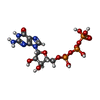
ChemComp-GTP:
GUANOSINE-5'-TRIPHOSPHATE / GTP, energy-carrying molecule*YM

Source
  • nedicistrovirus tfn-2012
  • oryctolagus cuniculus (rabbit)
KeywordsRIBOSOME / IRES / Translation / Initiation

+
About Yorodumi Papers

-
News

-
Feb 9, 2022. New format data for meta-information of EMDB entries

New format data for meta-information of EMDB entries

  • Version 3 of the EMDB header file is now the official format.
  • The previous official version 1.9 will be removed from the archive.

Related info.:EMDB header

External links:wwPDB to switch to version 3 of the EMDB data model

-
Aug 12, 2020. Covid-19 info

Covid-19 info

URL: https://pdbj.org/emnavi/covid19.php

New page: Covid-19 featured information page in EM Navigator.

Related info.:Covid-19 info / Mar 5, 2020. Novel coronavirus structure data

+
Mar 5, 2020. Novel coronavirus structure data

Novel coronavirus structure data

Related info.:Yorodumi Speices / Aug 12, 2020. Covid-19 info

External links:COVID-19 featured content - PDBj / Molecule of the Month (242):Coronavirus Proteases

+
Jan 31, 2019. EMDB accession codes are about to change! (news from PDBe EMDB page)

EMDB accession codes are about to change! (news from PDBe EMDB page)

  • The allocation of 4 digits for EMDB accession codes will soon come to an end. Whilst these codes will remain in use, new EMDB accession codes will include an additional digit and will expand incrementally as the available range of codes is exhausted. The current 4-digit format prefixed with “EMD-” (i.e. EMD-XXXX) will advance to a 5-digit format (i.e. EMD-XXXXX), and so on. It is currently estimated that the 4-digit codes will be depleted around Spring 2019, at which point the 5-digit format will come into force.
  • The EM Navigator/Yorodumi systems omit the EMD- prefix.

Related info.:Q: What is EMD? / ID/Accession-code notation in Yorodumi/EM Navigator

External links:EMDB Accession Codes are Changing Soon! / Contact to PDBj

+
Jul 12, 2017. Major update of PDB

Major update of PDB

  • wwPDB released updated PDB data conforming to the new PDBx/mmCIF dictionary.
  • This is a major update changing the version number from 4 to 5, and with Remediation, in which all the entries are updated.
  • In this update, many items about electron microscopy experimental information are reorganized (e.g. em_software).
  • Now, EM Navigator and Yorodumi are based on the updated data.

External links:wwPDB Remediation / Enriched Model Files Conforming to OneDep Data Standards Now Available in the PDB FTP Archive

-
Yorodumi Papers

Database of articles cited by EMDB/PDB/SASBDB data

  • Database of articles cited by EMDB, PDB, and SASBDB entries
  • Using PubMed data

Related info.:EMDB / PDB / SASBDB / Yorodumi / EMN Papers / Changes in new EM Navigator and Yorodumi

Read more