 Movie
Movie Controller
 Structure viewers
 About Yorodumi Papers


+Search query
-Structure paper
| Title | DEVELOPMENT OF A POTENT MONOCLONAL ANTIBODY FOR TREATMENT OF HUMAN METAPNEUMOVIRUS INFECTIONS. |
|---|---|
| Journal, issue, pages | bioRxiv, Year 2025 |
| Publish date | Jul 20, 2025 |
 Authors Authors | Evelyn D Harris / Morgan McGovern / Sara Pernikoff / Ren Ikeda / Lea Kipnis / William Hannon / Elizabeth B Sobolik / Matthew Gray / Alexander L Greninger / Sijia He / Chen-Ni Chin / Tong-Ming Fu / Marie Pancera / Jim Boonyaratanakornkit /  |
| PubMed Abstract | Human metapneumovirus (HMPV) is a major cause of respiratory infections, particularly among vulnerable populations, yet effective therapeutics remain unavailable. Monoclonal antibodies (mAbs) offer a ...Human metapneumovirus (HMPV) is a major cause of respiratory infections, particularly among vulnerable populations, yet effective therapeutics remain unavailable. Monoclonal antibodies (mAbs) offer a promising approach for both treatment and prevention. Here, we describe the discovery and characterization of 4F11, a highly potent and broadly neutralizing mAb with demonstrated in vitro and in vivo efficacy against HMPV. Using cryo-electron microscopy, we defined a unique mechanism of binding HMPV employed by 4F11, which distinguishes it from previously characterized RSV and HMPV mAbs. 4F11 targets an epitope located at the apex of the prefusion F protein (site Ø) with a 1:1 stoichiometry, distinct from the 3:1 stoichiometry observed with other HMPV site Ø antibodies. Unlike other site Ø antibodies, which penetrate the glycan shield between Asn57 and Asn172, 4F11 binds vertically and directly interacts with the Asn172 glycan, representing a unique glycan-dependent mode of recognition. In vitro, 4F11 displayed high potency and broad neutralization across diverse HMPV strains. It also showed a low propensity for resistance development, with only a single escape mutation (K179E) identified, a mutation not found in any published HMPV sequence to date. Viruses rescued with the K179E escape mutation had significantly decreased fitness in vitro compared to wild-type virus. In a hamster challenge model, 4F11 significantly reduced viral loads in both the lungs and nasal turbinates. These findings highlight 4F11 as a promising candidate for therapeutic development, particularly for immunocompromised individuals and other high-risk groups. |
 External links External links | bioRxiv / PubMed:40666860 / PubMed Central |
| Methods | EM (single particle) |
| Resolution | 4.03 - 4.13 Å |
| Structure data | EMDB-70773, PDB-9ore:  EMDB-70774: CryoEM map of 4F11 and MxR Fabs bound to HMPV DS-CavEs2 preF monomer |
| Chemicals | 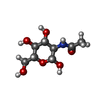 ChemComp-NAG: |
| Source |
|
 Keywords Keywords | IMMUNE SYSTEM / HMPV / prefusion F / ANTIBODY / site 0 / glycan dependent |


 human metapneumovirus
 homo sapiens (human)